Why Deferred Projects Are Now Moving — And What's Changed
Capital investment in new mineral drying equipment was largely frozen during 2022–2023. The reason was simple: energy price volatility made it impossible to build a reliable business case for heat recovery equipment when gas prices were swinging 300% in 12 months. No CFO was signing off on a 4-year payback calculation based on Q3 2022 gas prices.
That freeze is now thawing. Energy prices have stabilised — at a new, higher equilibrium. European natural gas is trading at 30–40% above pre-2021 levels on a structural basis, not as a spike. That makes the energy payback case for heat recovery easier to justify, and it's released a backlog of mineral processing projects that were waiting for that certainty.
But something else has changed too: the procurement requirements are more complex. Project approvals that previously needed a one-page dryer specification now require an integrated energy balance, an emissions compliance demonstration, and a 10-year lifecycle cost analysis. If you're tendering for a new rotary dryer in a minerals application in 2026, here's what the complete specification looks like.
The Minerals Drying Application Matrix
Central and Eastern Europe remains a significant producer of industrial minerals — potash (K₂SO₄, KCl), phosphate rock, salt, kaolin, barite, and calcium carbonate. Romania, Poland, Germany, and Bulgaria all have active mining operations requiring thermal processing. The drying step reduces mine-output moisture (typically 15–40%) to the specification required for downstream processing or direct sale (0.1–2% depending on product).
Not all minerals dry the same way. The table below shows the standard equipment pairing for the main CEE mineral streams:
| Mineral | Inlet Moisture | Target Moisture | Primary Dryer | Key Design Constraint |
|---|---|---|---|---|
| Potash (KCl) | 5–12% | 0.1–0.3% | Indirect rotary | Max temperature 120°C (dust explosion risk) |
| Phosphate rock | 18–35% | 1.0–2.0% | Direct-fired rotary | High throughput (50–200 t/h typical), dust control critical |
| Salt (NaCl) | 3–8% | ≤0.1% | Indirect rotary or FBD | Corrosive environment — 316L SS contact surfaces required |
| Kaolin | 25–40% | 0.5–1.5% | Flash dryer or rotary | Fine particle, high bag filter area required |
| Calcium carbonate | 10–25% | 0.2–0.5% | Direct-fired rotary | Temperature control critical — calcination risk above 840°C |
The Three Technical Requirements That Now Come With Every Project
**1. Heat recovery — no longer optional**
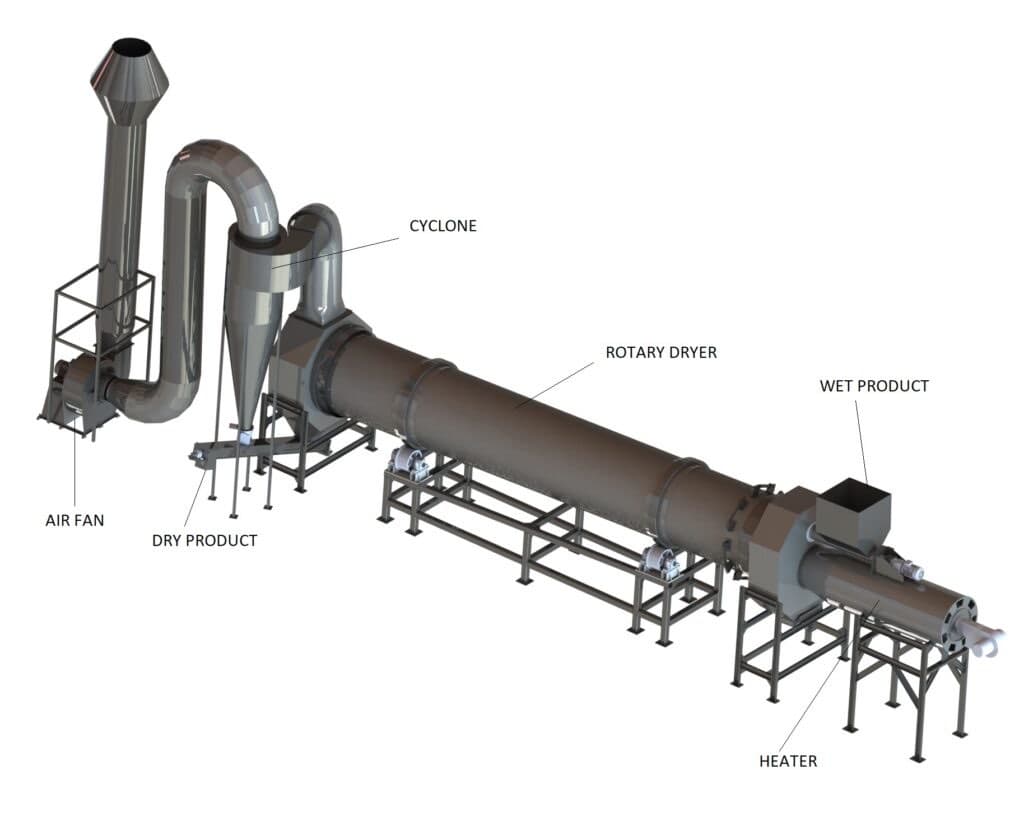
New rotary dryer projects are almost universally specified with waste heat recovery on the exhaust. For dryers with exhaust gas above 250°C, an HRSG producing process steam is the standard specification. For lower exhaust temperatures, air-to-air heat recovery for combustion air preheat is the minimum. The additional capital cost (typically 15–25% of the dryer cost) is accepted because the energy payback period at current gas prices is typically 24–36 months — well within approval thresholds.
**2. IED emission compliance from day one**
EU Industrial Emissions Directive compliance is no longer something you retrofit later. Older installations that were grandfathered at 30–50 mg/Nm³ particulate limits are being required to upgrade. New projects are specified at 10 mg/Nm³ from commissioning. Cyclone + jetpulse bag filter combinations remain the standard design. For fine mineral applications (kaolin, calcium carbonate), bag filter areas should be sized conservatively — undersized filters are the most common cause of emission non-compliance during production peaks.
**3. Drive train reliability specification**
For 24/7 production operations, unplanned downtime on the dryer is expensive: not just the maintenance cost, but the throughput loss on a continuous process. Drive train specifications in 2026 go well beyond "heavy duty" — they include girth gear and pinion hardness (Brinell 240–280 for the gear, 340–380 for the pinion), automatic lubrication system with level and pressure monitoring, riding ring hardness (minimum 260 HB), tyre/shell contact specification, and seal design for dusty environments. If a supplier's quotation doesn't address these parameters, ask why.
What to Ask Before You Start a Specification
If you're starting a mineral drying project in 2026, the single most effective thing you can do before approaching suppliers is to answer these four questions:
1. What is your exhaust gas temperature at design load — and do you have a heat demand within 200 metres that could use it?
2. What is your current bag filter emission limit, and when does your IED compliance review fall due?
3. What is your production schedule — 24/7, 2 shifts, seasonal? This determines whether drive train reliability is your primary concern or whether energy efficiency is.
4. What is your 10-year gas price assumption? Your finance team needs this for the NPV calculation anyway — get it agreed before the project.
Lozzar Process handles the complete scope for minerals drying projects — dryer, heat recovery, dust control, controls — with Ermak Proses as the manufacturing partner. If you have a new project or an existing plant with efficiency or compliance issues, contact us with your process data and we'll come back with a technical pre-assessment within 5 business days.