The Simple Truth About These Two Technologies
Cyclones are elegant engineering: no moving parts, no filter media, handles temperature extremes, runs for decades with almost no maintenance. But they can't reliably capture particles below 5–10 microns. If your dust is fine, you'll miss your emission limits — and in Europe, that's increasingly a permit condition, not a suggestion.
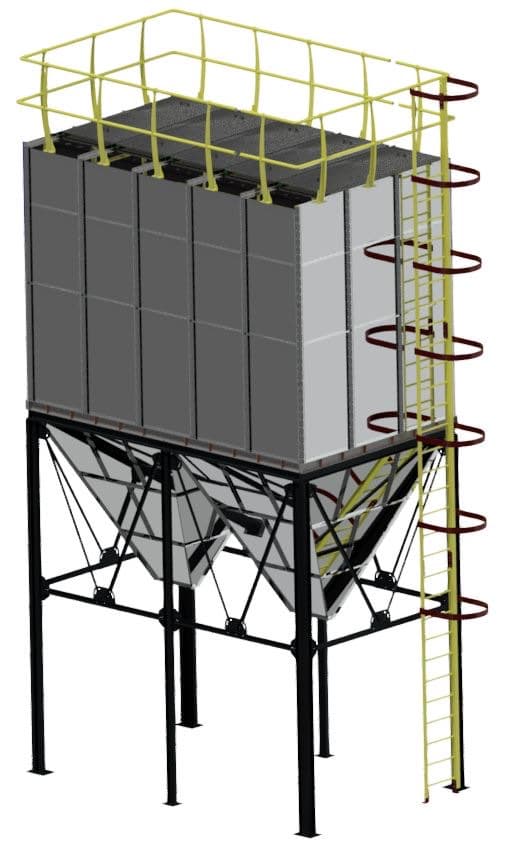
Bag filters capture 99.5–99.9% of everything above 0.5 microns. They are the standard for emission compliance. The trade-off is cost, maintenance (bag replacement every 2–5 years), and sensitivity to temperature and condensation.
In practice, most industrial dryer installations use both: a cyclone first to remove the coarse fraction (recovering product, protecting the bag filter), then a bag filter as the final emission control. The combination gives you the best of both — low maintenance on the coarse stage, guaranteed compliance at the final stage.
Direct Comparison
Here's the performance comparison that matters for industrial dryer and process plant applications:
| Parameter | Cyclone Separator | Jet-Pulse Bag Filter |
|---|---|---|
| Collection efficiency (>10 μm) | 85–95% | 99.5–99.9% |
| Collection efficiency (<5 μm) | 20–60% (poor) | >99% (excellent) |
| Max operating temperature | >900°C (steel/ceramic) | 130–200°C (standard bags); 250°C+ (hi-temp bags) |
| Pressure drop | 500–2,000 Pa | 1,000–3,000 Pa |
| Moving parts | None | Solenoid valves (pulse system) |
| Typical maintenance | Minimal — check wear every 3–5 years | Bag replacement every 2–5 years; valve check annually |
| Capital cost (same duty) | Base | 2.5–4× cyclone cost |
| Emission limit compliance (EU) | Typically no — cyclone alone usually >50 mg/Nm³ | Yes — achieves <10–20 mg/Nm³ |
The Standard Design: Why Both Together Makes Sense
For most industrial dryer applications (rotary, fluidized bed, spray), the standard approach is a cyclone followed by a bag filter. Here's why this combination wins:
The cyclone removes 85–90% of the dust load by mass — primarily the coarse, heavy particles. This dramatically reduces the dust loading on the bag filter, which extends bag life from 2 years to 4–5 years and reduces compressed air consumption for bag cleaning. The cyclone also acts as a product recovery device: in many applications, the cyclone catch is on-spec product that goes back to the product stream.
The bag filter then handles what the cyclone can't — the fine particles and emission compliance. Because the bag filter is seeing pre-cleaned gas, it operates at lower differential pressure and longer cleaning intervals.
If your application requires only product recovery (not emission compliance), a cyclone alone may be sufficient. If you're facing any regulatory particulate limit, design for a bag filter from the start — retrofitting one later is always more expensive.