Bag Filter (Pulse-Jet Fabric Filter)
The last line of defence between your process and clean air — reliable, < 5 mg/Nm³ guaranteed.
Bag filters — also called baghouses or fabric filters — are the workhorse of industrial dust collection. A pulse-jet bag filter captures fine particulate matter from process gas streams by forcing the gas through woven or needle-felt filter bags; accumulated dust cake is continuously dislodged by high-pressure compressed air pulses fired row-by-row, maintaining low pressure drop and uninterrupted on-line operation. Lozzar Process designs and supplies pulse-jet bag filters for all downstream applications in the drying, milling, conveying and pneumatic transfer industries — with outlet dust concentrations guaranteed below 5 mg/Nm³ and ATEX-compliant configurations for dust explosion zones up to Zone 20.
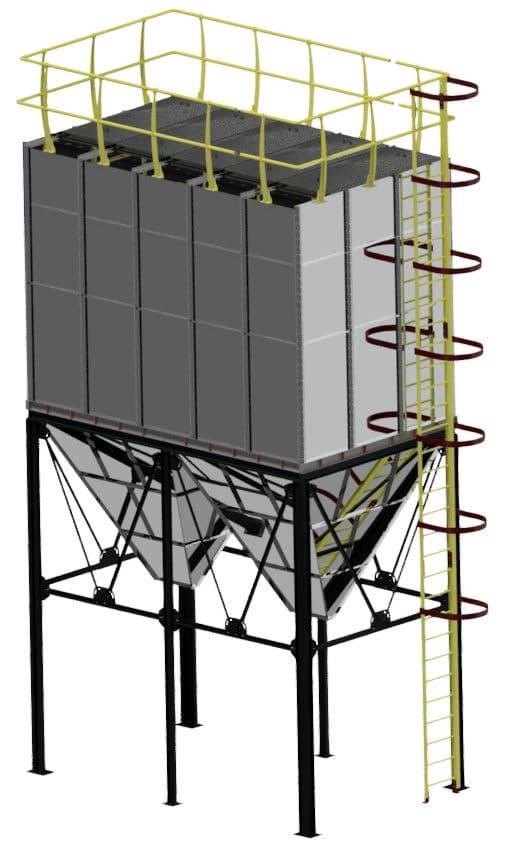
How a Pulse-Jet Bag Filter Works
Dirty gas enters the bag filter housing through the inlet duct and passes from the outside to the inside of cylindrical filter bags suspended from a tube sheet at the top of the housing. Particulate matter is retained on the outer surface of the bags, forming a dust cake that grows progressively thicker. Clean gas exits through the tube sheet into the clean-gas plenum and is discharged via the outlet.
The pulse-jet cleaning mechanism operates row-by-row without interrupting gas flow. A compressed air line (typically 5–7 bar) feeds a blow pipe positioned above each row of bags. At timed intervals — or when differential pressure across the filter exceeds a setpoint — a solenoid valve opens for 100–200 milliseconds, firing a high-velocity pulse of air down the centre of each bag in the row. This pulse propagates as a shock wave that momentarily reverses the gas flow through the bag, dislodging the dust cake, which falls into the hopper below and is discharged via a rotary valve or screw conveyor.
The dust cake itself is an active part of the filtration mechanism — the initial layer of dust collected on a clean bag dramatically improves filtration efficiency for sub-micron particles, which is why bag filters significantly outperform cyclone separators for fine powders. Filtration efficiency follows the combination of interception, inertial impaction and diffusion mechanisms; for d50 > 1 µm, efficiencies > 99.9% are routinely achievable.
Filter bag material selection is critical and depends on gas temperature, moisture, chemical composition and particle abrasivity. Standard polyester needle-felt bags operate up to 130°C; for drying applications with higher temperatures or sticky products, PTFE membrane bags (up to 260°C) with ultra-smooth surface coating prevent blinding and achieve sub-1 mg/Nm³ outlet concentrations.
Quick Reference
Technical Specifications
All parameters are indicative ranges. Final sizing is determined by process simulation based on your specific material and throughput requirements.
Pulse-Jet Bag Filter — Operating Parameters
| Parameter | Value / Range | Note |
|---|---|---|
| Inlet gas volume flow | 500 Nm³/h – 500,000 Nm³/h | Multiple compartments in parallel for very large flows |
| Filtration velocity (air-to-cloth ratio) | 1.0–3.0 m/min (1.0–1.5 m/min for sticky/fine; 2.0–3.0 m/min for coarse/dry) | Lower ratio = larger filter area = lower pressure drop; critical sizing parameter |
| Operating pressure drop (clean-to-dirty bag) | 800–2,500 Pa (typical steady-state 1,000–1,500 Pa) | Pulse cleaning activates automatically when ΔP exceeds high setpoint (~2,000 Pa) |
| Outlet dust concentration (clean gas) | < 5 mg/Nm³ standard; < 1 mg/Nm³ with PTFE membrane bags | EU Industrial Emissions Directive typically requires < 10–50 mg/Nm³; < 5 mg/Nm³ achievable for product recovery |
| Gas temperature (operating) | Up to 130°C (polyester); up to 200°C (PPS/Ryton); up to 260°C (PTFE/glass fibre) | Temperature must remain > 20°C above dew point to prevent condensation on bags |
| Compressed air pulse pressure | 4–7 bar (g); 5–6 bar typical | Higher pressure = more effective cleaning but higher wear on bags and fittings |
| Pulse interval (on-demand or timed) | 5–60 seconds per row (ΔP-controlled preferred) | ΔP-controlled cleaning extends bag life vs. fixed-timer cleaning; smart controllers reduce compressed air consumption 30–50% |
| Filter bag service life | 2–5 years (polyester standard); 5–10 years (PTFE membrane) | Abrasive dusts, high temperature or high moisture reduce life; PTFE membrane recommended for product recovery and abrasive materials |
| Housing material (standard / special) | Carbon steel S235/S355 standard; SS 304/316L for food, pharma and corrosive gases | Internal powder coating or rubber lining for corrosive gases; polished SS 316L for CIP food/pharma applications |
| ATEX compliance | Zone 20 (inside hopper/housing) and Zone 21/22 (external) available | Includes explosion venting (EN 14491), isolation flap valves, earthing, ATEX-rated instrumentation and pulse valve solenoids |
Filter Bag Material Selection Guide
| Parameter | Value / Range | Note |
|---|---|---|
| Polyester needle-felt | Max 130°C; pH 5–9; standard general-purpose bag | Most common, lowest cost; not suitable for acid gases, high moisture or sticky products |
| Polyimide (P84) needle-felt | Max 240°C; excellent acid resistance; irregular fibre cross-section for high filtration efficiency | Standard choice for high-temperature processes (cement, lime, coal combustion flue gas) |
| PTFE membrane on polyester/PPS substrate | Surface filtration; outlet < 1 mg/Nm³; max 200–260°C; non-stick surface | Best choice for product recovery, fine pharmaceutical powders, food-grade and sticky dusts; longest bag life; highest cost |
| Glass fibre + PTFE membrane | Max 260°C; high-temperature surface filtration; chemical resistance | For spray dryer exhausts, high-temperature chemical processes and acid gas environments |
| PPS (Ryton) needle-felt | Max 200°C; excellent acid and alkali resistance; suitable for SO₂/HCl environments | Coal-fired power plants, waste incinerators, chemical plants with acid condensation risk |
Need a technical pre-sizing? Send us your material data sheet, moisture content, required throughput and energy source — we return a technical sizing with drum dimensions and energy balance within 2 business days.
→ Send process data on WhatsAppTypical Upstream Process & Dust Characteristics
Reference data from industrial installations. Actual values depend on feed consistency, particle size distribution and required product quality.
| Material | Inlet moisture | Outlet moisture | Particle size | Gas temp. | Industry |
|---|---|---|---|---|---|
| Rotary dryer exhaust — mineral / fertiliser | Dust load 5–30 g/Nm³ | < 5 mg/Nm³ | d50 10–80 µm carry-over | 80–200°C gas | Minerals / Fertiliser |
| Fluidized bed dryer exhaust — fine chemical / pharma | Dust load 1–15 g/Nm³ | < 1 mg/Nm³ (PTFE bags) | d50 50–500 µm | 50–150°C gas | Fine Chemicals / Pharmaceutical |
| Spray dryer exhaust — food / dairy / detergent | Dust load 10–80 g/Nm³ (high for main cyclone bypass) | < 5 mg/Nm³ | d50 30–200 µm | 70–120°C gas | Food / Dairy / Detergents |
| Flash dryer exhaust — starch / pigment / PVC | Dust load 50–500 g/Nm³ | < 5 mg/Nm³ | d50 5–50 µm (very fine) | 60–180°C gas | Starch / Pigments / Polymers |
| Belt dryer exhaust — biomass / food / activated carbon | Dust load 1–10 g/Nm³ (low — larger particle) | < 10 mg/Nm³ | d50 100 µm – 2 mm fines | 40–150°C gas | Biomass / Food / Water Treatment |
| Pneumatic conveying vent — powder transfer | Dust load 20–200 g/Nm³ | < 5 mg/Nm³ | d50 50 µm – 1 mm | 20–80°C (ambient air) | All Industries (silo vents, bin filters) |
| Cement plant raw mill / kiln exhaust | Dust load 200–1,000 g/Nm³ | < 10 mg/Nm³ | d50 5–30 µm | 120–200°C gas | Cement & Construction Materials |
| Grain milling & silo venting — food grade | Dust load 5–50 g/Nm³ | < 5 mg/Nm³ | d50 20–200 µm (starch/bran) | 20–60°C (near ambient) | Food & Feed Milling |
Don't see your material? Send us your process data and we'll provide material-specific sizing.
System Configurations
Standard Pulse-Jet Baghouse (Online Cleaning)
Single-compartment housing with all rows cleaned sequentially while gas flow continues. No bypass dampers required. Suitable for continuous processes (dryers, mills) where gas flow cannot be interrupted. Pulse cleaning controlled by differential pressure transmitter — when ΔP across the filter exceeds the high setpoint (typically 1,500–2,000 Pa), the controller sequences through all bag rows, row-by-row, until ΔP returns to normal. Smart ΔP-controlled cleaning extends bag life by 30–50% vs. fixed-timer systems.
Compartmentalised Baghouse (Offline Cleaning)
Multiple parallel compartments separated by isolation dampers. One compartment at a time is isolated from gas flow, allowing vigorous reverse-air or shaker cleaning. Used for very sticky products (sugar, starch slurry fines, latex-coated particles) that cannot be adequately cleaned by pulse-jet while under gas flow. Also used for very high dust loads (> 500 g/Nm³) or large particle sizes where heavy cake requires complete gas flow reversal to dislodge. Higher capital cost than single-compartment pulse-jet; requires minimum 3 compartments for uninterrupted operation.
Bin Vent / Compact Cartridge Filter
Small-scale filters for silo filling vents, big-bag discharge stations, pneumatic conveying line terminals and drum filling points. Available in cartridge (pleated filter element) or miniature bag filter format. Cartridge filters offer 3–5× greater filtration area per unit volume than bag filters, making them compact for space-constrained installations. Mounted directly on silo nozzles. Reverse-pulse or shaker cleaned. Gas flows of 100–5,000 Nm³/h; dust loads typically 5–100 g/Nm³. Food-grade 316L SS and GMP-compliant versions available.
Selection Guide
Outlet dust concentration must be < 50 mg/Nm³ — regulatory emission limit or product recovery requirement
Bag filter — only technology that reliably achieves < 5 mg/Nm³ across the full range of industrial dust types and gas temperatures; cyclone separators cannot achieve < 50 mg/Nm³ for particles below 10 µm
Collected dust has product value and must be returned to the process — not discarded
Bag filter with PTFE membrane bags — < 1 mg/Nm³ outlet ensures near-zero product loss; hopper designed for dust return to main product stream or separate collection
Gas stream contains explosive dust (Kst > 0 bar·m/s) and the installation is classified ATEX Zone 20/21/22
ATEX-compliant bag filter with EN 14491 explosion vent, isolation flap valves and earthed construction — required by EU Directive; wet scrubbers are an alternative only when the collected dust cannot be handled dry
Gas flow is very large (> 100,000 Nm³/h) and a single compact unit is preferred over multiple smaller units
Large multi-compartment bag filter with modular housing design — single unit up to 500,000 Nm³/h; lower civil cost than multiple small units; central compressed air manifold and single instrumentation panel
When NOT to Use a Bag Filter
Gas stream contains condensing moisture or sticky hygroscopic dust that will blind and irreversibly block filter bags — gas temperature is below or near dew point
Dust is water-soluble and must be recovered as a liquid solution — or gas cleaning produces a liquid effluent that is directly piped to wastewater treatment
Gas stream particle size is predominantly above 50 µm, dust load is low (< 2 g/Nm³) and emission limit is > 50 mg/Nm³ — cyclone separator is sufficient and less expensive
Gas stream contains a high concentration of acid gases (HCl, HF, SO₃) at levels that will cause irreversible chemical attack on any standard or specialty bag material even with coating
Not sure which dryer is right for your process? We'll review your specifications and recommend the optimal solution.
Ask a technical question →Frequently Asked Questions
Filtration velocity (also called air-to-cloth ratio) is the most important design parameter in bag filter sizing. It is defined as the total gas flow (Nm³/min) divided by the total bag filter area (m²), giving units of m/min. The correct filtration velocity depends on: (1) dust particle size — finer particles (d50 < 20 µm) require lower velocity (1.0–1.5 m/min) because they form a denser, harder-to-clean cake; coarser particles (d50 > 50 µm) allow higher velocities (2.0–3.0 m/min). (2) Dust concentration at inlet — high dust loads (> 50 g/Nm³) require lower velocity because the cake builds faster. (3) Dust stickiness — sticky, hygroscopic or oil-contaminated dusts require lower velocity and PTFE membrane bags. (4) Cleaning efficiency — if pulse cleaning is marginal (inadequate compressed air, low pulse frequency), lower velocity compensates. The practical consequence: a lower filtration velocity means a larger filter housing (more bags, more area) and higher CAPEX, but lower operating pressure drop (lower fan energy, longer bag life, better emission control). A higher filtration velocity means a compact, cheap filter but higher ΔP, shorter bag life and risk of exceeding emission limits if cleaning is imperfect. As a sizing rule of thumb: for dryer exhausts with d50 30–100 µm, use 1.5–2.0 m/min; for fine chemical and pharmaceutical powders with d50 < 30 µm, use 1.0–1.5 m/min; for grain handling and coarse mineral dust, use 2.0–3.0 m/min. Lozzar Process always requests a dust sample for laboratory characterisation before finalising filtration velocity.
From Our Projects
Related Equipment
Cyclone Separator
Pre-separator upstream of bag filter for high dust loads > 50 g/Nm³ — cyclone removes bulk coarse fraction, bag filter polishes to < 5 mg/Nm³
View productRotary Dryer
Most common upstream equipment; rotary dryer exhaust carries 5–30 g/Nm³ mineral dust at 80–200°C — bag filter is mandatory downstream
View productWet Scrubber
Alternative for condensing-moisture or acid-gas applications where bag filters are unsuitable; wet scrubber also removes acid gases simultaneously with dust
View productIndustrial Fan
Required to pull gas through the bag filter against the 1,000–2,500 Pa pressure drop; fan selection must match filter ΔP and gas temperature
View productRequest a Quote for This Equipment
Include in your enquiry:
- →Gas volume flow (Nm³/h at operating temperature — not standard conditions)
- →Gas temperature at filter inlet (°C)
- →Gas moisture content (% vol. or g/kg dry gas)
- →Inlet dust concentration (g/Nm³)
- →Dust material name and particle size d10/d50/d90 (µm)
- →Kst value or dust explosion class (St 1/2/3 or non-explosive)
- →Required outlet emission limit (mg/Nm³)
- →ATEX zone classification, material of construction preference (CS / SS 304 / SS 316L)