Heat Recovery Steam Generator (HRSG / WHR)
Convert exhaust heat into steam or hot water — reduce energy costs by 15–30% on existing dryer and furnace installations.
HRSG and waste heat recovery (WHR) systems capture thermal energy from exhaust gases — from gas turbines, industrial dryers, rotary kilns, and process furnaces — and convert it into steam or hot water for process use or power generation. Lozzar Process supplies Ermak Proses HRSG units in vertical and horizontal configurations, designed for exhaust temperatures from 250°C to 600°C, with 20+ year service life and full CE compliance.
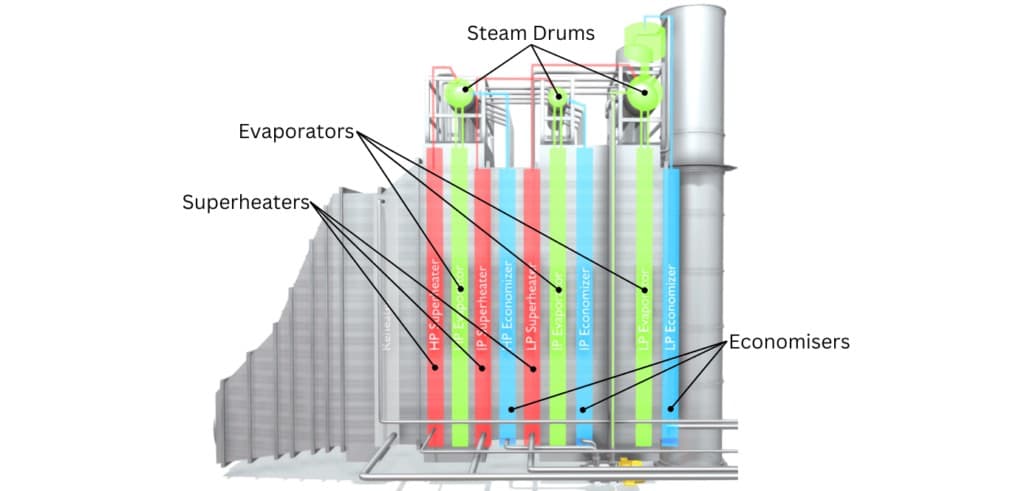
How HRSG / WHR Systems Work
Hot exhaust gas from a turbine, dryer, or furnace passes through the HRSG heat exchanger bundle. The gas gives up its thermal energy to water flowing through the tube bundle on the other side of the heat transfer surface. Depending on system design and steam drum pressure, the exiting hot gas is cooled to 120–180°C before being released to atmosphere or to a downstream scrubber or stack.
The water-side circuit consists of three functional zones arranged in series in the direction of heat transfer: the economizer (feedwater preheating), the evaporator (steam generation), and the superheater (steam temperature elevation). In a once-through design, water flows continuously through all three zones. In a drum-type design, the steam drum acts as a separator and buffer between the evaporator and superheater.
Vertical-flow HRSG (gas flows vertically, tube bundles are horizontal) is preferred for smaller units and retrofits — it fits the vertical exhaust duct geometry of most industrial equipment. Horizontal-flow HRSG (gas flows horizontally over vertical tube bundles) is standard for large combined-cycle power plant applications where gas turbine exhaust exits horizontally at grade.
The steam or hot water produced is routed to process (dryer heating, heat exchanger duties) or, in combined-cycle configurations, to a steam turbine for additional power generation. Payback periods for industrial WHR systems on dryers and kilns are typically 18–36 months depending on fuel cost and operating hours.
Quick Reference
Technical Specifications
All parameters are indicative ranges. Final sizing is determined by process simulation based on your specific material and throughput requirements.
Standard Operating Parameters
| Parameter | Value / Range |
|---|---|
| Exhaust gas inlet temperature | 250°C – 600°C |
| Exhaust gas outlet temperature | 120°C – 180°C (acid dew point limited) |
| Steam pressure range | 1 bar(g) – 40 bar(g) |
| Steam temperature | Saturated or superheated to 450°C |
| Steam production capacity | 0.5 – 200 t/h |
| Gas flow range | 5,000 – 2,000,000 Nm³/h |
| Thermal efficiency | 80–92% heat recovery from available exhaust enthalpy |
| Flow configuration | Vertical (gas up, horizontal tubes) or Horizontal (gas horizontal, vertical tubes) |
| Tube material | Carbon steel, alloy steel (P11/P22), SS 304/316 for corrosive gas |
| Service life | 20+ years with proper water treatment |
Vertical vs Horizontal Configuration
| Parameter | Value / Range |
|---|---|
| Gas flow direction | Vertical: upward | Horizontal: horizontal |
| Tube orientation | Vertical: horizontal (finned) | Horizontal: vertical (finned or bare) |
| Footprint | Vertical: smaller footprint | Horizontal: larger footprint |
| Typical application | Vertical: industrial dryers, kilns, retrofits | Horizontal: gas turbine combined cycle |
| Cleaning / maintenance access | Vertical: easier soot blowing | Horizontal: standard access platforms |
Need a technical pre-sizing? Send us your material data sheet, moisture content, required throughput and energy source — we return a technical sizing with drum dimensions and energy balance within 2 business days.
→ Send process data on WhatsAppHeat Source Examples
Reference data from industrial installations. Actual values depend on feed consistency, particle size distribution and required product quality.
| Material | Inlet moisture | Outlet moisture | Particle size | Gas temp. | Industry |
|---|---|---|---|---|---|
| Rotary dryer exhaust gas | 350–500°C exhaust | ~150°C after WHR | N/A | 350–500°C | Mining / Biomass / Fertilizer |
| Gas turbine exhaust | 480–600°C exhaust | ~120°C after WHR | N/A | 480–600°C | Power / Chemical / Refinery |
| Cement kiln exhaust | 300–450°C exhaust | ~140°C after WHR | N/A | 300–450°C | Cement |
| Industrial boiler flue gas | 250–350°C flue gas | ~130°C after WHR | N/A | 250–350°C | Chemical / Paper / Food |
Don't see your material? Send us your process data and we'll provide material-specific sizing.
HRSG Configurations
Vertical-flow HRSG (industrial / retrofit)
Exhaust gas enters at the bottom and flows upward through horizontal finned tube bundles. Compact footprint. Designed to fit the vertical exhaust outlets of rotary dryers, flash dryers, and industrial kilns. Standard choice for industrial WHR projects.
Horizontal-flow HRSG (combined cycle)
Gas turbine exhaust enters horizontally and flows over vertical tube bundles — economizer, evaporator (LP/HP), and superheater sections. Multi-pressure level design (LP + HP steam) maximises energy extraction. Standard configuration for combined-cycle power plants (CCPP).
When a WHR / HRSG Makes Sense
Existing dryer or furnace exhaust is above 300°C and operating >4,000 h/year
WHR system is almost always cost-effective. Typical payback 18–36 months. Send exhaust gas flowrate and temperature for a preliminary heat balance.
New dryer or kiln investment being planned
Design the WHR in from the start — better duct routing, optimized exhaust temperature, lower cost than retrofit.
Gas turbine being installed for power generation
HRSG is required for combined-cycle efficiency. Without HRSG, 60–65% of turbine fuel energy is wasted as exhaust heat.
When WHR is NOT Cost-Effective
Exhaust temperature is below 200°C (too close to acid dew point for safe heat recovery)
Operating hours below 3,000 h/year — payback becomes too long
Not sure which dryer is right for your process? We'll review your specifications and recommend the optimal solution.
Ask a technical question →Frequently Asked Questions — HRSG / WHR
The practical minimum is 250–280°C, set by the acid dew point of the exhaust gas. Below the dew point, sulfuric and hydrochloric acids condense on the cold-end tubes, causing rapid corrosion. For exhaust gases with low sulfur and chlorine content (natural gas combustion), recovery down to 150°C is feasible with condensing economizers and corrosion-resistant materials. Send us your fuel specification and gas composition and we will calculate the safe minimum exhaust temperature.
From Our Projects
Request a Quote for This Equipment
Include in your enquiry:
- →Exhaust gas flowrate (Nm³/h or kg/h)
- →Exhaust gas temperature (inlet to WHR)
- →Exhaust gas composition (if known — fuel type, O₂ content, dust load)
- →Required steam pressure and temperature (or hot water temperature)
- →Required steam / hot water quantity (t/h or kW)
- →Operating hours per year
- →Available space for WHR unit (dimensions or general layout)
- →Vertical or horizontal exhaust duct configuration