Rotary (Drum) Dryer & Cooler
The workhorse of bulk solid drying — robust, high-capacity, high-temperature.
Rotary drum dryers are the most widely deployed industrial dryer type for coarse bulk solids. Their robust construction tolerates wide fluctuations in feed moisture, particle size and throughput — making them the first choice for minerals processing, biomass energy, fertilizer production and aggregate drying where throughput matters more than precision.
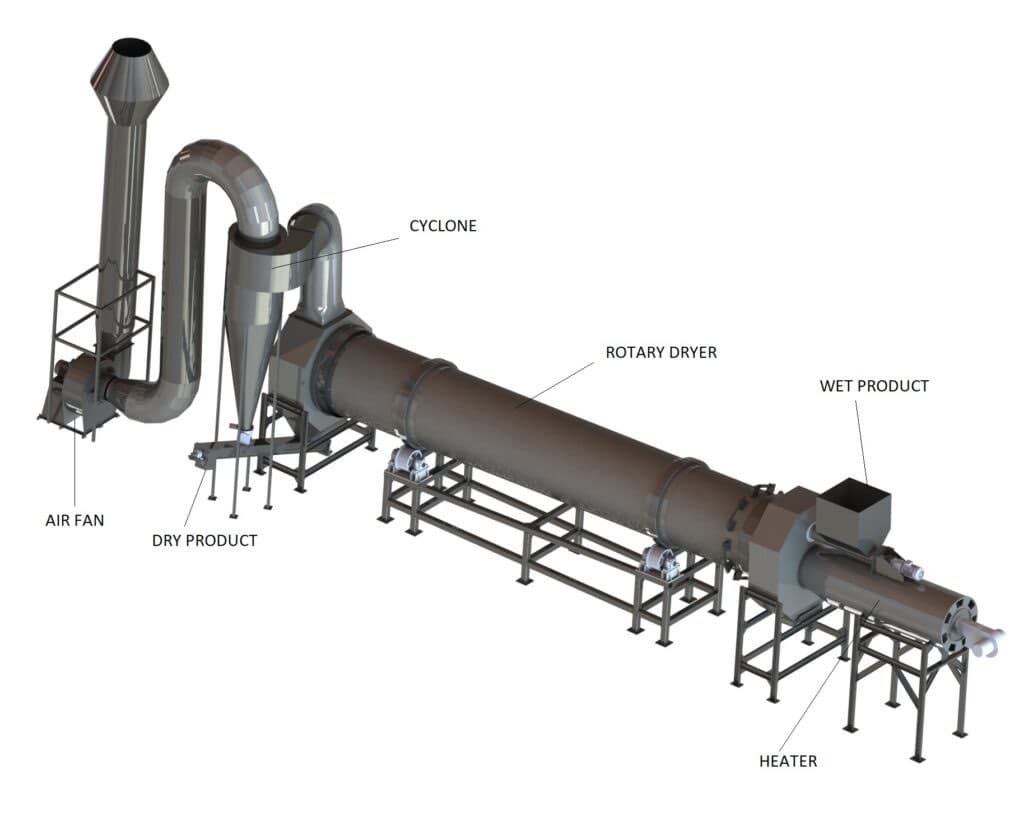
How a Rotary Drum Dryer Works
A rotary drum dryer consists of a cylindrical shell, slightly inclined at 1–5°, rotating at 1–8 RPM. Wet material enters at the elevated feed end and travels through the drum by gravity and the rotation-driven conveying action of internal lifting flights.
The lifting flights — shaped steel vanes welded to the drum interior — continuously pick up the material, carry it upward, then shower it through the hot gas stream flowing along the drum axis. This cascade action maximises gas-solid contact surface and is the primary mechanism of heat and mass transfer.
Hot gas flow can be co-current (gas and material move in the same direction) or counter-current (gas flows opposite to material travel). Co-current is used for high initial moisture content, heat-sensitive materials and sticky feeds. Counter-current achieves lower final moisture levels and is used when product temperature must be elevated, or when the last percentage points of moisture are difficult to remove.
Dried product exits at the lower discharge end. Where cooling is required, the same shell can be partitioned into a drying zone and a cooling zone, or a separate cooler drum can be attached in line — the combined unit is called a rotary dryer-cooler.
Quick Reference
Technical Specifications
All parameters are indicative ranges. Final sizing is determined by process simulation based on your specific material and throughput requirements.
Standard Operating Parameters
| Parameter | Value / Range | Note |
|---|---|---|
| Feed particle size | 2 mm – 50 mm (up to 100 mm with modified flights) | |
| Inlet moisture content | 5% – 60% (w.b.) | |
| Outlet moisture content | 0.1% – 1.0% (w.b.) — product-dependent | |
| Gas inlet temperature (co-current) | 300°C – 900°C | |
| Gas inlet temperature (counter-current) | 200°C – 600°C | |
| Product outlet temperature (co-current) | 60°C – 120°C | |
| Drum diameter | 0.6 m – 4.5 m | |
| Drum length | 4 m – 30 m (L/D ratio typically 4:1 – 10:1) | |
| Drum inclination | 1° – 5° (adjustable for residence time control) | |
| Rotation speed | 1 – 8 RPM (VFD-controlled) | |
| Evaporation capacity | 0.5 – 50 t water/hour | |
| Throughput range | 1 – 200 t/h dry product (application-dependent) | |
| Specific energy consumption | 800 – 1,400 kcal/kg water evaporated (3.3 – 5.8 MJ/kg) | Lower end achievable with waste heat integration |
| Drum shell material | Carbon steel (S235/S355) standard; SS 304/316, Duplex on request | |
| Heat sources accepted | Natural gas, LPG, fuel oil, biomass, waste heat / flue gas |
Co-Current vs Counter-Current Configuration
| Parameter | Value / Range |
|---|---|
| Flow direction | Co-current: gas → same as material | Counter-current: gas ← opposite to material |
| Best for (inlet moisture) | Co-current: high moisture (>20%) | Counter-current: lower moisture (<20%) |
| Achievable outlet moisture | Co-current: 0.5–2% | Counter-current: 0.1–0.5% |
| Product temperature at outlet | Co-current: lower (60–100°C) | Counter-current: higher (100–150°C) |
| Sensitivity to sticky feed | Co-current: handles sticky well | Counter-current: requires drier feed |
| Thermal efficiency | Co-current: 50–60% | Counter-current: 65–75% |
Need a technical pre-sizing? Send us your material data sheet, moisture content, required throughput and energy source — we return a technical sizing with drum dimensions and energy balance within 2 business days.
→ Send process data on WhatsAppMaterial Examples & Typical Operating Conditions
Reference data from industrial installations. Actual values depend on feed consistency, particle size distribution and required product quality.
| Material | Inlet moisture | Outlet moisture | Particle size | Gas temp. | Industry |
|---|---|---|---|---|---|
| Silica sand / Quartz sand | 5–12% | <0.1% | 0.5–5 mm | 700–900°C | Construction / Glass |
| Limestone / Calcium carbonate | 8–18% | <0.5% | 5–25 mm | 500–750°C | Cement / Chemical |
| Wood chips / Biomass | 40–60% | 8–12% | 10–50 mm | 300–500°C | Biomass Energy / Pellet |
| NPK Fertilizer granules | 3–8% | <0.5% | 2–6 mm | 120–250°C | Fertilizer |
| Iron ore concentrate | 8–15% | <1% | 5–30 mm | 600–850°C | Mining / Metallurgy |
| Clay / Kaolin | 20–35% | <1% | 5–20 mm | 400–650°C | Ceramics / Chemical |
| Coal / Lignite | 10–25% | <2% | 5–30 mm | 200–450°C | Energy / Mining |
| Phosphate rock | 6–14% | <0.5% | 3–25 mm | 400–700°C | Fertilizer / Mining |
Don't see your material? Send us your process data and we'll provide material-specific sizing.
Configurations & Variants
Single-pass co-current dryer
Standard configuration. Hot gas and material travel in the same direction. Gas enters at feed end (highest temperature), exits at discharge end. Excellent for high-moisture, heat-sensitive and sticky materials.
Single-pass counter-current dryer
Hot gas enters at the discharge end (where material is driest). Achieves very low residual moisture (<0.1%) and elevated product temperature. Used where complete drying is critical and product can withstand heat.
Rotary dryer-cooler (combined)
A single extended drum partitioned internally into a drying zone (hot gas) and a cooling zone (ambient or chilled air). Reduces footprint and capital cost vs two separate machines. Product exits at near-ambient temperature, ready for bagging or conveying.
Triple-pass (multi-shell) dryer
Three concentric cylinders (or two) share a single drive. Material passes through each cylinder in sequence, achieving very high contact efficiency in a compact footprint. Suitable when installation space is limited and high evaporation rates are required.
When to Choose a Rotary Dryer
Particle size is above 5 mm
Rotary dryers are specifically designed for coarse materials. Fluidized beds cannot fluidize particles above 5 mm efficiently.
Inlet moisture is above 20% and material is sticky
Co-current rotary dryers handle the stickiest feeds. Flash dryers require free-flowing input and fluidized beds require material that fluidizes cleanly.
Drying temperature must exceed 400°C
Only rotary dryers and flash dryers operate at these temperatures. Fluidized beds are limited to ~350°C. Rotary dryers can reach 900°C with appropriate refractory lining.
Required throughput exceeds 30 t/h dry product
At large scale, rotary dryers offer the lowest capital cost per tonne of drying capacity. Single units up to 200 t/h dry product are regularly delivered.
Feed has variable particle size distribution
Rotary dryers tolerate wide PSD without risk of channeling or uneven drying. Flash dryers and fluidized beds are sensitive to PSD variations.
When NOT to Use a Rotary Dryer
Particle size is below 1–2 mm and uniformity of drying matters
Material is a paste, suspension or liquid-solid mixture
Product is temperature-sensitive or fragile (pharmaceuticals, starch granules)
Feed is a liquid that must be converted directly to powder
Not sure which dryer is right for your process? We'll review your specifications and recommend the optimal solution.
Ask a technical question →Frequently Asked Questions — Rotary Drum Dryers
In a co-current dryer, hot gas and wet material enter from the same end and travel together toward the discharge. The hottest gas contacts the wettest material, which protects heat-sensitive products and handles sticky feeds well. Outlet moisture is typically 0.5–2%. In a counter-current dryer, hot gas enters at the discharge end and flows opposite to the material. The driest material contacts the hottest gas, achieving lower outlet moisture (0.1–0.3%) and higher product temperature — useful for minerals that require very low residual moisture or elevated product temperature for downstream processing.
From Our Projects
Related Equipment
Fluidized Bed Dryer
For fine particles (50 µm–5 mm) and uniform drying
View productFlash Dryer
For fine powders and filter cakes with short residence time
View productHrsg Whr
Recover waste heat from dryer exhaust — reduce energy cost 15–30%
View productBag Filter
Required downstream for dust collection from dryer exhaust gas
View productRequest a Quote for This Equipment
Include in your enquiry:
- →Material name and composition (if relevant)
- →Inlet moisture content (%) and target outlet moisture (%)
- →Required throughput — dry product (t/h or kg/h)
- →Particle size range (min / typical / max mm)
- →Available heat source (natural gas / LPG / oil / waste heat)
- →Available utilities at site (electricity voltage, steam pressure if any)
- →Any special requirements (ATEX zone, temperature limits, footprint constraints)