When a Rotary Dryer Is (and Isn't) the Right Tool
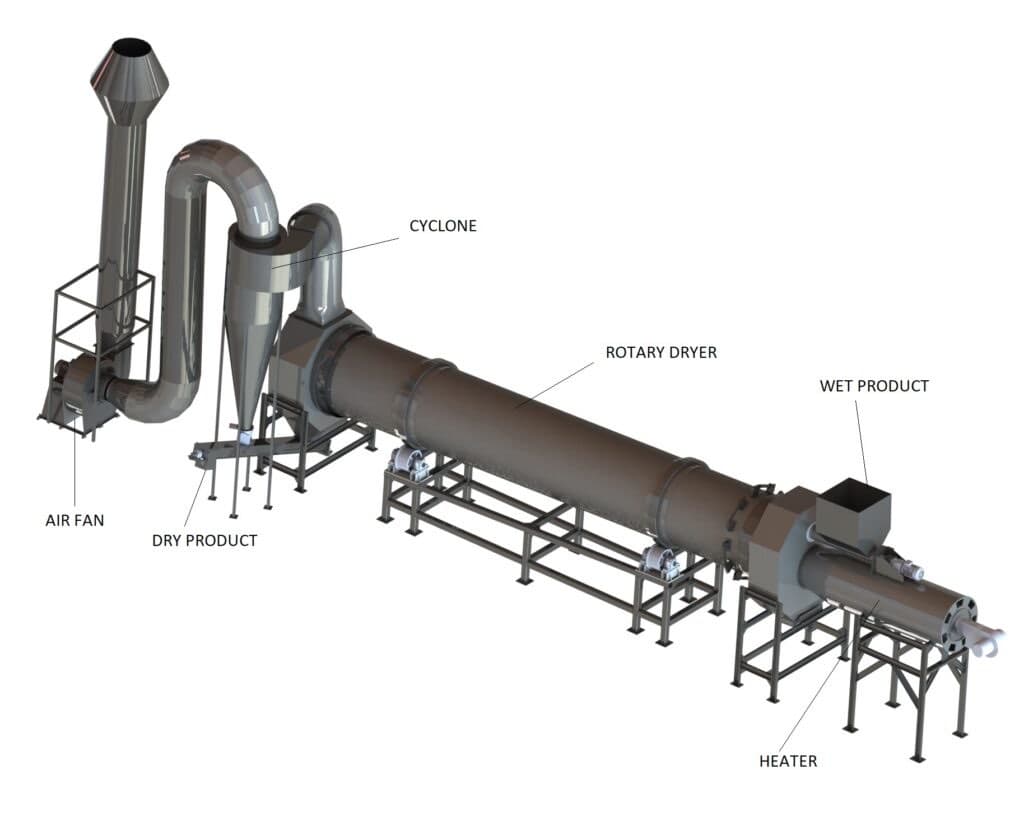
Rotary drum dryers have been drying bulk solids since the 1800s, and there's a reason they're still the dominant technology: they handle almost anything you throw at them. Coarse, wet, abrasive, sticky, variable — a rotary dryer takes it and keeps running.
But they're not always the right answer. If your material is fine (below 1 mm), heat-sensitive, or needs outlet moisture control tighter than ±0.5%, a rotary dryer will frustrate you. Below is a quick decision filter:
| Criterion | Rotary Dryer ✓ | Consider FBD Instead |
|---|---|---|
| Particle size | 3 mm – 100 mm+ | 0.1 mm – 5 mm |
| Inlet moisture | Up to 60% | Up to 40% |
| Outlet moisture tolerance | ±0.5% – ±1.5% | ±0.1% – ±0.3% |
| Material character | Coarse, abrasive, sticky, fibrous | Free-flowing granules, powders |
| Gas temperature | Up to 900°C (direct-fired) | Typically up to 500°C |
| Throughput | 1 – 200 t/h | 0.5 – 50 t/h |
Direct vs Indirect Heating: Which Design Do You Need?
This is the most impactful design decision for a rotary dryer project. Direct-fired units are simpler, more efficient, and cheaper — but the combustion gas contacts your product. Indirect units protect product purity but add capital cost. Here's how to think about it:
For minerals, aggregates, potash, biomass and fertilizer blends, direct-fired is almost always the correct choice. For solvents, fine chemicals, food-grade materials, or anything where combustion gas contact would contaminate the product or create an explosion risk, you need indirect heating.
| Parameter | Direct-Fired | Indirect-Fired |
|---|---|---|
| Thermal efficiency | 75–85% | 55–70% |
| Capital cost (relative) | Base | +30–50% |
| Product purity | Gas contact — not suitable for food/pharma | No gas contact — suitable for sensitive products |
| Max gas temperature | Up to 900°C | Up to 650°C |
| Fine dust carry-over | Higher (gas velocity through drum) | Lower (gas outside drum) |
| Typical applications | Minerals, potash, biomass, sand, fertilizer | Fine chemicals, solvents, food ingredients |
The Process Data You Must Have Before Contacting a Supplier
Here's the honest truth: without these eight data points, no reputable engineer can give you a reliable pre-sizing or budget figure. They'll give you something, but it won't be accurate. If you want a number you can actually plan a project around, you need to provide:
1. Material name and bulk density (kg/m³)
2. Inlet moisture content (% wet basis)
3. Target outlet moisture content (%)
4. Required throughput — specify wet-feed basis or dry-product basis
5. Particle size distribution (D10 / D50 / D90 in mm)
6. Maximum allowable product temperature (°C)
7. Available heat source (natural gas, LPG, hot oil, steam, biomass)
8. Site constraints (footprint limits, ceiling height, electrical class area)
The more of these you can supply, the faster we can return an accurate technical pre-sizing. And the earlier you're confident in the sizing, the fewer expensive surprises you face during detailed engineering.
Lead Times and What to Expect
Rotary dryers are not stock items — every unit is engineered to your process data. Lead times depend primarily on drum diameter:
— Standard sizes (1.0–2.5 m diameter, 8–20 m length): 14–20 weeks from order confirmation
— Large sizes (3.0 m diameter and above): 20–28 weeks
Ermak Proses manufactures in Istanbul and Lozzar Process handles all European logistics — factory acceptance tests, export documentation, and road or rail delivery to site. Typical transit time to Central Europe is 5–7 days. If your project has a hard commissioning date, work backwards from it and contact us early — lead times on the burner and drive systems can sometimes be the critical path, not the drum itself.