The Problem: You're Paying for Heat Twice
A typical direct-fired rotary dryer on a biomass or minerals application runs exhaust gas at 180–300°C to the stack. That heat represents roughly 15–25% of the total fuel input — heat you've already paid for, that's doing nothing but warming the atmosphere.
For a plant running 7,000 hours per year on natural gas at €0.06/kWh, every 100 kW of unrecovered exhaust heat costs approximately €42,000 per year. For a 5 MW dryer exhausting at 25% unrecovered, that's over €200,000 annually — going straight up the stack.
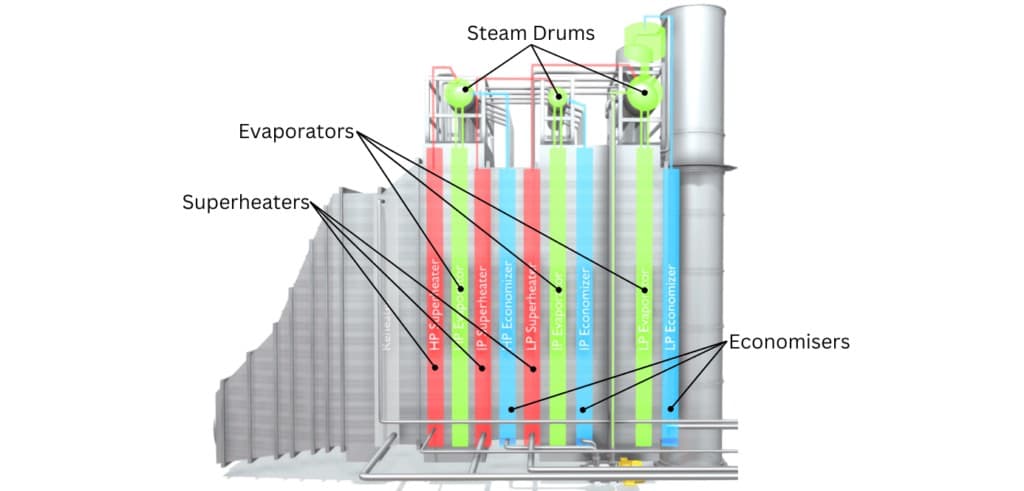
HRSG (Heat Recovery Steam Generator) and WHR (Waste Heat Recovery) systems exist specifically to capture this value. They don't consume additional fuel — they extract energy that's already flowing past your chimney.
Where HRSG Makes the Strongest Economic Case
Not every application justifies an HRSG investment. The economics get attractive when three conditions align: high exhaust temperatures, continuous operation, and a nearby heat sink (a process that can use the recovered steam or hot water). The table below summarises typical HRSG candidates and what to expect:
| Heat Source | Exhaust Temp. | Typical Recovery % | Payback |
|---|---|---|---|
| Rotary dryer (direct-fired) | 300–650°C | 18–25% of fuel input | 18–30 months |
| Biomass boiler / CHP | 250–400°C | 12–20% of boiler output | 24–42 months |
| Gas engine / genset | 400–550°C | 20–30% of engine output | 12–24 months |
| Pyrolysis / thermal treatment | 400–800°C | 25–35% of process heat | 15–28 months |
What Data You Need for a Feasibility Study
You don't need a detailed engineering study to understand if an HRSG project stacks up — but you do need four key numbers:
1. Exhaust gas flow rate (Nm³/h or kg/h)
2. Exhaust gas temperature at the point of heat recovery
3. Exhaust gas composition (particularly dust loading, SO₂ content, moisture)
4. What you'd do with the recovered energy (steam, hot water, pre-heated air)
With those four inputs, Lozzar Process can provide a preliminary technical assessment and indicative ROI within one week. Our HRSG systems are manufactured by Ermak Proses in Istanbul, with heat exchanger areas from 50 m² to over 2,000 m² and output from 200 kW thermal to 12 MW.