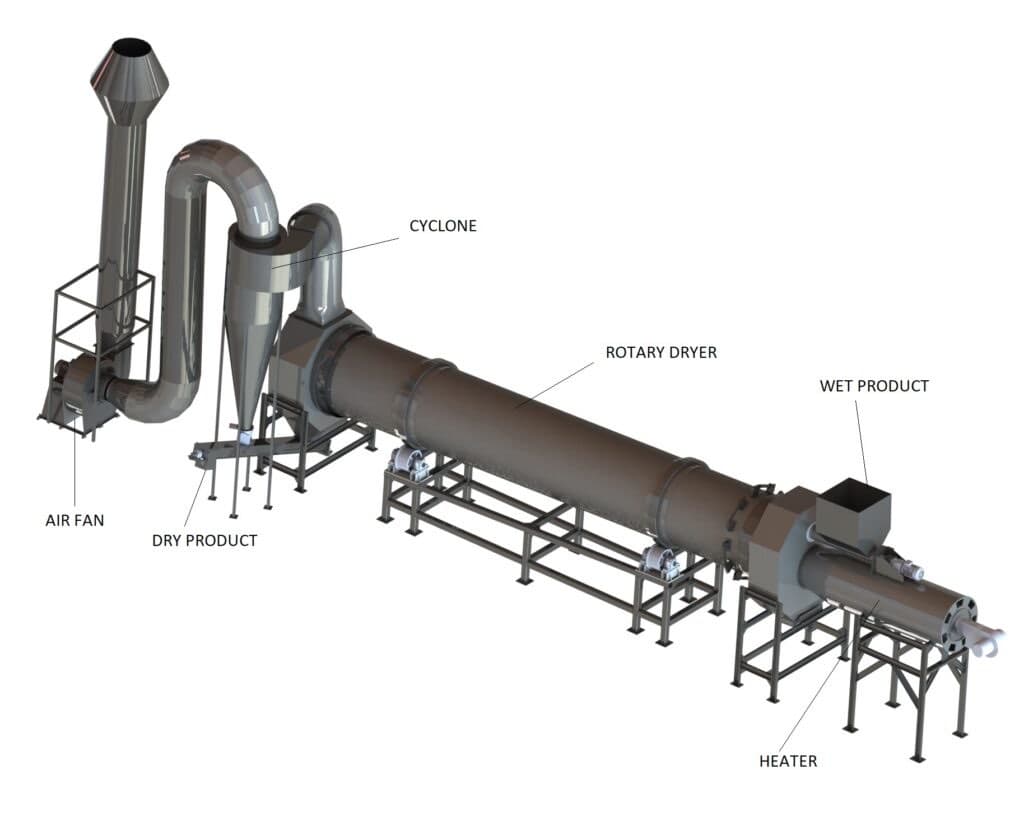
Where Dryer Energy Actually Goes
Before you can optimise a dryer, you need to understand where the energy is going. Most plant managers are surprised by the breakdown — the largest single loss in a typical rotary dryer is not the exhaust gas, it's excess air. Here's a typical energy balance for a direct-fired rotary dryer at 10 t/h throughput:
| Energy Destination | Typical Share | Reduction Potential |
|---|---|---|
| Evaporating water from product (useful work) | 50–65% | Reduce by controlling inlet moisture |
| Exhaust gas heat loss | 15–25% | Recover 60–80% with HRSG or heat exchanger |
| Excess combustion air | 8–20% | Reduce with airflow balance + O₂ trim control |
| Radiation & convection losses (drum shell, ducting) | 3–8% | Insulate drum ends and transfer ducting |
| Heating product mass (sensible heat) | 3–7% | Limited — product must reach target temperature |
5 Interventions Ranked by Impact and Investment Required
Not all of these require capital expenditure. In fact, the two highest-return interventions cost almost nothing:
| Intervention | Typical Energy Saving | Investment Required | Payback |
|---|---|---|---|
| Combustion tuning (O₂ trim control) | 8–15% | €5,000–15,000 | 3–8 months |
| Airflow balance & VFD on fan | 10–20% | €8,000–25,000 (VFD) | 4–10 months |
| Exhaust setpoint reduction (110°C → 80°C) | 10–18% | €0 (control change only) | Immediate |
| Inlet moisture reduction (mechanical pre-dewatering) | 8–15% per 5% moisture reduction | €30,000–120,000 (screw press or centrifuge) | 12–30 months |
| Exhaust heat recovery (HRSG / heat exchanger) | 15–30% of total fuel input | €60,000–250,000 (depends on duty size) | 18–36 months |
Where to Start: A Practical Sequence
If you're approaching dryer energy efficiency for the first time, this is the sequence that delivers the most value for the least disruption:
Step 1 (this week, cost: €0): Review your current exhaust temperature setpoint. If it's above 90°C and your bag filter is a standard design, there is almost certainly room to reduce it. Check the bag filter manufacturer's minimum operating temperature recommendation.
Step 2 (within one month, cost: €2,000–5,000): Commission a combustion analysis and airflow balance on your dryer. This identifies waste in the existing system before you invest in new equipment.
Step 3 (quarter 2–3, cost: €8,000–30,000): Install VFDs on your dryer fan motors if not already present. This alone typically saves 10–18% of fan electrical energy and improves moisture control response.
Step 4 (once you have 12 months of data): Model the business case for exhaust heat recovery based on actual measured exhaust flows and temperatures. This is when the HRSG or heat exchanger investment becomes defensible on numbers, not estimates.