Fluidized Bed Dryer
Uniform, gentle drying for fine powders and granules — superior product quality with minimum thermal stress.
Fluidized bed dryers suspend fine particles in an upward-flowing stream of hot air, creating intimate gas-solid contact that delivers exceptionally uniform drying at low to moderate temperatures. They are the preferred solution for fine chemicals, pharmaceutical intermediates, food powders, fertilizer salts and any material where particle integrity, product colour or residual moisture uniformity is critical. Lozzar Process supplies both continuous and batch fluidized bed systems with integrated fluid-bed coolers, vibrating decks and explosion-proof configurations for ATEX zones.
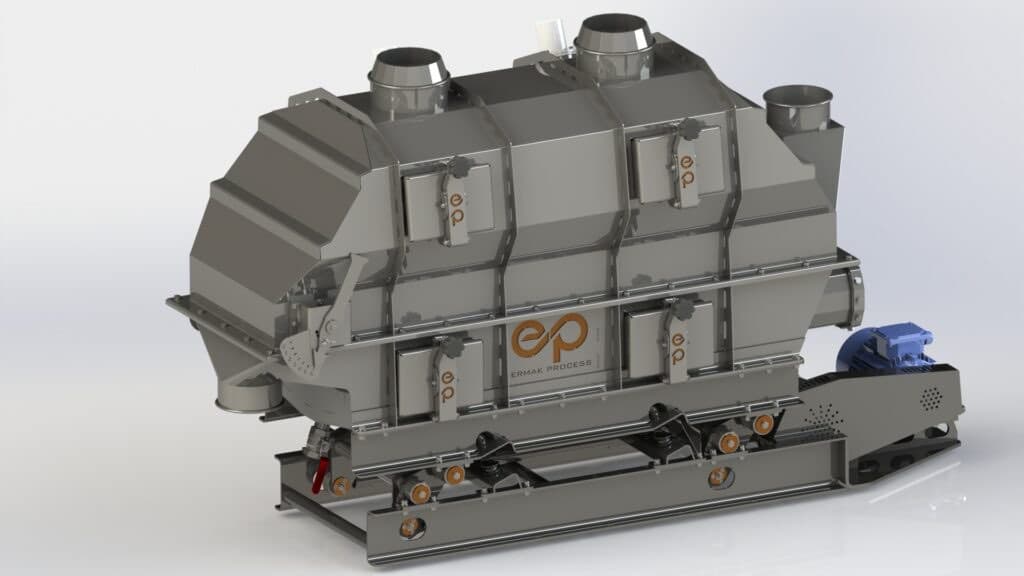
How a Fluidized Bed Dryer Works
A fluidized bed dryer forces heated air upward through a perforated distribution plate (the "grid") at a velocity precisely calculated to suspend the particulate bed — this is the minimum fluidization velocity (u_mf). Above u_mf, individual particles become separated and behave collectively like a fluid: they circulate freely, exchange heat with the gas at every surface, and dry with outstanding uniformity.
The perforated plate design is critical engineering: hole diameter, open area percentage, pressure drop across the plate and plenum geometry must all be matched to the specific material's particle size distribution, bulk density and minimum fluidization velocity. An incorrectly sized grid causes channelling (gas bypasses material through preferential paths), slugging or dead zones — all of which produce uneven drying. Lozzar engineers perform a full fluidization characterisation study for each new material before finalising plate design.
In a continuous fluidized bed dryer, material enters at one end of an elongated rectangular or circular chamber, moves across the fluidized bed by displacement (incoming feed pushes material forward), and discharges at the far end over a weir. Residence time is controlled by weir height and feed rate. In a batch system, a fixed charge is loaded, fluidized and dried to target moisture, then discharged — cycle times typically 20–90 minutes depending on material and target moisture.
Where further cooling is required, a second compartment with ambient or chilled air replaces hot air at the discharge end — this integrated dryer-cooler reduces the total equipment footprint and avoids material degradation from prolonged high-temperature exposure. Vibrating fluidized bed variants add mechanical vibration (1–5 mm amplitude, 700–1500 rpm) to assist fluidization of cohesive, wide-PSD or surface-wet materials that would otherwise resist homogeneous suspension.
Quick Reference
Technical Specifications
All parameters are indicative ranges. Final sizing is determined by process simulation based on your specific material and throughput requirements.
Fluidized Bed Dryer — Operating Parameters
| Parameter | Value / Range | Note |
|---|---|---|
| Particle size range | 50 µm – 5 mm | Optimal 100 µm–3 mm; <50 µm requires entrainment control; >5 mm use rotary dryer |
| Inlet air temperature | 80 – 600°C | Food/pharma typically 80–150°C; minerals/chemicals up to 600°C |
| Outlet product temperature | 40 – 120°C | Controlled by air flow rate and residence time |
| Inlet moisture content | 2 – 35% w/w | >35% w/w: pre-dewatering recommended (centrifuge/press); surface moisture preferred over bound moisture |
| Outlet moisture uniformity | ±0.2% w/w | Batch mode; continuous ±0.3–0.5% w/w depending on PSD spread |
| Throughput (continuous) | 0.1 – 50 t/h | Batch: 50–5000 kg/batch; scale-up ratio 1:50 achievable |
| Superficial gas velocity | 0.3 – 3.0 m/s | Must remain between u_mf and u_t (terminal velocity) for stable fluidization |
| Specific evaporation rate | 30 – 120 kg H₂O/m²·h | Per unit of bed cross-sectional area; higher than rotary drum for fine materials |
| Specific energy consumption | 900 – 1 800 kcal/kg water evaporated | Includes fan power; heat recovery from exhaust air can reduce to 700–1200 kcal/kg |
| Pressure drop across bed | 20 – 150 mbar | Mainly determined by bed height and bulk density; grid adds 10–30% of total |
| Bed height (static) | 150 – 600 mm | Shallow beds (150–250 mm) for short residence time; deep beds for difficult drying curves |
| Exhaust gas dust loading | 10 – 200 g/Nm³ | Bag filter or cyclone + bag filter required downstream; fine particles (d50 < 100 µm) need HEPA-grade filtration |
| Material of construction | SS 304 / SS 316L / Carbon steel | SS 316L standard for food/pharma; carbon steel with coating for bulk chemicals; Hastelloy for aggressive media |
| Explosion protection (ATEX) | Zone 20/21/22 compliant | Inert gas (N₂) purging option; PRDs, grounding, conductive internals; dust Kst class 1/2/3 accommodated |
Fluidized Bed vs. Vibrating Fluidized Bed — Performance Comparison
| Parameter | Value / Range | Note |
|---|---|---|
| Suitable particle size | Standard: 200 µm–5 mm | Vibrating: 50 µm–8 mm | |
| Cohesive / sticky materials | Standard: limited | Vibrating: ✓ suitable | Vibration breaks inter-particle bridges that resist fluidization |
| Residence time control | Standard: narrow RTD | Vibrating: adjustable via amplitude/freq | |
| Pressure drop | Standard: lower | Vibrating: 15–30% higher | Vibrating deck adds mechanical seal complexity |
| Maintenance complexity | Standard: low | Vibrating: moderate (bearings, seals) | |
| Typical CAPEX premium | +20–35% for vibrating variant | Justified when standard fluidized bed fails to achieve stable operation |
Need a technical pre-sizing? Send us your material data sheet, moisture content, required throughput and energy source — we return a technical sizing with drum dimensions and energy balance within 2 business days.
→ Send process data on WhatsAppMaterial Database — Fluidized Bed Drying Performance
Reference data from industrial installations. Actual values depend on feed consistency, particle size distribution and required product quality.
| Material | Inlet moisture | Outlet moisture | Particle size | Gas temp. | Industry |
|---|---|---|---|---|---|
| Ammonium sulphate (fertilizer) | 3–6% | <0.2% | 0.5–2.5 mm | 80–110°C | Fertilizers |
| Urea prills | 0.5–2% | <0.1% | 1–3 mm | 60–90°C | Fertilizers |
| Sodium chloride (table salt) | 2–5% | <0.05% | 0.2–1.5 mm | 100–150°C | Food & Chemical |
| Citric acid crystals | 8–15% | <0.5% | 0.3–2 mm | 50–80°C | Food & Pharma |
| Pharmaceutical granulate (API) | 15–25% | <2.0% | 100–800 µm | 40–80°C | Pharmaceuticals |
| PVC powder (suspension grade) | 20–30% | <0.3% | 80–250 µm | 60–85°C | Plastics / Polymers |
| Silica gel (precipitated) | 50–65% | <5% | 100–500 µm | 150–250°C | Chemical |
| Spray-dried lactose | 3–8% | <0.5% | 50–200 µm | 60–90°C | Food / Pharma excipient |
Don't see your material? Send us your process data and we'll provide material-specific sizing.
Fluidized Bed Dryer Configurations
Continuous Plug-Flow Fluidized Bed
Elongated rectangular chamber with horizontal material plug flow over the fluidizing grid. Multiple air temperature zones possible along the length (high temperature inlet zone, controlled temperature drying zone, cooling zone). Highest throughput option for non-cohesive granules with consistent PSD.
Batch Fluidized Bed (Top-Spray / Bottom-Spray)
Cylindrical vessel with conical bottom; material is charged, fluidized and dried in a single vessel. Top-spray nozzles can add binders or coatings during drying (granulation, coating and drying in one step). GMP-compliant designs with WIP (wash-in-place) available for pharmaceutical production.
Vibrating Fluidized Bed Dryer-Cooler
Mechanically vibrated deck (eccentric mass or electromagnetic drive) superimposed on upward air flow. Vibration amplitude 1–5 mm at 700–1500 rpm assists particle transport and breaks cohesive bridges. Combined drying and cooling zones in one unit: hot air section (drying) followed by ambient or chilled air section (cooling) — product exits at target bulk temperature without an additional cooler vessel.
Static Fluidized Bed (Internally Heated)
Immersed heat exchange tubes (steam, hot water or thermal oil) inside the fluidized bed supply the bulk of drying heat, while fluidizing air provides only particle suspension and moisture removal. Air volume is dramatically reduced (5–10× less than convective-only designs), resulting in much smaller bag filters, lower fan power and reduced exhaust treatment costs. Particularly advantageous for oxygen-sensitive or solvent-bearing materials where inert gas (N₂) operation must be maintained with minimal make-up gas cost.
When to Choose a Fluidized Bed Dryer
Fine particles: d50 between 100 µm and 3 mm
Fluidized bed is the primary technology for this size range. Gas-solid contact far exceeds rotary drum for fine particles, yielding shorter residence times and lower product temperatures.
Residual moisture uniformity is critical (±0.5% or tighter)
Fluidized bed batch drying achieves ±0.2% w/w uniformity. Required for pharmaceutical release specifications, food texture standards and chemical product certificates-of-analysis.
Product is heat-sensitive (max 60–120°C)
Short gas-solid contact time (2–20 minutes vs. 30–90 for rotary) means product temperature stays well below air temperature. Suitable for sugars, amino acids, vitamins and enzyme preparations.
GMP or food-grade cleaning and CIP/WIP is required
Batch fluid bed vessels have no internal ledges or moving parts — they are fully CIP/WIP cleanable with validated cleaning protocols. Continuous rotary dryers cannot achieve pharmaceutical CIP standards.
Drying and cooling in one unit is desired to save plant footprint
Multi-zone fluidized beds combine drying and cooling in one chamber. Eliminates a separate cooler vessel, connecting conveyor, foundation and instrumentation — typically saving 15–25% of total installed cost vs. separate units.
When NOT to Use a Fluidized Bed Dryer
Coarse particles: d50 > 5–8 mm, or wide PSD (d10/d90 ratio > 10)
Very high inlet moisture (>35% w/w) with bound (hygroscopic) moisture
Paste, filter cake, or sludge feed (plastic/non-flowable) that cannot be pre-dispersed
Very low residual moisture target (<0.1%) for highly hygroscopic materials requiring closed-loop desiccant recirculation
Not sure which dryer is right for your process? We'll review your specifications and recommend the optimal solution.
Ask a technical question →Fluidized Bed Dryer — Engineering FAQ
In practice, particles with d50 below 50 µm (Geldart Group C materials: flour, pigments, fumed silica) cannot form a stable fluidized bed — they channel or agglomerate instead of fluidizing uniformly. For d50 50–200 µm (Geldart Group A), fluidization is possible but requires careful control of superficial velocity to remain below the terminal velocity (u_t). Entrainment control measures — low superficial velocity (0.3–0.8 m/s), expanded freeboard height, cyclone pre-separation and bag filter downstream — are mandatory. For d50 < 100 µm, vibrating fluidized beds or spray dryers are generally preferred. All Lozzar fluidized bed designs are validated against a Geldart classification study of the customer's specific material before quotation.
From Our Projects
Related Equipment
Rotary Dryer
Use rotary dryer for coarse bulk solids (d50 > 5 mm), high temperature applications (>250°C) or very large throughputs (>50 t/h) where particle uniformity is less critical
View productFlash Dryer
Flash dryer for filter cakes, pastes and high-moisture feeds (>35%) requiring rapid surface drying before further processing — output feeds into fluid bed for final drying
View productSpray Dryer
Pair spray dryer + fluid bed for liquid-to-powder processes: spray dryer creates particle morphology, fluid bed achieves final moisture and cools product — standard in infant formula, instant coffee, pharma granulation
View productBag Filter
Bag filter is mandatory downstream of every fluidized bed dryer — fine particles always entrain in exhaust air; Lozzar supplies complete FBD + bag filter systems as integrated packages
View productRequest a Quote for This Equipment
Include in your enquiry:
- →Material name and brief process context (e.g. "ammonium sulphate after crystalliser")
- →Particle size distribution: d10, d50, d90 (sieve or laser diffraction data preferred)
- →Inlet moisture content (% w/w) and moisture type (surface or bound)
- →Target outlet moisture (% w/w) and allowable tolerance
- →Required throughput: dry product kg/h or evaporation rate kg H₂O/h
- →Heat source available: steam (pressure bar g), hot water (°C), gas or oil
- →Any ATEX zone classification, dust Kst class, or product temperature limits