The Core Physics (In Plain Language)
A rotary dryer tumbles your material through a hot gas stream inside a spinning drum. Residence time is long — 5 to 30 minutes. The material is constantly mixed but loosely controlled. Think of it like a clothes dryer: forgiving, tolerant of variation, but not surgical.
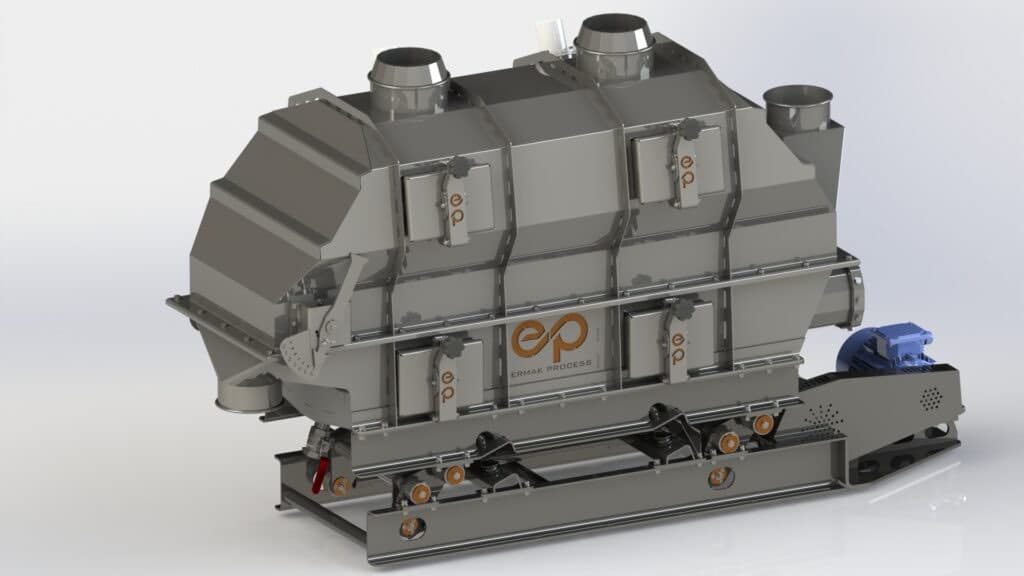
A fluidized bed dryer suspends each particle individually in an upward gas stream. Every particle is surrounded by drying gas simultaneously. Contact is intense and uniform — but the material has to actually fluidize, which means particle size and density have to fall within a workable range.
The result is a fundamental performance split: rotary dryers are broader and tougher; fluid beds are tighter and more precise. The comparison table below shows exactly where each one wins.
Head-to-Head Comparison
Eight parameters that actually matter for specifying and operating an industrial dryer:
| Parameter | Rotary Drum Dryer | Fluidized Bed Dryer |
|---|---|---|
| Particle size range | 1 mm – 100 mm+ | 0.1 mm – 8 mm (must fluidize) |
| Outlet moisture uniformity | ±0.5% – ±1.5% | ±0.1% – ±0.3% |
| Specific energy consumption | 3,000 – 5,000 kJ/kg water evaporated | 2,500 – 4,000 kJ/kg water evaporated |
| Residence time | 5 – 30 min | 3 – 15 min (batch: up to 60 min) |
| Footprint | Long and narrow — 8–30 m length | Compact — shorter vessel, taller plenum |
| Capital cost (relative) | Base | +10–25% for same evaporation duty |
| Feed moisture tolerance | High — handles ±15% variation | Low — moisture swings disturb fluidization |
| Integrated cooling | Separate cooler required | Drying + cooling in one vessel |
The Decision Rules (When You Don't Have Time to Debate)
Choose a rotary dryer if any of these are true:
— Material particle size is above 5 mm
— Inlet moisture varies by more than ±8% in operation
— Material is sticky or non-free-flowing
— Required throughput is above 20 t/h dry product
— Gas inlet temperature must exceed 500°C
— Budget is constrained and moisture control is not critical
Choose a fluidized bed dryer if:
— Material is granular, free-flowing and within 0.2–6 mm
— Outlet moisture specification is ±0.2–0.3% or tighter
— You need integrated cooling (fertilizers, detergents, polymers)
— Product temperature uniformity is critical for quality
— Specific energy consumption is a key operating cost driver
Still unsure? Send us your material data sheet and process requirements — we'll tell you which technology fits and why, without any obligation.