The Problem Nobody Wanted to Admit
The compound fertilizer producer in Debrecen, Hungary, had been running their NPK 15-15-15 granulation line with a rotary dryer that was installed in 2007. For years, the team had been "managing" the moisture problem: adjusting the exit temperature setpoint, varying the feed rate, blending dry and wet batches together. But the numbers told the real story.
Over a 12-month period before the project, outlet moisture samples taken every 30 minutes showed values ranging from 0.1% to 2.8% — against a product specification of 0.5% ±0.5%. On any given shift, 15–25% of the production was outside specification. The result: €180,000 per year in rejected product, rework costs, and customer complaints about caking in transit.
When Lozzar Process was asked to help, the initial brief was "can you fix the existing dryer?" After a two-day process audit, the answer was: "You can fix it, but it won't solve the problem. The problem is the technology, not just the machine."
Root Cause and Technology Decision
The process audit identified three contributing factors: worn lifting flights that had reduced active flight area by approximately 40%, significant air infiltration through drum seal wear (adding 30–35% excess air, reducing gas temperature and effective drying), and a single exhaust moisture sensor positioned off-centre — not representative of the full discharge cross-section.
But repairing those issues would only partially restore the rotary dryer's original performance. And the original performance — ±0.8% moisture at design throughput — was never tight enough for the current product specification. The NPK granules being produced (2.0–4.0 mm) are precisely in the particle size range where a fluidized bed dryer outperforms a rotary dryer on moisture uniformity. Every particle surrounded by gas simultaneously, short residence time, plug flow behaviour — it's the right tool for this job.
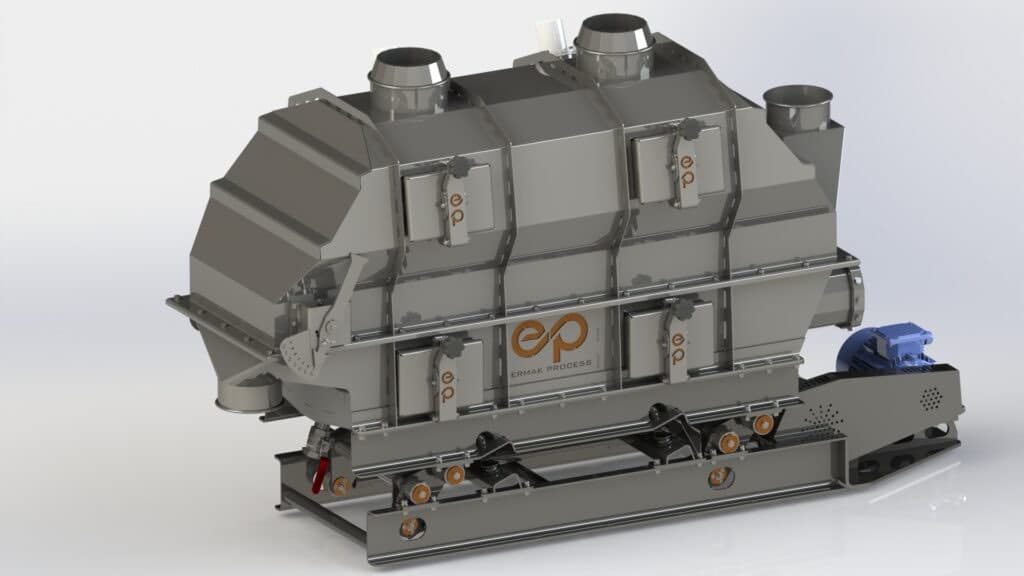
Lozzar Process recommended a static fluid bed dryer: 1.8 m wide × 7.2 m active bed length, stainless steel construction, sized for 8.5 t/h dry product with integrated cooling section to bring product from drying temperature (~75°C) to bagging temperature (<45°C) in one unit.
Results: Before vs After
Post-commissioning performance data collected over 60 consecutive days of production tells the story clearly:
| KPI | Before (Rotary Dryer) | After (Fluid Bed Dryer) |
|---|---|---|
| Outlet moisture range | 0.1% – 2.8% | 0.33% – 0.57% |
| Moisture uniformity (±) | ±1.4% (std dev) | ±0.12% (std dev) |
| In-specification samples | 76% (24% off-spec) | 99.2% |
| Specific thermal energy | 920 kWh/t water evaporated | 810 kWh/t water evaporated (−12%) |
| Off-spec product losses | ~€180,000/year | ~€23,000/year (−87%) |
The equipment payback, calculated on product loss savings alone, is under 18 months. When energy savings are factored in, the financial case for the replacement strengthened further. The client's production manager summed it up: "We spent years adjusting a dryer that was never going to do what we needed. Now we run the line and the moisture takes care of itself."