The Chemistry of Caking — Why the Numbers Are Non-Negotiable
Fertilizer granules are hygroscopic — they actively absorb moisture from the atmosphere and from adjacent granules during storage and transport. When granule surface moisture exceeds a threshold called the Critical Relative Humidity (CRH), the crystal structure at granule contact points dissolves and recrystallises. The granules fuse together. The bag or bulk container becomes a solid block. The product is unsaleable.
The CRH values for common fertilizer products are well-documented and unforgiving. They set a hard ceiling on acceptable outlet moisture from your dryer:
Urea: CRH 72% RH | Ammonium Nitrate (AN): CRH 59% RH | NPK 15-15-15: CRH ~65–70% RH (product-specific)
For most NPK products stored in Central European warehouse conditions (summer peak RH 60–70%), there is essentially no safety margin between "product is fine" and "product is caking" if the dryer exits above 0.5% moisture. This is why fertilizer drying is a precision engineering problem, not just a drying problem — and why fluidized bed dryers, not rotary dryers, are specified for modern NPK granulation plants.
Critical Relative Humidity (CRH) and moisture specifications for common fertilizer granule products
| Product | CRH | Target Outlet Moisture | Moisture Uniformity Required | Max Bagging Temperature | Preferred Dryer Type |
|---|---|---|---|---|---|
| Urea (prilled or granulated) | 72% RH | 0.25–0.4% | ±0.10% | 45°C | Fluidized bed dryer-cooler |
| Ammonium Nitrate (AN) | 59% RH | 0.1–0.3% | ±0.08% | 35°C (safety critical) | Fluidized bed with chilled air cooling |
| NPK 15-15-15 | ~67% RH | 0.3–0.5% | ±0.15% | 40°C | Fluidized bed dryer-cooler |
| NPK high-K (e.g. 5-10-30) | ~70–75% RH | 0.4–0.6% | ±0.15% | 40°C | Fluidized bed dryer-cooler |
| CAN (Calcium Ammonium Nitrate) | ~73% RH | 0.5–0.8% | ±0.20% | 40°C | Rotary dryer + FBD cooler |
What a Correctly Specified Fluid Bed Dryer-Cooler Must Deliver
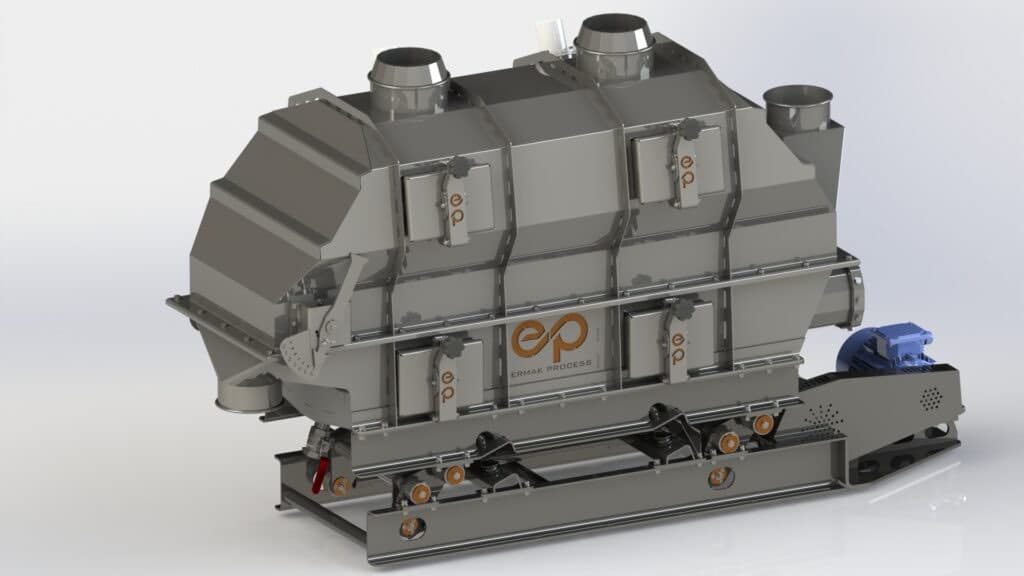
The standard design for NPK and compound fertilizer drying and cooling is the multi-zone static fluidized bed: a continuous, horizontal vessel divided into a drying zone (hot air fluidisation, typically 100–150°C inlet air) and a cooling zone (ambient or chilled air fluidisation). The product flows as a plug from drying to cooling in a single pass — ensuring uniform residence time and therefore uniform outlet temperature and moisture.
The specifications that define whether a fluidized bed dryer-cooler is correctly designed for a fertilizer application:
**Bed area (m²)**: sized based on superficial air velocity (typically 1.0–2.5 m/s for fertilizer granules, depending on bulk density and particle size) and bed height (150–300 mm). Bed area directly determines throughput capacity — undersizing is the most common cause of moisture out-of-spec during production peaks.
**Distributor plate design**: the hole pattern, hole velocity, and plate material determine whether the product actually fluidises uniformly or whether channelling occurs. Channelling — where some product paths through the bed without being properly fluidised — is the hidden cause of moisture hot spots and caking incidents. It cannot be fixed by adjusting the air temperature after commissioning.
**Heat exchanger panels**: immersed panels (for indirect heating or cooling) reduce the inlet air temperature requirement and improve control. In the cooling zone, immersed water-cooled panels allow the product to be cooled to 35–40°C even when ambient air is at 32°C — which ambient-only cooling cannot achieve in a Central European summer.
**A properly designed fertilizer fluid bed dryer-cooler should deliver**: outlet moisture ≤0.5% (with ±0.15% uniformity), outlet product temperature ≤40°C (for NPK) or ≤35°C (for AN), specific thermal energy consumption 700–850 kWh/tonne water evaporated.
The Summer Cooling Problem — And How to Solve It Before It's a Problem
In many existing fertilizer plants, the dryer is adequate but the cooler is insufficient — and the plant only discovers this in the first hot summer after commissioning.
As ambient temperatures in Central Europe increasingly reach 35–38°C on peak summer days, the ambient-air cooling zone of a standard fluid bed struggles to achieve the 40°C product outlet target. The result: product exits the cooler at 45–50°C. The heat continues releasing during bagging and pallet stacking — causing localised moisture migration and caking at the bottom of the bag, the last thing any quality manager wants to see.
There are two engineering solutions:
**Chilled air cooling**: A refrigeration circuit cools the fluidisation air in the cooling zone to 10–15°C. This delivers consistent 35–38°C product temperature year-round, regardless of ambient temperature. Capital cost: €80,000–200,000 depending on capacity. More expensive than the alternative, but eliminates the problem completely.
**Extended fluid bed cooling section**: Adding a downstream cooling section (2–4 m additional bed length) increases residence time in the cooling zone. Capital cost: €40,000–100,000 depending on scope. Less expensive, but has limits — if ambient is above 38°C consistently, extended length alone may not be sufficient.
For new fertilizer plant projects, Lozzar Process always recommends sizing the cooling zone for a design ambient of 35°C — not the average annual temperature, and not the temperature at the site when the project was specified in February. This adds approximately 10–15% to the cooler capital cost but eliminates a known failure mode that typically becomes apparent in year two or three of operation.