Cyclone Separator
No bags, no filters, no moving parts — robust particle separation from 5 µm to coarse bulk, 24/7.
Cyclone separators use centrifugal force — not filter media — to separate solid particles from a gas stream. Dust-laden gas enters the cylindrical body tangentially, creating a spiral vortex that drives particles outward to the wall, down the cone and into the discharge hopper, while clean gas exits upward through the central vortex finder. With no filter bags, no moving parts and no cleaning mechanisms, a cyclone separator operates continuously at temperatures up to 900°C, handles abrasive and sticky dusts that would blind fabric filters, and requires almost zero maintenance. Lozzar Process supplies high-efficiency cyclones (HC series) and standard cyclones (SC series) as standalone collectors for coarse particle recovery and as first-stage pre-separators upstream of bag filters and wet scrubbers.
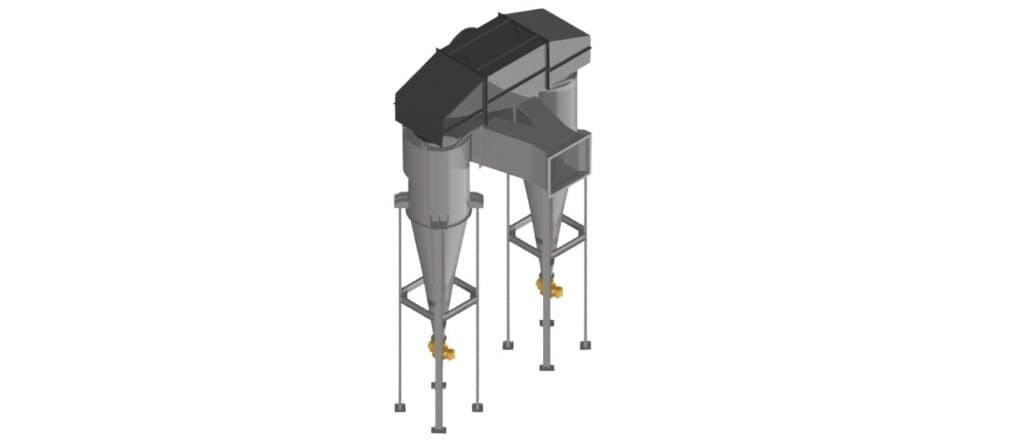
How a Cyclone Separator Works
Dust-laden gas enters the cyclone tangentially at the top of the cylindrical section. The tangential entry forces the gas into a downward outer spiral along the cyclone wall. Centrifugal acceleration — typically 5–2,500 × g depending on cyclone diameter — pushes particles radially outward against the wall. Particles lose momentum through wall friction, slow down, and migrate downward along the cone to the dust outlet at the apex, where they discharge continuously into a sealed collection hopper via a rotary valve.
The cleaned gas, having lost its rotational momentum as particles are separated, reverses direction near the apex and exits upward through the central vortex finder tube (also called the inner vortex tube or dip tube). This inner upward vortex is the clean gas path. The boundary between the outer downward vortex (carrying particles) and the inner upward vortex (carrying clean gas) is a fundamental fluid dynamic feature — the vortex length, typically 1.5–2.5× the cylinder height, determines the minimum particle size that can be separated.
The critical design parameters that determine cyclone performance are: (1) inlet velocity — higher velocity creates more centrifugal force but also increases turbulence, which re-entrains separated particles; optimal inlet velocity is 15–25 m/s. (2) Cyclone diameter — smaller diameter creates higher centrifugal acceleration (a ∝ 1/r) and separates finer particles, but handles less gas flow; high-efficiency cyclones use D = 100–300 mm with multiple units in parallel. (3) Cone angle and length — steeper, longer cones improve collection efficiency for fine particles.
The cut size (d₅₀) — the particle diameter at which 50% collection efficiency occurs — is the primary specification parameter. High-efficiency cyclones achieve d₅₀ = 2–5 µm; standard cyclones achieve d₅₀ = 8–15 µm. Above 2× the cut size, collection efficiency exceeds 95%. This is why cyclones are ideal first-stage collectors for coarse particles but always require a bag filter downstream for particles below 10–20 µm.
Quick Reference
Technical Specifications
All parameters are indicative ranges. Final sizing is determined by process simulation based on your specific material and throughput requirements.
Cyclone Separator — Operating Parameters
| Parameter | Value / Range | Note |
|---|---|---|
| Inlet gas velocity | 12–25 m/s (optimum 15–20 m/s) | < 12 m/s: insufficient centrifugal force; > 25 m/s: increased turbulence and re-entrainment |
| Cut size d₅₀ (50% collection efficiency) | Standard cyclone: 8–15 µm | High-efficiency cyclone: 2–5 µm | At 2× d₅₀ (e.g. > 20 µm for standard), efficiency > 95%; particles below d₅₀ largely pass through |
| Overall collection efficiency (typical inlet PSD) | 70–90% overall (mass basis) for d50 inlet > 20 µm; > 95% for d50 inlet > 50 µm | Overall efficiency is mass-weighted — coarse fraction dominates; fine fraction (< 10 µm) may only reach 10–40% efficiency |
| Gas volume flow (single unit) | 200 Nm³/h – 200,000 Nm³/h per cyclone body | Multiple cyclones in parallel for larger flows; multi-cyclone (multicyclone) uses many small-diameter bodies sharing one inlet/outlet |
| Pressure drop | 500–2,500 Pa (standard: 800–1,200 Pa; high-efficiency: 1,500–2,500 Pa) | Higher efficiency = higher ΔP; optimise by balancing fan energy cost against downstream filter bag life saved |
| Gas temperature | Carbon steel: up to 400°C | Refractory-lined: up to 900°C | SS 304/316L: up to 550°C | No theoretical upper limit from process standpoint — cyclone contains no organic components; limited only by material of construction |
| Dust inlet concentration | 1 g/Nm³ – no upper limit (handles > 1,000 g/Nm³ in heavy mineral applications) | Unlike bag filters, cyclone efficiency improves slightly at very high dust loads (wall layer effect) |
| Abrasion resistance | Wear-resistant steel (Hardox 400/500); ceramic tile lining; basalt rubber lining for highly abrasive dusts | Critical for mineral, cement, coal ash and sand applications; cone and inlet section are primary wear zones |
| Outlet dust concentration (clean gas) | 50–500 mg/Nm³ typical (depends on inlet PSD) | Cyclone alone rarely achieves < 50 mg/Nm³ — always pair with bag filter for regulatory emission compliance |
Standard Cyclone vs. High-Efficiency Cyclone vs. Multi-Cyclone
| Parameter | Value / Range |
|---|---|
| Body diameter | Standard: 500–3,000 mm | High-eff.: 200–500 mm | Multi-cyclone: 50–150 mm per tube |
| Cut size d₅₀ | Standard: 8–15 µm | High-eff.: 2–5 µm | Multi-cyclone: 1–3 µm |
| Pressure drop | Standard: 500–1,000 Pa | High-eff.: 1,200–2,000 Pa | Multi-cyclone: 1,500–3,000 Pa |
| Capacity per unit | Standard: high | High-eff.: medium | Multi-cyclone: low per tube, high in bank |
| Maintenance | Standard: minimal | High-eff.: minimal | Multi-cyclone: tube blockage risk with sticky/wet dust |
| Best application | Standard: pre-separator, coarse recovery | High-eff.: primary collector for d50 > 10 µm | Multi-cyclone: fine dust, boiler fly ash |
Need a technical pre-sizing? Send us your material data sheet, moisture content, required throughput and energy source — we return a technical sizing with drum dimensions and energy balance within 2 business days.
→ Send process data on WhatsAppTypical Applications & Materials
Reference data from industrial installations. Actual values depend on feed consistency, particle size distribution and required product quality.
| Material | Inlet moisture | Outlet moisture | Particle size | Gas temp. | Industry |
|---|---|---|---|---|---|
| Rotary dryer pre-separator — mineral / fertiliser | Dust load 20–200 g/Nm³ | 5–50 g/Nm³ (cyclone reduces load 70–90%) | d50 inlet 30–200 µm | 80–400°C gas | Minerals / Fertiliser / Cement |
| Flash dryer product recovery — starch / pigment / PVC | Dust load 100–800 g/Nm³ | < 10 g/Nm³ to downstream bag filter | d50 10–80 µm | 80–200°C gas | Starch / Pigments / Polymers |
| Spray dryer primary separator — dairy / detergent / ceramic | Dust load 50–300 g/Nm³ | 5–50 g/Nm³ | d50 50–300 µm (product particles) | 80–250°C gas | Food / Dairy / Ceramics / Detergents |
| Cement raw mill / kiln off-gas — coarse fraction | Dust load 200–1,000 g/Nm³ | 10–100 g/Nm³ | d50 20–100 µm | 150–350°C gas | Cement & Construction |
| Biomass pellet mill exhaust — wood dust / fines | Dust load 5–50 g/Nm³ | 1–10 g/Nm³ (coarse fraction recovered) | d50 50–500 µm wood fines | 40–100°C gas | Biomass / Wood / Energy |
| Grain milling — flour / bran / semolina separation | Dust load 10–100 g/Nm³ | 2–20 g/Nm³ | d50 30–200 µm | 20–60°C near-ambient | Food & Feed Milling |
| Hot gas generator / combustion exhaust — fly ash | Dust load 5–100 g/Nm³ (fly ash) | 1–20 g/Nm³ | d50 20–150 µm | 200–600°C gas | Energy / Waste Incineration / Minerals |
| Pneumatic conveying separator — bulk powder transfer | Dust/product load 100–2,000 g/Nm³ | Product collected > 95% mass; residual fines to bin vent filter | d50 100 µm – 5 mm (product) | 20–80°C ambient air | All Powder-Handling Industries (silo filling, batching) |
Don't see your material? Send us your process data and we'll provide material-specific sizing.
System Configurations
Standard Single Cyclone (SC Series)
Single large-diameter cyclone body for high gas flow applications. Diameter 500–3,000 mm; handles gas flows up to 200,000 Nm³/h in one unit. d₅₀ = 8–15 µm. Carbon steel construction with wear-resistant lining at cone and inlet. Typically used as first-stage pre-separator ahead of a bag filter to reduce downstream filter dust load by 70–90%. Also used standalone for product recovery from conveying air and as primary separator downstream of spray dryers. Tangential or spiral inlet; dust discharge via rotary airlock valve.
High-Efficiency Cyclone (HC Series)
Smaller diameter (200–500 mm) cyclone with optimised geometry for maximum fine particle collection efficiency. d₅₀ = 2–5 µm; efficiency > 90% for particles above 10 µm. Higher pressure drop (1,200–2,000 Pa) than standard cyclone. Used where bag filter downstream is not desired or practical — for example, when product is collected in the cyclone hopper and must remain dry and free-flowing, or when operating temperature (> 260°C) makes bag filters impractical. Multiple HC cyclones in parallel to achieve required gas flow with small individual diameter.
Multi-Cyclone Bank (MC Series)
A single inlet/outlet plenum containing dozens to hundreds of small-diameter (50–150 mm) cyclone tubes in parallel. Each small tube operates at the same gas velocity as a large cyclone but the small radius generates up to 500 × g centrifugal acceleration — achieving d₅₀ = 1–3 µm. Total gas capacity is the sum of all tubes. Used in coal-fired boiler fly ash collection, fine biomass combustion gas cleaning, and anywhere sub-3 µm collection without bag filters is required. Risk of tube blockage with sticky or moist dust — not recommended for dryer exhausts with residual moisture.
Selection Guide
Inlet dust load is very high (> 50 g/Nm³) and a bag filter is required downstream — cyclone as pre-separator reduces bag filter size and bag replacement frequency
Standard cyclone (SC series) upstream of bag filter — removes 70–90% of mass at inlet; bag filter now handles 5–15 g/Nm³ instead of 50–500 g/Nm³, extending bag life 2–5× and reducing filter area by up to 60%
Gas temperature exceeds 260°C — bag filter operating limit — but particulate must be separated before the gas cools
High-efficiency cyclone (HC series) or refractory-lined standard cyclone — no temperature limit from process standpoint; after cooling to < 200°C, a bag filter can handle the remaining fines if required for emission compliance
Product recovered in the cyclone hopper is the main product — spray dryer product, flash dryer product, pneumatic conveying transfer — and must be returned dry to the process
Standard or high-efficiency cyclone as primary product collector — hopper with rotary airlock discharges product continuously into main product conveyor; remaining fine fraction (typically 2–5% of mass) goes to downstream bag filter for final recovery
Application requires the absolute lowest capital and operating cost for coarse dust collection and emission limits are > 100 mg/Nm³
Standard cyclone standalone — no consumables, no maintenance schedule, operating cost essentially zero beyond rotary valve lubrication; for quarry, aggregate, coarse mineral and construction applications where regulations permit > 100 mg/Nm³
When NOT to Use a Cyclone Separator
Emission limit is < 50 mg/Nm³ — regulatory compliance requires outlet below what cyclones can reliably achieve for fine industrial dusts
Particle size is predominantly below 5 µm (submicron fumes, combustion gases, VOC condensates) — centrifugal forces insufficient to separate sub-5 µm particles effectively
Gas contains soluble acid gases (HCl, SO₂, HF) or requires simultaneous dust and gas-phase contaminant removal
Dust is highly cohesive or sticky and will deposit on cyclone walls, cone and discharge — causing blockage and bypassing collected material back into the clean gas stream
Not sure which dryer is right for your process? We'll review your specifications and recommend the optimal solution.
Ask a technical question →Frequently Asked Questions
The combination of cyclone + bag filter is used for three reasons, each of which can justify the additional capital cost of the cyclone: 1. Dust load reduction: At inlet dust loads above 50 g/Nm³ (typical for flash dryers, rotary dryers and spray dryers), the bag filter becomes the limiting piece of equipment. High dust loading means the bags cake up rapidly, ΔP climbs quickly and the pulse cleaning system is activated continuously rather than periodically. This shortens bag life from 3–5 years to 12–18 months. A cyclone upstream removes 70–90% of the mass (all particles above ~30 µm) and reduces the bag filter inlet load to 5–15 g/Nm³, restoring normal bag life. 2. Coarse particle abrasion: In mineral and cement applications, coarse particles (> 50 µm sand, limestone, clinker) are highly abrasive and will physically wear through filter bags in weeks if allowed to strike the bag surface at inlet velocity. The cyclone removes these abrasive coarse particles, leaving only fine dust (< 30 µm) at the bag filter — fine dust is much less abrasive. 3. Product recovery: In spray drying, flash drying and pneumatic conveying, the coarse product fraction (which represents 90–98% of the mass) should be collected separately from the fine fraction (which may have different quality, particle size or moisture). The cyclone collects the main product; the bag filter collects the off-spec fines separately. This prevents fine contamination of the main product and allows the fine fraction to be recycled, blended or discarded independently. The one case where cyclone can be omitted is a standalone bag filter handling low dust loads (< 10 g/Nm³) with non-abrasive, non-sticky fine dust — for example, downstream of a fluidized bed dryer or a small conveying system. In this case, the bag filter alone is sufficient and the cyclone would add unnecessary capital cost and pressure drop.
From Our Projects
Related Equipment
Bag Filter
Standard downstream partner — cyclone removes coarse fraction, bag filter polishes gas to < 5 mg/Nm³ for regulatory emission compliance
View productRotary Dryer
Primary upstream equipment — rotary dryer exhaust at 20–200 g/Nm³ mineral dust is the most common cyclone application
View productIndustrial Fan
Fan must overcome cyclone pressure drop (500–2,500 Pa) plus downstream bag filter ΔP — integrated fan and cyclone sizing ensures correct system pressure balance
View productWet Scrubber
Alternative downstream equipment when condensing moisture or acid gases make bag filters unsuitable; cyclone + wet scrubber combination covers both coarse dust and gas-phase contaminants
View productRequest a Quote for This Equipment
Include in your enquiry:
- →Gas volume flow (Nm³/h at operating temperature)
- →Gas temperature at cyclone inlet (°C)
- →Dust material name and particle density (kg/m³)
- →Particle size distribution at inlet: d10 / d50 / d90 (µm)
- →Inlet dust concentration (g/Nm³)
- →Target collection efficiency (%) or target outlet concentration (g/Nm³)
- →Abrasivity: Mohs hardness of dust or material description
- →Downstream equipment (bag filter / scrubber / atmosphere discharge)