Static (Indirectly Heated) Fluidized Bed Dryer
Maximum energy efficiency, minimum exhaust gas — indirect heating for solvent recovery and dust-critical applications.
The static indirectly heated fluidized bed dryer combines the uniform particle suspension of conventional fluidized bed technology with heat transfer through immersed tube bundles — rather than through the fluidization gas itself. This fundamental difference slashes exhaust gas volume by 60–80% compared with a convective fluidized bed dryer, making it the technology of choice for solvents (closed-loop N₂ circuit with condenser), highly dusty products, and materials where the hot gas temperature required for convective drying would cause thermal degradation. Lozzar Process designs and supplies static FBD systems for the fine chemical, pigment, fertiliser and specialty pharmaceutical sectors, including full ATEX Zone 20 dust hazard compliance.
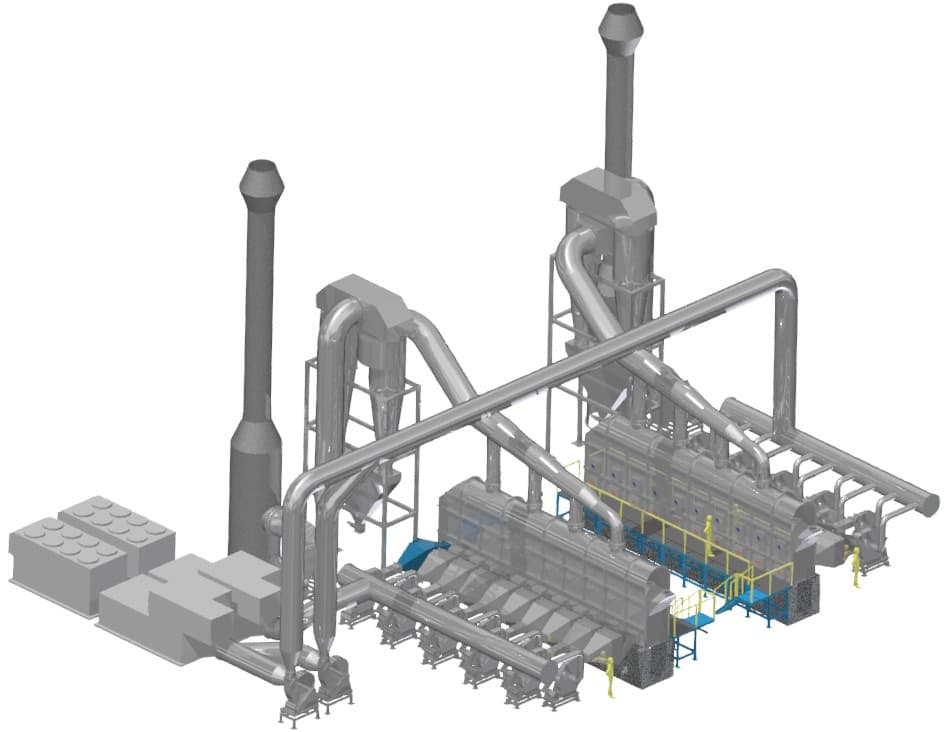
How a Static Indirectly Heated Fluidized Bed Dryer Works
In a static indirectly heated fluidized bed dryer the fluidization gas — typically air or nitrogen — is supplied at a comparatively low flow rate, just sufficient to achieve and maintain minimum fluidization velocity (u_mf). Because the gas serves only as a fluidizing medium rather than the primary heat carrier, the inlet gas temperature can remain near ambient or at a modest level (50–120°C), which is fundamentally different from convective dryers that must supply all drying energy through a high-temperature gas stream.
The heat required for evaporation is delivered instead through tube bundles immersed within the fluidized bed. Steam (up to 20 bar, ~210°C saturation), pressurised hot water or thermal oil (up to 320°C) flows inside the tubes; the turbulent particle suspension on the shell side achieves overall heat transfer coefficients U = 100–350 W/m²·K — substantially higher than in non-fluidized paddle or plate dryer configurations because the particles are continuously renewing contact with the tube surfaces.
Since exhaust gas volume is 60–80% lower than in a convective system, the downstream dust collection equipment (bag filter or cyclone) can be dramatically reduced in size — or, in a closed-loop inert gas circuit, the gas is recycled through a condenser to recover solvent, then recompressed and returned to the bed. This closed-loop N₂ design is the industry standard for products containing flammable solvents, enabling ATEX Zone 20 compliance within the vessel and Zone 21 at the perimeter.
Residence time in a continuous static FBD is controlled by weir height at the discharge end. Batch variants load a fixed charge, fluidize, heat the bed to target temperature and hold until moisture specification is met — typical batch cycles 30–120 minutes. Because the bed temperature is determined by the heating medium rather than the inlet gas, product temperature can be held within ±2°C of setpoint throughout the drying curve, avoiding both under-drying and thermal overshoot.
Quick Reference
Technical Specifications
All parameters are indicative ranges. Final sizing is determined by process simulation based on your specific material and throughput requirements.
Operating Parameters — Static Indirectly Heated Fluidized Bed Dryer
| Parameter | Value / Range | Note |
|---|---|---|
| Feed form | Free-flowing granules, crystalline solids, powders (d50 ≥ 80 µm) | Cohesive Geldart C powders require vibration assist |
| Particle size range | 80 µm – 6 mm | Below 80 µm: closed-loop with bag filter essential |
| Fluidization gas inlet temperature | 20–120°C (ambient to modest preheat) | Heat supplied by immersed tubes — gas acts only as fluidizing medium |
| Heating medium | Steam 3–20 bar (133–210°C sat.) or thermal oil up to 320°C | Thermal oil preferred for product temperatures > 150°C |
| Heat transfer coefficient U (immersed tubes) | 100–350 W/m²·K | Highest at u/u_mf ≈ 3–5; declines above due to bubble bypass |
| Specific energy consumption | 550–1,000 kcal/kg water evaporated | Lower end with steam condensate heat recovery; compare convective FBD 900–1,800 kcal/kg |
| Exhaust gas volume vs. convective FBD | 20–40% of convective system at same evaporation rate | Enables smaller bag filter / condenser; key advantage for solvent applications |
| Inlet moisture (feed) | 5–40% w/w | Higher moisture feeds may require pre-dewatering (centrifuge, filter press) |
| Outlet moisture (product) | 0.05–3% w/w | Sub-0.1% achievable with extended residence time or integrated fluid bed cooler-finisher |
| Bed temperature uniformity | ±2°C setpoint control | Product temperature tracks heating medium, not gas inlet — superior to convective dryers |
| Throughput (continuous units) | 50 kg/h – 5 t/h evaporation equivalent | Batch units 20–2,000 kg charge; limited by heat transfer area of tube bundle |
Convective FBD vs. Static Indirectly Heated FBD — Side-by-Side
| Parameter | Value / Range |
|---|---|
| Heat source | Convective: hot gas (80–600°C inlet) | Static: immersed tubes (steam / thermal oil) |
| Exhaust gas volume | Convective: high (sizing factor for downstream filter) | Static: 60–80% less |
| Solvent recovery (closed-loop N₂) | Convective: possible but large N₂ volumes | Static: preferred — small N₂ volume, compact condenser |
| Bed temperature control accuracy | Convective: limited by gas inlet control | Static: ±2°C — bed T tracks heating medium |
| CAPEX (same evaporation duty) | Convective: lower (simpler vessel, no tube bundle) | Static: higher (tube bundle, heat exchanger circuit) |
| Best-fit application | Convective: inorganic salts, fertilisers, food powders | Static: solvents, pigments, pharma APIs, flammable dusts |
Need a technical pre-sizing? Send us your material data sheet, moisture content, required throughput and energy source — we return a technical sizing with drum dimensions and energy balance within 2 business days.
→ Send process data on WhatsAppTypical Materials Processed
Reference data from industrial installations. Actual values depend on feed consistency, particle size distribution and required product quality.
| Material | Inlet moisture | Outlet moisture | Particle size | Gas temp. | Industry |
|---|---|---|---|---|---|
| Organic pigment (azo / phthalocyanine) | 15–35% | < 0.3% | 100 µm – 1 mm | 80–130°C bed | Pigments & Coatings |
| Pharmaceutical API (solvent-wet crystal cake) | 20–40% (IPA / EtOH / acetone) | < 0.5% | 200 µm – 2 mm | 50–80°C bed | Pharmaceutical |
| Ammonium nitrate / NPK fertiliser granules | 3–8% | < 0.3% | 1–3 mm prills | 60–84°C bed | Fertiliser |
| Fine chemical intermediate (chlorinated aromatic) | 10–25% (water + solvent blend) | < 0.1% | 300 µm – 3 mm | 70–110°C bed | Fine Chemicals |
| PVC (polyvinyl chloride) powder | 20–30% | < 0.3% | 80–250 µm | 55–70°C bed | Polymer / Plastics |
| Sodium bicarbonate (NaHCO₃) | 5–15% | < 0.1% | 150 µm – 1 mm | 50–65°C bed | Food / Pharmaceutical |
| Copper sulphate pentahydrate (CuSO₄·5H₂O) | 8–18% free water | < 1% free water | 0.5–5 mm crystals | 45–60°C bed | Agrochemicals / Mining |
| Activated carbon (post-wash regeneration) | 40–60% | < 5% | 0.5–4 mm granules | 120–200°C bed | Water Treatment / Chemicals |
Don't see your material? Send us your process data and we'll provide material-specific sizing.
System Variants
Continuous Static FBD — Open-Loop (Air)
Standard configuration for non-flammable, non-solvent materials. Ambient or lightly preheated air (20–80°C) fluidizes the bed; all drying heat is supplied by steam or thermal oil tube bundles. Exhaust air exits through a bag filter or cyclone. At identical evaporation duty the bag filter is 60–80% smaller than for a convective FBD. Suitable for inorganic salts, fertilisers, food-grade granules and pigments.
Continuous Static FBD — Closed-Loop N₂ (Solvent Recovery)
Preferred configuration for flammable solvents (ethanol, isopropanol, acetone, MEK, toluene) and ATEX Zone 20/21 applications. Nitrogen circulates in a closed loop through the vessel, a primary water-cooled condenser (10–15°C) and a secondary brine condenser (–10°C to –25°C) that drives solvent vapour below 25% LEL, then returns to the vessel plenum via recompressor. Recovered solvent purity ≥ 99.5% w/w. N₂ purge consumption at steady state only 1–5 Nm³/h — 10–50× less than a convective closed-loop system.
Batch Static FBD (GMP / Pharma)
Designed for pharmaceutical API and intermediate batch processing under cGMP. All product-contact surfaces in 316L SS with Ra ≤ 0.8 µm electropolished finish. Contained loading and discharge via isolator interfaces. CIP spray balls and WIP cycle with full drainability (3° slopes, zero dead legs). Automatic weigh cell monitoring for batch yield tracking. Complete electronic batch record compliant with 21 CFR Part 11 / EU Annex 11. Batch sizes 20–500 kg. Closed N₂ loop standard for solvent-wet APIs.
Selection Guide
Product contains flammable solvents (IPA, EtOH, acetone, toluene) and requires > 95% solvent recovery with ATEX Zone 20 compliance
Static FBD closed-loop N₂ — combines fluidized bed uniformity with compact closed-loop solvent condensation; 10–50× less N₂ make-up consumption than a convective closed-loop system at the same duty
Material is thermally sensitive in the 50–100°C range and requires bed temperature control tighter than ±5°C to avoid colour change, polymorphic conversion or decomposition
Static FBD — bed temperature follows heating medium setpoint at ±2°C; convective dryers with hot gas cannot provide this control at low product temperatures because gas inlet temperature must be substantially higher than product temperature
Product is a fine dust (d50 100–500 µm) requiring ATEX Zone 20/21 but without solvents — minimum exhaust gas volume needed to reduce dust collection equipment size and fugitive dust risk
Static FBD open-loop air — 60–80% smaller bag filter than convective FBD; reduced dust explosion risk from smaller duct volumes and lower gas velocities in the exhaust circuit
Material is free-flowing crystalline or granular (d50 ≥ 200 µm) at 5–40% inlet moisture and residual moisture uniformity (±0.2%) is more critical than maximum throughput
Static FBD preferred over paddle dryer — fluidization delivers particle-level mixing for ±0.2% moisture uniformity; paddle dryer has plug-flow axial mixing only and cannot achieve the same bed-wide uniformity
When NOT to Use a Static Fluidized Bed Dryer
Feed is a paste, filter cake or sludge with inlet moisture > 40% and poor flowability — cannot form free-flowing particles for fluidization
Required evaporation rate exceeds 5 t/h — heat transfer area of immersed tube bundle is the limiting factor at very large scale
Feed particle size is below 80 µm and material is cohesive (Geldart Group C) — will not fluidize freely even with vibration assist
Feed is a liquid (solution, slurry, suspension) requiring conversion to powder — fluidized beds of any type cannot accept liquid feed without a pre-forming step
Not sure which dryer is right for your process? We'll review your specifications and recommend the optimal solution.
Ask a technical question →Frequently Asked Questions
The energy efficiency advantage of a static FBD stems from two mechanisms operating simultaneously. First, heat transfer: in a convective FBD the inlet gas must carry all drying energy, so it must be heated to 80–600°C. The exhaust gas leaves at 50–120°C carrying significant sensible heat — this lost heat is the primary energy penalty. In a static FBD, heat enters via tube bundles at high efficiency (U = 100–350 W/m²·K); the gas is not heated and leaves near ambient, so exhaust sensible heat loss is negligible. Second, exhaust gas volume: because the gas only needs to fluidize the bed (not carry heat), the volumetric gas flow can be reduced to 20–40% of what a convective FBD requires for the same evaporation duty. This means: (a) the N₂ make-up for a closed-loop circuit is 60–80% lower, dramatically reducing compression and refrigeration duty; (b) the bag filter treating the exhaust can be 60–80% smaller. In practice, the combined effect is that a static FBD consumes 550–1,000 kcal/kg water evaporated versus 900–1,800 kcal/kg for a convective FBD — a saving of 30–50% on process energy. The saving matters most when: (i) steam is expensive relative to capital (the higher CAPEX of tube bundles amortises quickly); (ii) you have a closed-loop N₂ circuit (each Nm³/h of N₂ saved reduces compressor power and condenser refrigeration year-round); (iii) you process a temperature-sensitive material where the convective FBD would need a very large vessel to keep gas inlet temperature low.
From Our Projects
Related Equipment
Fluidized Bed Dryer
Convective FBD — higher throughput (> 5 t/h), lower CAPEX, no tube bundle; choose when solvent recovery and minimum gas volume are not required
View productPaddle Dryer
For pastes, sludges and cohesive feeds that cannot be fluidized; both use indirect heating but paddle handles non-free-flowing materials up to 80% inlet moisture
View productBag Filter
Required downstream for open-loop systems handling dusty products; 60–80% smaller than for a convective FBD at the same evaporation duty
View productFlash Dryer
Alternative for filter cakes and cohesive powders below 80 µm where indirect heating is not required and high throughput at lowest CAPEX is the priority
View productRequest a Quote for This Equipment
Include in your enquiry:
- →Solvent name, flash point and LEL (if applicable)
- →Feed particle size d10 / d50 / d90 and bulk density
- →Inlet moisture (% w/w wet basis) and target outlet moisture
- →Maximum allowable product temperature (°C)
- →Required throughput (kg/h feed or kg/h water evaporation)
- →Batch or continuous; desired batch cycle time if batch
- →Available heating medium: steam (bar) or thermal oil (°C)
- →ATEX zone classification at your site