Flash (Pneumatic) Dryer
From wet filter cake to dry powder in under 5 seconds — the fastest route from dewatering to finished product.
Flash dryers — also called pneumatic dryers or ring dryers — disperse wet feed into a high-velocity stream of hot gas, drying the particles almost instantaneously as they are conveyed through the drying duct. The entire drying event takes 1–5 seconds, making flash dryers uniquely suited to materials that would degrade under prolonged heat exposure. They handle filter cakes, centrifuge discharge, press cake and high-moisture crumbles that no other dryer technology can accept without pre-treatment. Lozzar Process supplies ring-type and straight-duct flash dryers, combined with disintegrators, cage mills and fluidized bed finishers to deliver complete drying solutions from dewatering through to packed product.
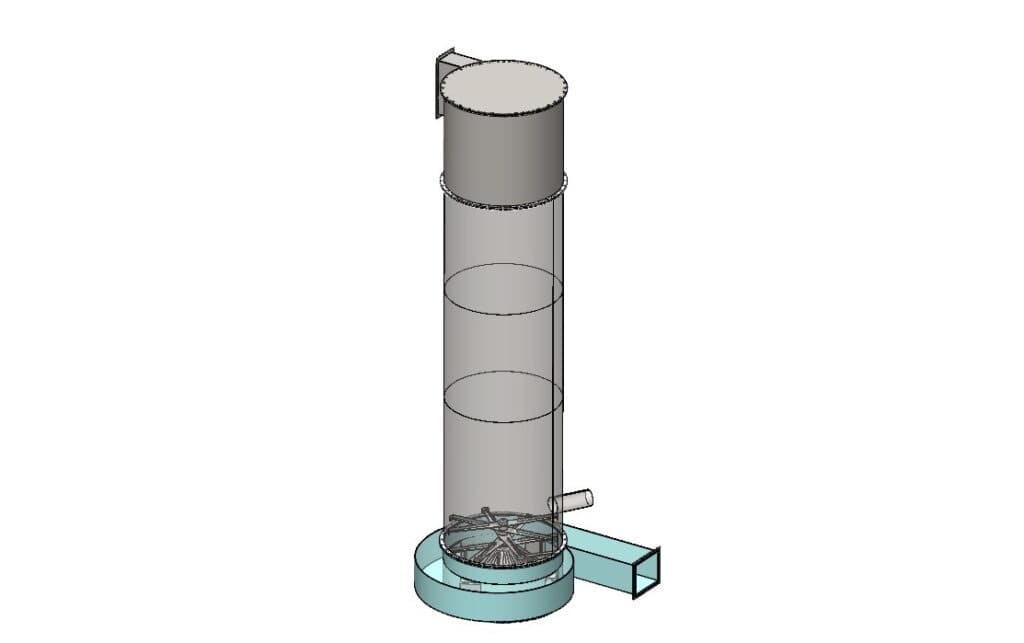
How a Flash Dryer Works
A flash dryer operates on pneumatic conveying combined with evaporative drying in a single continuous step. Wet feed — typically a filter cake, centrifuge cake or press cake containing 15–60% moisture — is introduced into a high-velocity hot gas stream (60–180 m/s in the duct) via a dispersing device: a cage mill, pin mill or disintegrator that simultaneously fragments the cake and exposes fresh surface area to the drying gas.
The key to flash drying efficiency is the extremely high gas-solid contact surface created by rapid dispersion. A 1 mm filter cake fragment has a surface area roughly 6,000 times larger than a 1 m³ block of the same material. In the hot gas stream at 60–180 m/s, surface moisture evaporates within a fraction of a second — the particle exit temperature rarely exceeds 50–80°C even though the inlet air temperature is 200–550°C, because evaporative cooling limits the product temperature during the drying phase.
In a straight-duct (pipe) flash dryer, the gas-particle stream travels 5–15 m vertically before entering the separation cyclone. In a ring (loop) dryer configuration, an annular duct allows fine/wet particles to be re-circulated and coarse/dry particles to exit at the classifier — this self-classification mechanism is standard for starch drying and results in exceptional outlet moisture uniformity without a separate classifier or screen.
After the drying duct, the gas-solid stream enters a cyclone separator where the dried product is collected and the exhaust gas passes to a bag filter for fine particle recovery. Flash drying is almost always followed by a product cooler or fluid bed cooler, since product exits at 40–80°C and most bulk materials must be cooled to 30–45°C before packaging.
Quick Reference
Technical Specifications
All parameters are indicative ranges. Final sizing is determined by process simulation based on your specific material and throughput requirements.
Flash Dryer — Operating Parameters
| Parameter | Value / Range | Note |
|---|---|---|
| Feed form | Filter cake / centrifuge cake / press cake / crumble | Must be dispersible: friable lumps disintegrate in cage mill; plastic/sticky pastes require pre-conditioning |
| Inlet moisture content | 10 – 60% w/w | Most efficient at 20–45%; above 50% requires back-mixing (dry product blended with wet feed to improve dispersibility) |
| Outlet moisture content | 0.1 – 5% w/w | Surface moisture only; bound moisture removal limited — below 1% w/w bound moisture requires fluid bed finishing step |
| Inlet hot gas temperature | 150 – 600°C | Higher inlet temperatures enable lower gas volume flow and smaller duct diameter — limited by product heat sensitivity |
| Gas velocity in drying duct | 15 – 30 m/s (ring dryer: 25–50 m/s) | Must exceed terminal velocity of largest particle to maintain pneumatic transport; ring dryer higher velocity enables classifier separation |
| Residence time in dryer duct | 0.5 – 5 seconds | Ring dryer: 15–60 seconds (recirculation loop); straight duct: 0.5–3 seconds — product rarely exceeds 60–80°C despite high inlet gas temperatures |
| Throughput range | 200 kg/h – 20 t/h (dry product) | |
| Specific energy consumption | 1 000 – 2 500 kcal/kg water evaporated | Higher than fluid bed due to large gas volume; partial heat recovery from exhaust can reduce to 800–1800 kcal/kg |
| Outlet product temperature | 40 – 80°C | Controlled by outlet gas temperature (typically 80–120°C); product temperature ≈ wet bulb temperature of exit gas during drying phase |
| Particle size after drying | 10 µm – 3 mm | Determined by disintegrator/cage mill setting; ring dryer provides tighter PSD via built-in classification |
| Dust loading at cyclone inlet | 50 – 500 g/Nm³ | High loading typical — always requires cyclone primary separation + bag filter; product loss via uncollected fines can be 2–8% without bag filter |
Ring Dryer vs. Straight-Duct Flash Dryer — Comparison
| Parameter | Value / Range | Note |
|---|---|---|
| Outlet moisture uniformity | Straight: ±2–5% | Ring: ±0.5–1% | Ring dryer classifier retains coarser/wetter particles for additional drying passes |
| Outlet particle size control | Straight: limited | Ring: precise (adjustable classifier) | |
| Feed variability tolerance | Straight: sensitive | Ring: robust (classifier buffers variation) | |
| Installed height requirement | Straight: 12–25 m | Ring: 8–15 m | Ring dryer more compact due to recirculation loop; significant civil cost saving for tall buildings |
| Typical CAPEX | Straight: lower (–20–30%) | Ring: higher but better performance | |
| Best application | Straight: minerals, bulk chemicals | Ring: starch, fine chemicals, pharma intermediates |
Need a technical pre-sizing? Send us your material data sheet, moisture content, required throughput and energy source — we return a technical sizing with drum dimensions and energy balance within 2 business days.
→ Send process data on WhatsAppMaterial Database — Flash Drying Applications
Reference data from industrial installations. Actual values depend on feed consistency, particle size distribution and required product quality.
| Material | Inlet moisture | Outlet moisture | Particle size | Gas temp. | Industry |
|---|---|---|---|---|---|
| Wheat starch (filter cake) | 35–42% | <14% | 5–25 µm | 130–180°C inlet | Food / Starch |
| Kaolin clay (filter press cake) | 20–30% | <1% | 0.5–10 µm | 400–550°C inlet | Minerals / Ceramics |
| Titanium dioxide (TiO₂) | 25–40% | <0.5% | 0.2–1 µm | 300–450°C inlet | Pigments / Coatings |
| Calcium carbonate (precipitated) | 30–50% | <0.3% | 1–15 µm | 250–400°C inlet | Chemical / Minerals |
| PVC (suspension grade, centrifuge cake) | 22–28% | <0.3% | 80–250 µm | 130–160°C inlet | Plastics |
| Sodium sulphate (centrifuge cake) | 5–12% | <0.1% | 0.2–2 mm | 200–350°C inlet | Chemical |
| Iron oxide pigment (filter cake) | 40–55% | <1% | 0.1–2 µm | 300–500°C inlet | Pigments |
| Calcium phosphate (dibasic) | 20–35% | <0.5% | 5–50 µm | 200–350°C inlet | Food / Pharma |
Don't see your material? Send us your process data and we'll provide material-specific sizing.
Flash Dryer System Configurations
Straight-Duct (Pipe) Flash Dryer
Vertical drying duct 10–20 m tall, with hot air generator at the base, disintegrator/cage mill at the feed point, and cyclone + bag filter at the top. Simplest configuration, lowest CAPEX. Product residence time 0.5–3 seconds — suitable for materials with predominantly surface moisture.
Ring (Loop / Toroidal) Flash Dryer
Annular closed-loop drying duct with an internal classifier (adjustable paddle wheel or vane classifier) separating dry/fine particles (discharged to product cyclone) from coarse/wet particles (re-circulated for additional drying passes). Self-regulating: feed variations are buffered by the recirculation loop, giving consistent outlet moisture without manual adjustment. More compact building height than straight duct.
Flash Dryer + Fluid Bed Finisher (Combined System)
Flash dryer removes the bulk of surface moisture (inlet 30–60% → intermediate 5–15%), then the fluid bed finisher removes the remaining moisture to final target (<2% or as specified) and cools the product. The combined system achieves what neither unit can alone: flash dryer handles high inlet moisture and disperses cake feeds; fluid bed achieves tight final moisture uniformity (±0.2%) and reduces product temperature to 35–45°C before packaging.
When to Choose a Flash Dryer
Feed is a filter cake, centrifuge cake or press cake (not free-flowing)
Flash dryer is the only dryer that can accept lump/cake feeds without pre-dispersion equipment (the integrated disintegrator handles this). Fluid bed and belt dryers cannot accept cake feeds directly.
High inlet moisture (20–60%) and predominantly surface moisture
Flash drying excels at removing surface moisture from high-moisture feeds at maximum throughput. The short residence time means no over-drying risk. For bound moisture removal below 1%, follow with a fluid bed finishing step.
Particle size reduction simultaneously with drying is desired
The cage mill or disintegrator at the flash dryer inlet performs drying and grinding in a single step. For kaolin, TiO₂, calcium carbonate — the dried product particle size is determined by the mill setting, eliminating downstream grinding.
Building height is limited — ring dryer more compact than rotary dryer
Ring flash dryers operate within 8–15 m building height vs. 6–10 m for the dryer body of a comparable rotary drum (but 2–3 m larger diameter making the footprint similar). The self-classifying ring dryer particularly suits retrofit installations inside existing buildings.
Product is heat-sensitive but inlet moisture is very high (>25%)
Flash drying achieves product temperatures of only 40–70°C despite very high inlet air temperatures (200–450°C), because evaporative cooling dominates during moisture removal. This thermal protection is unique to flash drying and cannot be replicated in belt or rotary dryers at equivalent moisture removal rates.
When NOT to Use a Flash Dryer
Material has significant bound moisture (<1% w/w outlet target) — flash drying only removes surface moisture efficiently
Coarse, non-dispersible lumps (>20 mm) or highly plastic/sticky paste that cannot be disintegrated
Very coarse granules (d50 > 3 mm) requiring drying without size reduction
Free-flowing granules with tight particle size specification and outlet moisture uniformity < ±1%
Not sure which dryer is right for your process? We'll review your specifications and recommend the optimal solution.
Ask a technical question →Flash Dryer — Engineering FAQ
Flash dryers operating with air can be designed for explosive dust environments (ATEX Zone 20/21/22) with explosion relief venting per NFPA 68/EN 14491, full electrostatic bonding and grounding, and inert gas purging options. For flammable solvent-bearing feeds, the standard approach is a closed-loop nitrogen inert gas circuit: the drying gas (N₂) is recirculated, solvent vapour is recovered in a condenser, and makeup N₂ replaces the small purge stream. O₂ concentration is maintained below the LOC (typically <2% v/v for organic solvents). This closed-loop design also allows solvent recovery for re-use — important both from a cost and regulatory (VOC emission) perspective. Lozzar has experience with pharmaceutical intermediates containing residual IPA, ethanol and acetone, and designs the closed-loop system with solvent balance calculations and SIL-rated safety interlocks.
From Our Projects
Related Equipment
Fluidized Bed Dryer
Pair with fluid bed dryer as a finisher — flash removes bulk moisture from filter cake, fluid bed achieves final target moisture (<1%) and cools product: the industry-standard two-stage drying system for PVC, starch and fine chemicals
View productRotary Dryer
Use rotary dryer for coarse granular minerals (d50 > 5 mm) or very large throughputs (>20 t/h) where particle integrity must be maintained and size reduction is not desired
View productSpray Dryer
Use spray dryer when feed is a liquid (solution or slurry) rather than a solid/cake — spray drying creates particle morphology from liquid feeds, whereas flash drying processes solid cake feeds
View productBag Filter
Bag filter mandatory downstream — flash dryers generate high exhaust dust loading (50–500 g/Nm³); cyclone pre-separator + bag filter package is standard on all Lozzar flash dryer systems
View productRequest a Quote for This Equipment
Include in your enquiry:
- →Feed form: filter cake / centrifuge cake / press cake / crumble (not free-flowing granule)
- →Inlet moisture content (% w/w) — is moisture predominantly surface or bound/hygroscopic?
- →Target outlet moisture (% w/w) and allowable tolerance
- →Required throughput: wet feed kg/h or dry product kg/h
- →Heat source: gas (fuel type), steam (bar g), hot oil — inlet temperature capability
- →Particle size of dried product required (d50 target or product specification)
- →ATEX zone classification, dust Kst class, or flammable solvent content (closed-loop N₂ required?)