Paddle Dryer (Indirect Heated)
Minimum energy, minimum exhaust gas, maximum temperature control — the precision dryer for difficult wet feeds.
Paddle dryers use indirectly-heated hollow paddle shafts to transfer heat by conduction directly to the wet product — without the large volumes of hot gas required by convective dryers. This indirect heating approach delivers three unique advantages: specific energy consumption as low as 500–700 kcal/kg (the lowest of any continuous dryer), minimal exhaust gas volume (typically 90–95% less than a comparable convective dryer), and the ability to handle pastes, sludges, plastic masses and filter cakes that cannot be fluidized or conveyed pneumatically. Lozzar Process supplies single-shaft and twin-shaft paddle dryers in SS 304, SS 316L, carbon steel and special alloys, with steam, thermal oil or hot water heating circuits and vacuum drying capability for solvent recovery applications.
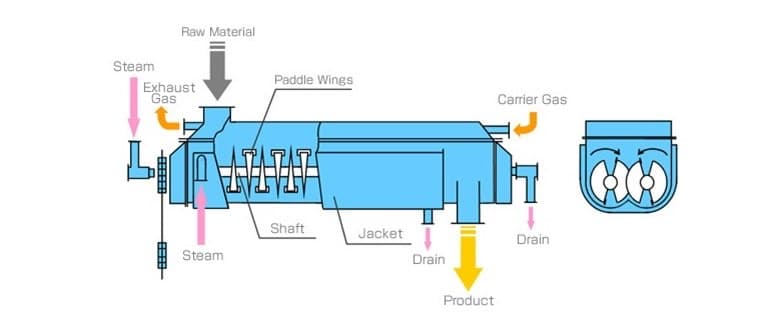
How a Paddle Dryer Works
A paddle dryer consists of a trough-shaped housing with one or two horizontal rotating shafts carrying wedge-shaped hollow paddles. The shaft interior and paddles are connected to a heating medium circuit (steam, hot water or thermal oil at 80–350°C), converting the shaft-paddle assembly into an extended heated surface with intimate contact with the wet material.
As the paddles rotate (3–30 RPM), they simultaneously convey the material slowly along the trough from the feed end to the discharge end, and continuously expose fresh material surfaces to the heated paddle faces. The wedge shape of the paddles is specifically designed to avoid material accumulation on paddle faces — the leading edge of each paddle cuts into the material bed, and the trailing face lifts and turns the material, providing self-cleaning action while maximising heat transfer surface utilisation.
Heat transfer in a paddle dryer is predominantly by conduction (paddle surface to product particle) — fundamentally different from convective dryers where the gas phase carries both heat and moisture. This means the exhaust gas volume is only what is needed to carry away the evaporated moisture, not to provide the drying energy. A paddle dryer evaporating 1,000 kg/h water requires only 200–400 m³/h of exhaust gas vs. 30,000–80,000 m³/h for a comparable convective dryer — dramatically reducing the size of downstream gas treatment equipment (cyclone, bag filter, scrubber).
For vacuum operation, the trough is sealed and connected to a vacuum system. Evaporation occurs at sub-atmospheric pressure (typically 50–200 mbar abs), reducing the boiling point of water to 33–60°C — enabling drying of thermolabile materials at product temperatures of 40–70°C, or complete recovery of organic solvents from wet feeds.
Twin-shaft (bi-lobe) designs provide more intensive mixing and higher heat transfer coefficients vs. single-shaft, at the cost of higher mechanical complexity. Twin-shaft units are preferred for very sticky or doughy materials that tend to form lumps in single-shaft designs.
Quick Reference
Technical Specifications
All parameters are indicative ranges. Final sizing is determined by process simulation based on your specific material and throughput requirements.
Paddle Dryer — Operating Parameters
| Parameter | Value / Range | Note |
|---|---|---|
| Feed form accepted | Paste / sludge / filter cake / granule / powder | Widest feed flexibility of any dryer: handles non-flowable pastes, sticky sludges, plastic masses and dry granules in the same unit |
| Heating medium | Steam (up to 20 bar) / thermal oil (up to 350°C) / hot water | Paddle surface temperature: 100–330°C; product temperature typically 20–60°C below paddle surface due to thermal resistance through product layer |
| Inlet moisture content | 10 – 80% w/w | Handles very high moisture feeds (50–80%) that cannot be fed to rotary or fluid bed dryers without pre-dewatering |
| Outlet moisture content | <0.1 – 5% w/w | Atmospheric operation: <0.5% achievable; vacuum operation: <0.05% possible for highly hygroscopic materials |
| Specific energy consumption | 500 – 900 kcal/kg water evaporated | Lowest of all dryer types — indirect heating efficiency; steam-heated units approach thermodynamic minimum (540 kcal/kg latent heat) |
| Exhaust gas volume | 0.5 – 3 kg gas/kg water evaporated | 90–95% less exhaust gas than convective dryers; significantly reduces downstream gas treatment equipment size and cost |
| Heat transfer coefficient (U) | 50 – 200 W/m²·K | Lower than convective fluid bed (1000–4000 W/m³·K) but paddle dryers compensate with larger heat transfer area per unit volume |
| Throughput range | 100 kg/h – 10 t/h (continuous) | Shaft length 1–8 m; single shaft effective area 2–30 m²; twin shaft up to 60 m² per unit; multiple units in parallel for higher capacity |
| Vacuum operation capability | 20 – 500 mbar absolute | Enables drying at 60–80°C product temperature for thermolabile materials; allows solvent recovery by condensation |
| Material of construction | CS / SS 304 / SS 316L / Duplex / Hastelloy C276 | Shaft and paddles must withstand heating medium pressure (up to 20 bar steam) plus product torque loads; special alloys for corrosive slurries |
Single-Shaft vs. Twin-Shaft Paddle Dryer
| Parameter | Value / Range | Note |
|---|---|---|
| Heat transfer area per unit volume | Single: 80–120 m²/m³ | Twin: 120–180 m²/m³ | |
| Mixing intensity | Single: moderate | Twin: high (counter-rotating shafts) | Higher mixing reduces local hot spots and improves moisture uniformity for difficult sticky materials |
| Suitable for plastic/sticky feeds | Single: moderate | Twin: ✓ excellent | |
| Maintenance complexity | Single: low | Twin: moderate (shaft alignment, rotary joints) | |
| CAPEX | Single: baseline | Twin: +30–50% |
Need a technical pre-sizing? Send us your material data sheet, moisture content, required throughput and energy source — we return a technical sizing with drum dimensions and energy balance within 2 business days.
→ Send process data on WhatsAppMaterial Database — Paddle Drying Applications
Reference data from industrial installations. Actual values depend on feed consistency, particle size distribution and required product quality.
| Material | Inlet moisture | Outlet moisture | Particle size | Gas temp. | Industry |
|---|---|---|---|---|---|
| Municipal wastewater sludge (dewatered) | 70–80% | 10–25% | Paste / crumble | 150–200°C paddle | Wastewater Treatment |
| Polymer sludge (latex coagulate) | 40–60% | <0.5% | Paste / granule after drying | 120–160°C paddle | Plastics / Polymers |
| Cellulose acetate (acetic acid bearing) | 30–45% (solvent basis) | <0.5% | 0.5–3 mm crumble | 90–130°C paddle (vacuum) | Specialty Chemicals |
| Pharmaceutical API wet granulate | 20–35% | <2% | 0.1–2 mm | 60–80°C paddle (vacuum) | Pharmaceuticals |
| Potato starch (wet from centrifuge) | 38–45% | <18% (commercial grade) | 5–30 µm (after drying) | 80–120°C paddle | Food / Starch |
| Industrial salt (NaCl, wet from centrifuge) | 2–5% | <0.05% | 0.1–3 mm crystal | 130–180°C paddle | Chemical / Food |
| Bentonite (mining grade, filter cake) | 30–40% | <8% | Plastic cake → granule | 150–220°C paddle | Minerals / Drilling |
| Organic dye intermediate (filter press cake) | 25–40% | <1% | Cake / granule | 100–150°C paddle | Specialty Chemicals |
Don't see your material? Send us your process data and we'll provide material-specific sizing.
Paddle Dryer Configurations
Single-Shaft Paddle Dryer (Atmospheric)
Standard configuration. Single hollow shaft with wedge paddles, trough housing, steam or thermal oil heated. Best value for non-sticky, non-cohesive materials with inlet moisture up to 50%. Lowest capital cost, simplest maintenance. Shaft length 1–8 m, heat transfer area 2–30 m². Used for: salt, sugar, inorganic chemicals, mineral sludges, wastewater sludge with prior dewatering to <75% moisture.
Twin-Shaft Paddle Dryer (Atmospheric)
Two counter-rotating shafts provide intensive mixing action that prevents lump formation in sticky, cohesive or high-moisture plastic feeds. The counter-rotating paddles continuously break up agglomerates and present fresh surfaces to the heating area. Heat transfer area 4–60 m² per unit. Standard for polymer sludges, cellulosic materials, biological sludge and other difficult feeds where single-shaft designs produce uneven drying or lump accumulation.
Vacuum Paddle Dryer
The trough housing is made vacuum-tight (full vacuum or partial vacuum, 20–500 mbar abs). Vapour from the drying product is drawn out by a vacuum pump and condensed in a surface condenser — enabling solvent recovery. Operating at 50–200 mbar abs, water boils at 33–60°C, allowing drying of thermolabile materials (APIs, enzymes, vitamins) at product temperatures of 40–70°C. Also used for drying of organic solvent-bearing feeds under inert atmosphere. The vacuum system adds cost but eliminates downstream bag filter and fan requirements (no exhaust gas flow).
When to Choose a Paddle Dryer
Feed is a paste, sludge or non-flowable wet mass
Paddle dryers are the only continuous dryer that reliably processes non-flowable, plastic, sticky materials without pre-treatment. The paddle action both conveys and mixes such feeds throughout the drying cycle.
Minimum energy consumption is the top priority (energy cost per tonne of product)
Paddle dryers at 500–700 kcal/kg use 30–50% less energy than equivalent rotary or fluid bed dryers (800–1,800 kcal/kg) and 75–85% less than spray dryers. For high-volume commodity products (salts, sludge, starches) this difference represents millions of euros in annual energy cost savings.
Product is thermolabile or requires drying below 80°C
Vacuum paddle dryers achieve product temperatures of 40–70°C with excellent thermal uniformity. Unlike spray dryers, residence time is 30–180 minutes allowing even bound moisture removal at very low temperatures — achieving <0.1% moisture with no thermal damage.
Organic solvent recovery is required (closed system)
Vacuum paddle dryers operate in a fully closed system. Solvent vapour is drawn from the sealed trough by a vacuum pump and condensed in a surface condenser — collecting solvent for reuse and preventing atmospheric emission. The paddle dryer is often the preferred system for pharmaceutical drying under GMP where organic solvent limits in the final product are tightly regulated.
When NOT to Use a Paddle Dryer
Very high throughput (>15 t/h dry product) — paddle dryers are limited in scale vs. rotary dryers
Free-flowing granules or powders (d50 50 µm–5 mm) requiring fast, uniform drying
Coarse minerals, aggregates or biomass (d50 > 5 mm) requiring high-temperature drying (>300°C)
Liquid feed (solution, slurry, emulsion) requiring conversion to powder in one step
Not sure which dryer is right for your process? We'll review your specifications and recommend the optimal solution.
Ask a technical question →Paddle Dryer — Engineering FAQ
Paddle dryers can accept feeds up to 80–85% moisture content — close to the maximum achievable by mechanical dewatering (centrifuge cake or filter press cake at 75–80% moisture). There is no theoretical lower limit on material flowability: a paddle dryer can process non-flowable, plastic, sticky masses that resist any other drying technology without pre-treatment. In practice, the critical design consideration is the "sticky phase" transition: as wet paste dries, it typically passes through a sticky/cohesive intermediate stage (approximately 20–40% moisture for most organic materials) where material tends to agglomerate and adhere to paddle surfaces and housing walls. Twin-shaft designs with wiping paddle geometries overcome this by continuously shearing and breaking agglomerates. The designer must ensure sufficient heat transfer area before the sticky zone to carry the material through this transition without plugging. Lozzar characterises the drying curve (including sticky zone identification) for all new materials in our test facility before finalising paddle dryer design.
From Our Projects
Related Equipment
Flash Dryer
Flash dryer as alternative for filter cakes that can be disintegrated — higher throughput but requires dispersible feed; paddle dryer preferred for non-dispersible pastes and when minimum exhaust gas is required
View productFluidized Bed Dryer
Fluidized bed dryer for granular materials that don't need the paste-handling capability of a paddle dryer — better moisture uniformity and shorter residence time for free-flowing particles
View productRotary Dryer
Rotary dryer for very large throughputs (>15 t/h) or coarse granular materials — lower installed cost per t/h at high capacity, but higher energy consumption than paddle dryer
View productEvaporator
Pre-concentrate high-moisture liquid feeds (>85% moisture) to 50–75% moisture by evaporation before paddle drying — reduces paddle dryer size and operating cost proportionally
View productRequest a Quote for This Equipment
Include in your enquiry:
- →Feed form: paste, sludge, filter cake, or granule? (can it flow, or is it plastic/non-flowable?)
- →Inlet moisture content (% w/w) and moisture type (free surface moisture or bound/hygroscopic)
- →Target outlet moisture (% w/w) — and is vacuum operation preferred for temperature-sensitive material?
- →Required throughput: wet feed kg/h or evaporation rate kg H₂O/h
- →Heating medium available: steam (bar g), thermal oil (max °C), or hot water
- →Material properties: sticky? Abrasive? Corrosive? Contains organic solvents (solvent recovery needed)?
- →Temperature limit of product (°C) — determines if atmospheric or vacuum design is required