Spray Dryer
From liquid to free-flowing powder in a single step — the definitive solution for liquid feed drying at any scale.
Spray dryers are the only industrial drying technology that converts liquid feed — solutions, slurries, emulsions, suspensions — directly into a dry, free-flowing powder in a single continuous operation. Atomisation creates millions of microdroplets per second with enormous surface area; hot gas evaporates the liquid phase in milliseconds, leaving solid particles with tightly controlled size, bulk density and moisture. From infant formula and instant coffee to ceramic powders, pharmaceutical excipients and detergent granules, spray drying defines product form and performance for over 200 industrial product categories. Lozzar Process supplies rotary atomiser, two-fluid nozzle and pressure nozzle spray dryer systems, with integrated fluid bed finishers and proprietary energy recovery designs.
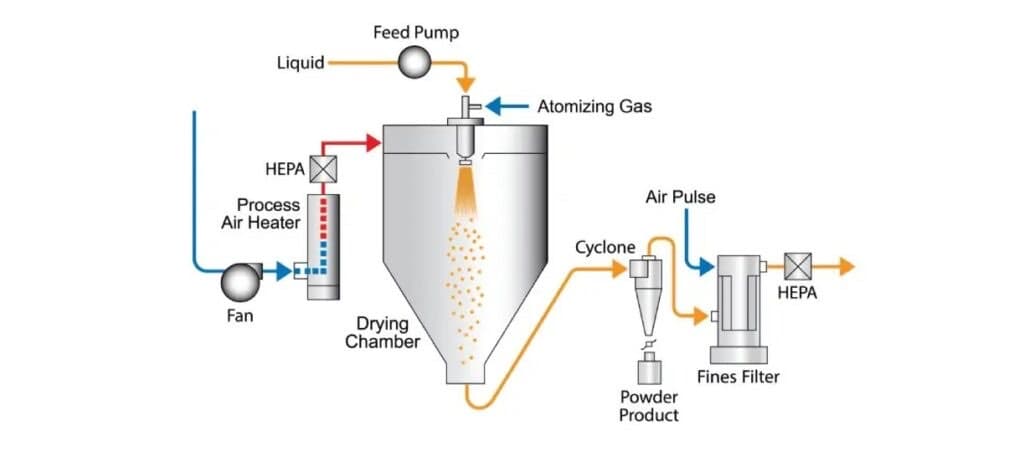
How a Spray Dryer Works
A spray dryer consists of four functional sections operating in continuous sequence: feed atomisation, gas-droplet contact, droplet drying, and product/gas separation.
In atomisation, the liquid feed is broken into a fine dispersion of droplets (d10–d90 typically 10–300 µm depending on atomiser type and feed viscosity). Three atomiser technologies serve different applications: (1) Rotary (spinning disc) atomisers — a disc spinning at 10,000–25,000 rpm generates droplets by centrifugal force; produces the narrowest size distribution and handles feeds up to 70% solids including abrasive slurries; (2) Two-fluid (pneumatic) nozzles — compressed air or steam shatters the liquid into fine droplets; lower capacity per nozzle, suited to small-scale and laboratory dryers; (3) Pressure (hydraulic) nozzles — feed is pressurised to 50–500 bar and forced through a small orifice; produces the largest droplets (100–500 µm) and is standard for detergents and coarse powder applications.
The atomised spray enters the drying chamber co-currently with hot gas (inlet 150–350°C for food/pharma; up to 600°C for ceramics). The enormous gas-droplet contact surface (1 kg of 100 µm droplets has ~600 m² surface area) drives moisture evaporation within 0.1–30 seconds. Particle exit temperatures are 60–120°C despite much higher gas inlet temperatures — evaporative cooling again limits product temperature. The fundamental spray drying equation: outlet gas temperature = f(inlet temperature, evaporation load, gas flow, chamber geometry) — this is the primary control variable.
Dried particles fall to the chamber cone and are discharged via a rotary valve, or are carried by the gas stream to a cyclone separator. A downstream bag filter captures the fine fraction not collected by the cyclone — typically 15–35% of total production depending on particle size. An integrated or downstream fluid bed finishing stage further reduces moisture (to <1% w/w) and reduces powder temperature to 35–45°C for packaging.
Quick Reference
Technical Specifications
All parameters are indicative ranges. Final sizing is determined by process simulation based on your specific material and throughput requirements.
Spray Dryer — Key Operating Parameters
| Parameter | Value / Range | Note |
|---|---|---|
| Feed form | Solution / slurry / emulsion / suspension | Feed solids content: 10–70% w/w; viscosity limit: <10,000 cP for pressure nozzles, <50,000 cP for rotary atomiser |
| Inlet gas temperature | 150 – 600°C | Food/pharma: 150–250°C; detergent/inorganic chemicals: 250–400°C; technical ceramics: up to 600°C |
| Outlet gas temperature | 70 – 120°C | Primary control variable for outlet moisture; lower outlet T = lower outlet moisture but risk of wall deposition |
| Outlet product moisture | 1 – 8% w/w | Below 3% w/w requires fluid bed finishing stage; highly hygroscopic products may need closed-loop dehumidified air |
| Product particle size (d50) | 10 – 500 µm | Rotary atomiser: 50–200 µm; two-fluid nozzle: 10–80 µm; pressure nozzle: 100–500 µm; controlled by atomiser speed/pressure and feed concentration |
| Bulk density of powder | 150 – 800 kg/m³ | Controlled by feed solids concentration, atomiser type and chamber air flow pattern; hollow sphere morphology gives lower density |
| Evaporation capacity | 10 kg/h – 50 000 kg/h | Lab/pilot: 10–100 kg/h; pilot-scale: 100–500 kg/h; production: 500–50,000 kg/h — chamber diameter 1–18 m |
| Specific energy consumption | 2 500 – 4 000 kcal/kg water evaporated | Higher than all other dryer types; offset by unique ability to create controlled particle morphology from liquid feed |
| Chamber wall temperature (product contact) | 80 – 150°C | Critical for heat-sensitive materials — Lozzar designs with insulated walls and controlled air sweep to minimise wall deposition |
| Material of construction | SS 304 / SS 316L / Duplex / Carbon steel | Food/pharma: SS 316L, electropolished; detergent: carbon steel; ceramics/abrasive slurries: SS 316L with wear-resistant liners in high-velocity zones |
Atomiser Type Comparison
| Parameter | Value / Range | Note |
|---|---|---|
| Rotary disc atomiser | d50: 50–200 µm | Span: narrow | Feed solids: up to 70% | Abrasive: ✓ | Best for high-solids, abrasive, viscous feeds; widest operational flexibility; highest CAPEX |
| Two-fluid (pneumatic) nozzle | d50: 10–80 µm | Span: wide | Feed solids: up to 50% | Abrasive: limited | Smallest particles; highest compressed air consumption (energy penalty); suited to small-scale, lab and pharmaceutical |
| Pressure (hydraulic) nozzle | d50: 100–500 µm | Span: moderate | Feed solids: up to 60% | Abrasive: limited | Coarsest product; detergent industry standard; low compressed air cost; nozzle wear with abrasive feeds |
Need a technical pre-sizing? Send us your material data sheet, moisture content, required throughput and energy source — we return a technical sizing with drum dimensions and energy balance within 2 business days.
→ Send process data on WhatsAppMaterial Database — Spray Drying Applications
Reference data from industrial installations. Actual values depend on feed consistency, particle size distribution and required product quality.
| Material | Inlet moisture | Outlet moisture | Particle size | Gas temp. | Industry |
|---|---|---|---|---|---|
| Infant formula (whole milk base) | 55–65% (as feed liquid) | 2.5–3.5% | 100–200 µm | 170–190°C inlet | Food / Dairy |
| Instant coffee (extract) | 70–75% (as feed liquid) | 2–4% | 150–300 µm | 200–240°C inlet | Food / Beverage |
| Detergent powder (STPP slurry) | 35–45% (as feed slurry) | <5% | 200–500 µm | 300–400°C inlet | Consumer Chemicals |
| Alumina (Al₂O₃) ceramic powder | 60–75% (as aqueous suspension) | <0.5% | 50–150 µm | 450–600°C inlet | Technical Ceramics |
| Whole egg powder | 73–77% (as liquid egg) | <5% | 80–200 µm | 155–175°C inlet | Food / Ingredient |
| Maltodextrin / glucose syrup | 60–70% (as solution) | <5% | 50–150 µm | 160–200°C inlet | Food / Starch derivatives |
| API (active pharmaceutical ingredient) | 80–95% (as solution or suspension) | <2% | 1–50 µm | 130–160°C inlet | Pharmaceuticals |
| Silica (precipitated, aqueous slurry) | 85–92% (as slurry) | <6% | 20–100 µm | 250–350°C inlet | Chemical / Rubber |
Don't see your material? Send us your process data and we'll provide material-specific sizing.
Spray Dryer Configurations
Single-Stage Spray Dryer
Classic configuration: liquid feed in, dry powder out from chamber cone and cyclone. Product exits at 60–120°C and must be cooled before packaging. Outlet moisture typically 3–8% w/w. Suitable for non-hygroscopic products not requiring very low final moisture.
Two-Stage Spray Dryer + Integrated Fluid Bed (IFB)
An annular fluid bed built into the chamber cone receives the partially dried spray particles (still 5–15% moisture) and completes drying + cooling before discharge. The IFB enables lower spray dryer outlet gas temperature (energy saving) and simultaneous agglomeration of fine particles into larger, more dispersible granules — the industry standard for instant food products. Product characteristics: lower fines content, better dispersibility, lower dust in the final product, controlled bulk density.
Closed-Loop Spray Dryer (N₂ Inert Gas Circuit)
Nitrogen replaces air as the drying gas; the circuit is closed, with solvent vapour removed by a condenser (for recovery) rather than venting to atmosphere. O₂ concentration maintained <2% v/v. Mandatory for feeds containing organic solvents (ethanol, acetone, IPA, methylene chloride) or for oxygen-sensitive active materials. Solvent recovery value can significantly offset the additional capital cost of the closed-loop system.
When to Choose a Spray Dryer
Feed is a liquid: solution, slurry, emulsion or suspension
Spray drying is the only continuous dryer that accepts liquid feeds directly. All other dryers require solid or semi-solid feed — if your process produces a liquid, spray drying eliminates a dewatering step.
Particle morphology must be controlled (bulk density, sphericity, dispersibility)
Spray drying is the only technology that creates defined particle shapes from liquid feeds. Critical for instant food products (rapidly dissolving powder), pharmaceutical inhalation powders (controlled aerodynamic diameter), and ceramics pressing powders (controlled green density).
Product requires encapsulation or surface coating of active components
Spray drying can encapsulate oil droplets, flavours, vitamins and sensitive actives in a wall material (maltodextrin, gum arabic, modified starch) in a single step — producing microencapsulated powders with extended shelf life and controlled release.
Feed solids concentration is low (10–30%) and dewatering is not cost-effective
For dilute solutions and extracts, mechanical dewatering (filtration, centrifugation) may not be feasible before the product phase. Evaporation to concentrate + spray dry is the standard route for low-solids liquid feeds in food and pharmaceutical processing.
When NOT to Use a Spray Dryer
Feed is already a solid, powder, granule, or filter cake (not liquid or pumpable slurry)
High throughput (>20 t/h dry product) with low product value — energy cost (2,500–4,000 kcal/kg) prohibitive
Coarse granular product required (d50 > 500 µm) without agglomeration step
Very high outlet moisture requirement is not achievable (<1% w/w) without additional downstream finishing
Not sure which dryer is right for your process? We'll review your specifications and recommend the optimal solution.
Ask a technical question →Spray Dryer — Engineering FAQ
Atomiser selection depends on feed properties, required particle size, scale and abrasiveness: Rotary disc: choose when feed contains abrasive particles (ceramics, minerals), solids content exceeds 50%, feed composition or viscosity varies significantly, or the widest operational flexibility is needed. Disc speed controls d50: faster = finer. Scale: very large production units (>10 t/h water evaporation) typically use rotary atomisers because a single disc handles the full capacity without multiple nozzle manifolds. Two-fluid nozzle: choose when very fine powder is needed (d50 < 50 µm), for small-scale or pilot-scale dryers, or in pharmaceutical applications where nozzle cleanliness and sterility are paramount. High compressed air consumption (30–80 Nm³/kg water evaporated) is the main disadvantage. Pressure nozzle: choose for coarse powders (d50 > 100–500 µm), detergent production, or when very high throughput per nozzle is needed. Multiple nozzles installed in parallel for scale-up. Wear with abrasive slurries is the main limitation.
From Our Projects
Related Equipment
Fluidized Bed Dryer
Integrate fluid bed finisher downstream of spray dryer for final moisture removal (<3% → <1%), cooling to 35–45°C and controlled agglomeration — the two-stage system is industry standard in infant formula, coffee and pharma granulation
View productFlash Dryer
Flash (ring) dryer preferred over spray dryer for solid cake feeds (starch, kaolin) — 40–60% energy saving; use spray dryer only when liquid feed cannot be dewatered or particle morphology from liquid is specifically required
View productBag Filter
Bag filter recovers fine particles from spray dryer exhaust — typically 15–35% of production exits with exhaust gas; SS 316L bag filter with PTFE membrane bags is standard for food and pharma spray dryer systems
View productEvaporator
Pre-concentrate low-solids liquid feeds (10–25% solids) to 40–55% solids via evaporator before spray drying — reduces spray dryer size by 40–60% and cuts energy cost per tonne of dried product proportionally
View productRequest a Quote for This Equipment
Include in your enquiry:
- →Feed description: solution, slurry, emulsion or suspension — and what is the liquid phase (water, organic solvent, mixture)?
- →Feed solids concentration (% w/w or % v/v) and approximate viscosity (cP)
- →Target powder particle size (d50, or product specification reference)
- →Target outlet moisture (% w/w) and bulk density requirement if specified
- →Required evaporation capacity (kg water/h) or dry product output (kg/h)
- →Inlet temperature capability: gas burner (fuel type), steam or hot oil available
- →Any ATEX zone or organic solvent content (closed-loop N₂ circuit required?)