Evaporator
Concentrate, recover and crystallise — with the lowest steam consumption in the industry.
Evaporation is the most energy-intensive unit operation in liquid processing — yet most installations still use single-effect systems that waste 90% of the latent heat of the water they evaporate. Lozzar designs multi-effect and mechanical vapour recompression (MVR) evaporators that reuse the evaporated vapour as the heating medium for the next stage, achieving steam economies of 3–10 kg of water evaporated per kg of steam consumed. Applications span liquid food concentration, pharmaceutical mother liquor processing, scrubber blowdown ZLD treatment, fertiliser solution concentration and solvent recovery. Every system is designed from a rigorous mass and energy balance, with heat transfer area sized by proven U-values for the specific liquid chemistry, viscosity and fouling tendency.
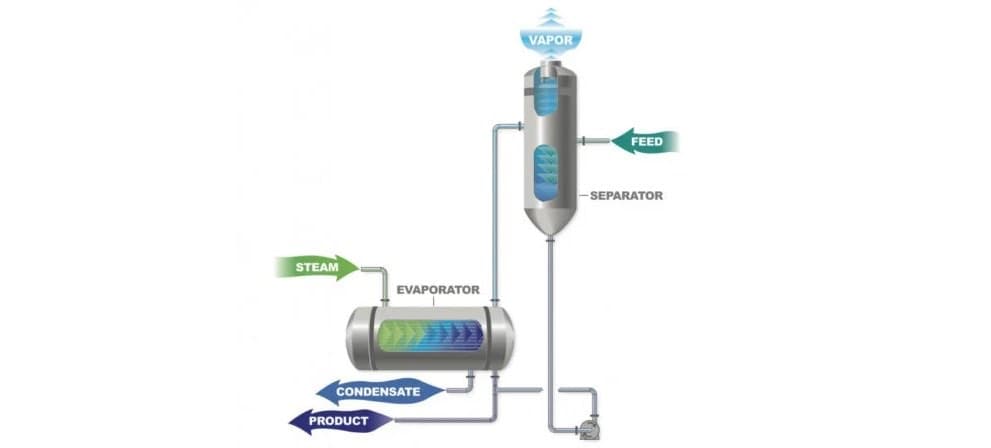
How Evaporators Work — and How to Minimise Energy Cost
An evaporator concentrates a liquid by supplying heat to vaporise the solvent (usually water) while the dissolved or suspended solids remain in the liquid phase. The primary heat source is steam or hot water condensing inside heating tubes or plates; the vapour generated in the evaporator body (secondary vapour) carries away the evaporated solvent at the boiling point corresponding to the operating pressure.
**Single-effect evaporation** uses 1.0–1.1 kg of steam per kg of water evaporated — the latent heat of the secondary vapour is wasted to the condenser. This is only acceptable for small duties (<500 kg/h evaporation) or when steam cost is negligible.
**Multi-effect evaporation (MEE)** reuses the secondary vapour from effect 1 as the heating steam for effect 2, which operates at lower pressure (and lower boiling point) to maintain a positive temperature driving force. Each additional effect roughly halves the steam consumption: 2-effect = 0.5 kg steam/kg evaporation; 3-effect = 0.33; 5-effect = 0.2. Capital cost increases with each effect but operating cost falls. The optimum number of effects is where the marginal steam saving equals the annualised capital cost increment — typically 3–5 effects for industrial duties above 2,000 kg/h.
**Mechanical vapour recompression (MVR)** takes the secondary vapour, compresses it with a centrifugal compressor or blower (pressure ratio 1.2–2.0, ΔT = 5–20°C), and returns it to the steam chest as the heating medium. The only external energy input is the compressor shaft power — achieving steam economies equivalent to 8–15 effects. Specific energy consumption: 15–35 kWh per tonne evaporated (vs 550–700 kWh/tonne for a single-effect). MVR is the lowest operating cost option whenever electricity is cheaper than 5× the cost of equivalent steam energy — as is currently true in most European markets.
**Thermal vapour recompression (TVR/TVC)** uses a steam ejector to mix high-pressure motive steam with secondary vapour, recompressing the mixed vapour to an intermediate pressure usable as heating steam. No moving parts; lower capital than MVR compressor; steam economy 1.5–3.5 kg/kg. Used as a simple energy-saving upgrade to existing single-effect systems.
The four principal **evaporator body designs** are: falling film (FF), forced circulation (FC), rising film (RF) and plate evaporator. Selection depends on liquid viscosity, fouling tendency, temperature sensitivity and required concentration ratio.
Quick Reference
Technical Specifications
All parameters are indicative ranges. Final sizing is determined by process simulation based on your specific material and throughput requirements.
Operating Parameters
| Parameter | Value / Range | Note |
|---|---|---|
| Evaporation capacity | 100 kg/h – 100 t/h water evaporated | Multi-train parallel systems for >100 t/h; modular skid-mounted for <2 t/h |
| Steam economy (single-effect) | 0.9 – 1.1 kg evaporation / kg steam | Baseline; see multi-effect and MVR for superior options |
| Steam economy (3-effect MEE) | 2.5 – 3.0 kg evaporation / kg steam | 5-effect MEE: 4.0–5.0; add TVR stage: up to 8.0 |
| Specific energy (MVR) | 15 – 35 kWh / tonne water evaporated | Equivalent to 10–15 effect MEE; depends on boiling point elevation and compressor ΔT |
| Operating pressure range | -0.95 bar g (vacuum) to +6 bar g | Vacuum operation lowers boiling point — enables heat-sensitive product processing; vacuum to 20 mbar abs achievable |
| Feed concentration (inlet) | 1 – 50 wt% dissolved solids | Forced circulation handles to 70 wt% and near-saturation slurries; crystalliser handles >saturation |
| Product concentration (outlet) | Up to saturation / crystallisation point | Falling film: up to 50 wt%; forced circulation: up to 70–80 wt%; crystalliser: produces dry solid |
| Heating steam pressure | 0.5 – 20 bar g | 0.5 bar g = 112°C; 6 bar g = 165°C; 20 bar g = 212°C; higher pressure = larger ΔT = less heating area required |
| Overall heat transfer coefficient U (falling film) | 1,500 – 3,500 W/m²·K | Forced circulation: 800–2,500 W/m²·K; rising film: 1,000–2,500 W/m²·K; plate: 2,000–5,000 W/m²·K |
| Construction materials | SS 304 / SS 316L / Duplex / Titanium / Hastelloy C-276 | Selected per product, pH, chloride content and operating temperature; carbon steel for non-corrosive utilities |
| Cleaning method | CIP (caustic/acid), steam-clean, high-pressure water, mechanical rodding | Falling film: CIP by recirculating NaOH 1–2% then HNO₃ 0.5–1% at 70–80°C; forced circulation: easier to clean by high-velocity water flushing |
Evaporator Body Type Comparison
| Parameter | Value / Range | Note |
|---|---|---|
| Falling film (FF) | U: 1,500–3,500 W/m²·K; residence time: 2–30 s; ΔT_min: 3°C | Best for heat-sensitive, low-viscosity feeds (µ < 100 mPa·s); gentle evaporation; lowest temperature difference; not suitable for fouling/scaling feeds |
| Forced circulation (FC) | U: 800–2,500 W/m²·K; tube velocity: 2–4 m/s; ΔT_min: 5°C | Best for scaling, fouling or high-viscosity liquids (µ up to 5,000 mPa·s); high-velocity flow minimises scale deposition; salt crystallisation duty; highest CAPEX |
| Rising film (RF) / Long tube vertical | U: 1,000–2,500 W/m²·K; tube length: 3–8 m; ΔT_min: 8°C | Low capital, simple construction; requires higher ΔT than falling film; suitable for non-scaling liquids; lower U than FF for viscous liquids |
| Plate (PHE-type) evaporator | U: 2,000–5,000 W/m²·K; ΔT_min: 2°C; compact | Highest U; smallest footprint; T < 160°C; plates fully accessible for cleaning; gasketed version for food/pharma CIP duty |
| MVR (mechanically assisted vapour loop) | 15–35 kWh/t; steam consumption: near-zero; ΔT across compressor: 5–20°C | Best lifecycle cost when electricity:steam cost ratio < 1:5; not viable for high boiling point elevation (BPE > 15°C) |
Need a technical pre-sizing? Send us your material data sheet, moisture content, required throughput and energy source — we return a technical sizing with drum dimensions and energy balance within 2 business days.
→ Send process data on WhatsAppApplication Examples
Reference data from industrial installations. Actual values depend on feed consistency, particle size distribution and required product quality.
| Material | Inlet moisture | Outlet moisture | Particle size | Gas temp. | Industry |
|---|---|---|---|---|---|
| Dairy whey / milk concentration | 93–96% water (4–7% total solids) | 55–60% water (40–45% total solids — pre-spray drying concentrate) | True solution (no particles) | 62–72°C (pasteurised); vacuum evaporation at 40–55°C to protect proteins | Dairy / Food |
| Caustic soda (NaOH) concentration — 30% → 50% | 70% water (30 wt% NaOH) | 50% water (50 wt% NaOH) | Clear solution (no solids until >70% NaOH) | BPE: +8–12°C above pure water boiling point at operating pressure | Chemical / Chlor-Alkali |
| Ammonium sulphate (NH₄)₂SO₄ concentration + crystallisation | 60–70% water (NH₄)₂SO₄ from scrubber | Crystal slurry at saturation; centrifuged → dry fertiliser granules | Crystal size controlled by residence time and seeding: d50 0.5–2 mm target | Boiling at 80–105°C under vacuum; BPE +6°C | Fertiliser / Chemical / Flue Gas Treatment |
| Scrubber blowdown ZLD — NaCl / Na₂SO₄ crystallisation | 85–95% water (mixed salts from scrubber circuit) | Dry salt crystals (NaCl, Na₂SO₄, CaSO₄) for disposal / recovery | Mixed salt slurry → crystal size d50 0.2–1 mm | 70–110°C under vacuum (forced circulation evaporator) | Waste / Chemical / Power Generation |
| Tomato / fruit juice concentration | 93–96% water (4–7 °Brix) | 70–72% water (28–30 °Brix paste or 65–68 °Brix triple concentrate) | Suspended pulp; viscosity rises sharply above 25 °Brix | Vacuum evaporation at 42–55°C (preserve colour, vitamins, aroma) | Food / Beverage |
| Black liquor concentration (pulp & paper) | 85% water (15% dry solids) | 20–25% water (75–80% dry solids — combustible in recovery boiler) | Complex organic + inorganic mixture; high fouling tendency | Multiple effect + TVR; T 70–130°C; high BPE due to dissolved organics | Pulp & Paper |
| Pharmaceutical mother liquor recovery (API crystallisation) | 70–90% organic solvent + water mixture | API crystals + recovered solvent for reuse | API crystals d50 10–200 µm (controlled by supersaturation and seeding) | Vacuum evaporation at 20–60°C; ATEX Zone 1 (solvent vapour); SS 316L / Hastelloy | Pharmaceuticals / Fine Chemicals |
| Sugar juice concentration (beet / cane) | 85% water (15 wt% sucrose) | 35% water (65 wt% sucrose — Brix 65, saturated syrup) | Clear solution after clarification; BPE +1.5°C at 65 °Brix | Quintuple effect evaporation at 65–130°C; steam economy 4.5–5.0 kg/kg | Sugar / Food |
Don't see your material? Send us your process data and we'll provide material-specific sizing.
Evaporator Configurations
Falling Film Evaporator (FFE)
Feed liquid is distributed uniformly over the top of vertical tube bundles and flows downward as a thin film on the inner tube walls while steam condenses on the outside. The falling film maximises heat transfer area contact with minimum liquid holdup — residence time 2–30 seconds versus 5–30 minutes for forced circulation. This makes FFE uniquely suited for heat-sensitive products: dairy, pharmaceuticals, flavours, vitamins. Operating conditions: tube-side liquid velocity 0.3–1.5 m/s; steam-side condensation coefficient 8,000–15,000 W/m²·K; liquid-side coefficient 2,000–6,000 W/m²·K; overall U = 1,500–3,500 W/m²·K. Minimum ΔT (steam-to-boiling) as low as 3°C — enables very tight multi-effect temperature cascades. Not suitable for viscous liquids (µ > 200 mPa·s) or feeds prone to crystallisation in the film.
Forced Circulation Evaporator (FCE)
A centrifugal pump circulates the process liquid at high velocity (2–4 m/s) through a shell-and-tube heat exchanger (the calandria) where it is superheated slightly above the boiling point, then flashes in a separate vapour body where pressure is lower. Evaporation occurs in the flash zone — not on the tube surfaces — eliminating film boiling and scaling on the tubes. The continuous high-velocity circulation maintains turbulent flow that keeps solids suspended and prevents tube fouling. Handles liquids from thin aqueous solutions up to near-saturated slurries (up to 70 wt% dissolved solids), highly viscous liquids (up to 5,000 mPa·s), and solutions prone to crystallisation. Highest CAPEX of all evaporator types; highest energy consumption per tonne (pump power + steam). The only viable option for salt crystallisation duty (ammonium sulphate, sodium chloride, sodium sulphate, potassium chloride).
MVR Evaporator (Mechanical Vapour Recompression)
The secondary vapour leaving the evaporator body is compressed by a centrifugal compressor or Roots blower, raising its condensation temperature by 5–20°C above the boiling point of the feed liquid in the heat exchanger — creating the temperature driving force needed for heat transfer without consuming steam. The compressed vapour then condenses in the heating tubes, releasing its latent heat to evaporate more liquid. Net energy consumption: 15–35 kWh per tonne of water evaporated. Startup steam is required (30–60 min until compressor loop is self-sustaining). Compressor pressure ratio: 1.15–1.5 (centrifugal); 1.5–3.0 (Roots blower). MVR is economically superior to multi-effect MEE when the electricity-to-steam cost ratio is < 1:4.5. Not suitable when boiling point elevation BPE > 15°C (NaOH > 40%, salt near saturation) because the required compressor pressure ratio becomes impractical. Combine with FF or FC evaporator body.
When to Choose an Evaporator — and Which Type
Liquid must be concentrated by removing water and product is temperature-sensitive (dairy, pharma, food)
Falling film evaporator under vacuum (40–65°C) — minimum product residence time, minimum thermal damage, gentle film boiling at lowest possible temperature.
Liquid crystallises on heating surfaces or contains high suspended solids that would block a film evaporator
Forced circulation evaporator — high tube velocity (2–4 m/s) keeps surfaces clean; evaporation in flash zone eliminates tube-surface boiling; handles slurries up to 70 wt% dissolved solids.
Evaporation duty > 2,000 kg/h and steam cost is significant (energy represents > 30% of operating cost)
Multi-effect MEE (3–5 effects) reduces steam consumption to 0.2–0.33 kg/kg. Compare with MVR: if electricity cost is < 5× steam energy cost, MVR gives lower operating cost. Lozzar calculates both options in the feasibility stage.
Scrubber or wastewater treatment liquid discharge is not acceptable and ZLD is required by permit
Forced circulation evaporator + forced circulation crystalliser — produces dry salt crystals with zero liquid effluent. Integrate with scrubber and heat exchanger into a single ZLD package with one performance guarantee.
When NOT to Use an Evaporator
Product must be completely dry (< 1% moisture) — evaporation cannot reach bone-dry; a dryer is required for final drying
Liquid volume is small (< 200 kg/h) and steam cost is low — a simple single-effect with direct fire or hot water heating is adequate
Solvent is organic (not water) and recovery is the goal — a distillation column gives sharper separation than an evaporator
Liquid contains very high dissolved salts with BPE > 20°C — MVR is not viable and multi-effect is expensive; direct crystallisation may be more economic
Not sure which dryer is right for your process? We'll review your specifications and recommend the optimal solution.
Ask a technical question →Frequently Asked Questions — Evaporators
The break-even comparison is based on annual operating cost: **MEE annual cost** = evaporation_rate (t/h) ÷ steam_economy × steam_price (€/t) × operating_hours/year. **MVR annual cost** = evaporation_rate (t/h) × specific_electricity (kWh/t) × electricity_price (€/kWh) × operating_hours/year. At European 2024 prices (steam €20–30/t at 6 bar, electricity €0.08–0.12/kWh): for 1 t/h evaporation at 8,000 h/year — 3-effect MEE consumes 0.33 t steam/h → €52,800/year; MVR consumes 25 kWh/t → 25,000 kWh/year → €2,500/year. MVR wins decisively unless the capital cost premium (MVR compressor adds €150,000–400,000) cannot be amortised. For payback: ΔCapital ÷ ΔOperating_cost. At €200,000 extra capital and €50,000/year saving, payback = 4 years. For evaporation > 5 t/h at continuous operation, MVR payback is almost always < 3 years at current European energy prices. The one exception: high BPE fluids (NaOH > 40%, near-saturated salt) where compressor pressure ratio > 2.5 makes MVR mechanically impractical — then 5-effect + TVR is the lowest-cost thermal option.
From Our Projects
Related Equipment
Spray Dryer
Evaporator + spray dryer is the classic 2-stage concentration/drying sequence for dairy, food and pharma: evaporate from 5% to 45–50% solids (low energy cost), then spray dry to powder (high cost but small volume) — combined system minimises total energy per tonne of powder
View productWet Scrubber
Forced circulation evaporator + crystalliser converts scrubber blowdown to dry salt — the ZLD back-end for any scrubber system where liquid discharge to drain is not permitted
View productHeat Exchanger
Condensate from each evaporator effect must be recovered by a heat exchanger and returned as boiler feedwater — combined heat integration reduces total steam demand by a further 5–15%
View productCrystallizer
Evaporator concentrates the liquid to near-saturation; crystalliser takes it to crystallisation and separates the solid product — the two units are always designed together as an integrated evaporation-crystallisation system
View productRequest a Quote for This Equipment
Include in your enquiry:
- →Feed liquid: name/composition, concentration (wt% or °Brix), mass flow (kg/h) and temperature (°C)
- →Target outlet concentration (wt% or °Brix) and maximum allowable product temperature
- →Required evaporation rate (kg/h water to be removed)
- →Fouling/scaling tendency: does the liquid scale, crystallise or foam?
- →Viscosity at feed and target concentration (mPa·s)
- →Available steam pressure (bar g) and cooling water temperature (°C)
- →Preference: multi-effect MEE or MVR? (Lozzar will calculate both and recommend)
- →Operating duty: continuous or batch? Hours per year?
- →Regulatory requirements: GMP (food/pharma)? ATEX zone? PED category?
- →Site constraints: available floor area (m²) and maximum height (m)