Belt (Conveyor) Dryer
The gentlest continuous dryer — perfect preservation of particle shape, colour and biological activity for delicate products.
Belt dryers convey product on a perforated conveying belt through a drying tunnel, with heated air blown through the product layer from below (or above) by circulation fans. The product is never tumbled, agitated or subjected to high mechanical stress — making belt dryers the technology of choice for fragile pellets, shaped extrudates, food pieces (vegetable slices, herb leaves, meat strips), wood biomass chips and any application where particle integrity, colour retention and product shape must be preserved through the drying process. Lozzar Process supplies single-belt, multi-pass and multi-belt dryer systems in stainless steel for food-grade and GMP applications, and carbon steel for biomass and industrial chemical products.
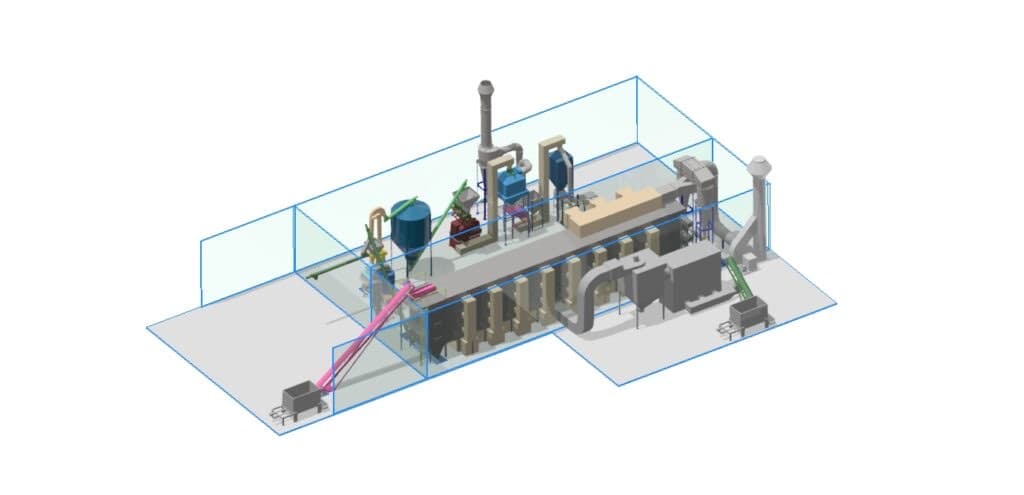
How a Belt Dryer Works
A belt dryer consists of an insulated drying tunnel through which a perforated stainless steel or polyester mesh belt continuously transports the product layer. Inside the tunnel, recirculation fans draw hot air upward (or downward) through the product layer and through the perforations in the belt. The air picks up moisture from the product surface and is either discharged or partially recirculated through a heat exchanger to recover energy.
The drying tunnel is divided into independent temperature and airflow zones: typically 2–8 zones, each with its own heat source (steam coil, hot water coil or direct gas heating), recirculation fan and exhaust/fresh air damper. This zoning allows a precisely tailored drying profile: high temperature in the early zones to drive off surface moisture rapidly, followed by gentler conditions in the middle zones to avoid case-hardening, and a final low-temperature zone for conditioning or cooling.
Product residence time is controlled by belt speed: slower belt = longer residence = more drying. Belt speed typically 0.01–0.3 m/min. For difficult-to-dry materials or those requiring very low final moisture, a multi-pass design is used: the product cascades from one belt level to the next (2–5 levels), each with independent airflow, effectively increasing residence time while maintaining a compact equipment length.
Air flow through the product layer is the critical design parameter. The "through-air" principle (as opposed to the "over-product" air flow used in tunnel dryers) achieves far better gas-solid contact and more uniform drying because every particle in the bed depth is directly exposed to the drying air stream. The bed depth (typically 20–150 mm) and air velocity (0.5–3 m/s through the bed) are optimised for each product to achieve the target moisture without particle damage.
Quick Reference
Technical Specifications
All parameters are indicative ranges. Final sizing is determined by process simulation based on your specific material and throughput requirements.
Belt Dryer — Operating Parameters
| Parameter | Value / Range | Note |
|---|---|---|
| Product form accepted | Pellets / granules / extrudates / chips / slices / leaves / lumps | Must form a stable bed layer on belt: minimum particle size ~3 mm (fine powders fall through belt perforations); maximum dependent on required bed depth uniformity |
| Air temperature range | 40 – 250°C | Food/pharma: 40–120°C; biomass chips: 80–150°C; technical pellets: 100–200°C; maximum limited by belt material (polyester: <200°C; SS mesh: <400°C) |
| Product bed depth | 20 – 150 mm | Shallow bed (20–50 mm) for delicate products, uniform drying; deep bed (80–150 mm) for high throughput, less moisture-critical applications |
| Air velocity through bed | 0.5 – 3.0 m/s | Below particle entrainment velocity; fine light particles (leaves, chips) require lower velocity to avoid blow-off |
| Belt width | 0.5 – 4.5 m | Standard widths: 0.5, 1.0, 1.5, 2.0, 2.5, 3.0 m; wider belts reduce tunnel length for equivalent area but increase lateral uniformity challenge |
| Effective belt length (single-pass) | 4 – 40 m | Multi-pass 3-belt systems: equivalent of 12–120 m in 4–15 m building length |
| Inlet moisture content | 5 – 60% w/w | Above 60%: material typically too plastic/wet to form stable bed on belt without pre-drying or extrusion; below 5%: belt dryer may be oversized vs. fluid bed |
| Outlet moisture content | 0.5 – 15% w/w | Food products: 8–14% (safe moisture for shelf stability); technical products: <2%; bound moisture below 0.5% requires longer residence or higher temperature |
| Specific energy consumption | 1 000 – 2 000 kcal/kg water evaporated | Multi-zone heat recovery and partial exhaust recirculation reduce to 800–1500 kcal/kg; variable with bed depth and product void fraction |
| Belt material options | SS 304 / SS 316L wire mesh | Polyester mesh | Modular plastic | SS mesh: food/pharma and high-temperature; polyester: lower cost, food-grade below 200°C; modular plastic: chemical resistance, easy replacement |
| Throughput range | 100 kg/h – 20 t/h (dry product) | |
| Number of temperature zones | 2 – 8 independent zones | Each zone independently controlled: temperature, fan speed, fresh/exhaust air ratio — enables fully customised drying profile |
Single-Belt vs. Multi-Belt (Multi-Pass) Comparison
| Parameter | Value / Range | Note |
|---|---|---|
| Building length requirement | Single: 6–40 m | Multi-belt 3-pass: 4–15 m for equivalent drying area | |
| Residence time per metre of building | Single: 1× | Multi-belt: 3–5× | Multi-belt systems dramatically more efficient use of building footprint |
| Product layer turning/mixing | Single: no turning | Multi-belt: turning at each belt transfer | Turning at belt transfer breaks surface crust and exposes fresh surface — improves drying rate and uniformity for thick bed products |
| Suitable for fragile products | Single: ✓ excellent | Multi-belt: moderate (some breakage at transfer) | |
| CAPEX | Single: lower | Multi-belt: +20–40% but much shorter building needed |
Need a technical pre-sizing? Send us your material data sheet, moisture content, required throughput and energy source — we return a technical sizing with drum dimensions and energy balance within 2 business days.
→ Send process data on WhatsAppMaterial Database — Belt Drying Applications
Reference data from industrial installations. Actual values depend on feed consistency, particle size distribution and required product quality.
| Material | Inlet moisture | Outlet moisture | Particle size | Gas temp. | Industry |
|---|---|---|---|---|---|
| Wood pellets (biomass energy) | 15–30% | <10% | 6–10 mm diameter pellets | 80–130°C air | Biomass / Energy |
| Wood chips (particleboard raw material) | 25–50% | 3–8% | 5–30 mm | 100–160°C air | Wood / Panel Industry |
| Carrot slices / vegetable pieces | 85–92% | 5–8% | 5–15 mm pieces | 60–90°C air | Food / Dehydrated Vegetables |
| Herb leaves (basil, thyme, oregano) | 70–80% | 8–12% | 5–30 mm leaves | 40–60°C air | Food / Herbs & Spices |
| Cat litter (sodium bentonite pellets) | 20–30% | <5% | 2–4 mm spherical pellets | 100–160°C air | Consumer / Pet Products |
| Pharmaceutical tablets (pre-coating) | 3–8% | <0.5% | 5–15 mm diameter tablets | 40–70°C air | Pharmaceuticals |
| Activated carbon granules | 40–55% | <5% | 1–4 mm granules | 100–150°C air | Chemical / Water Treatment |
| Dried pasta / extruded food products | 28–32% | 12–13% | Various shapes 2–10 mm | 55–85°C air (controlled humidity) | Food / Pasta |
Don't see your material? Send us your process data and we'll provide material-specific sizing.
Belt Dryer Configurations
Single-Belt Through-Air Dryer
Classic configuration. Single horizontal perforated belt, multi-zone heated tunnel, fans below or above the belt driving air through the product layer. Lengths 4–40 m, widths 0.5–3 m. Best for fragile products that cannot tolerate the cascade at belt-to-belt transfer — tablets, fragile biscuits, dried fruit pieces. Simple design, easy access for cleaning and maintenance.
Multi-Belt (Multi-Pass) Dryer
Three or more belt levels stacked vertically within the same insulated housing. Product enters on the top belt, dries while being conveyed horizontally, then cascades down to the second belt (turning the product) and so on. Each belt level may have independent airflow direction (up or down through bed). Significantly more compact than single-belt equivalent — a 3-belt system in 8 m building length equals 24 m single belt. Turning at each cascade improves drying uniformity for thick-bed products like wood chips and vegetable pieces.
Belt Dryer with Controlled Humidity Zones (Pasta Dryer)
Specialised for pasta, bakery and extruded food products where uncontrolled moisture removal causes cracking (case-hardening). The drying profile alternates between drying phases (low relative humidity, high temperature) and conditioning/resting phases (high relative humidity, lower temperature). Resting phases allow moisture redistribution from the core to the surface, preventing stress cracking in starchy extrudates. Relative humidity in drying zones controlled to ±2% RH by fresh-air:recirculation ratio modulation.
When to Choose a Belt Dryer
Product integrity is critical — shaped extrudates, whole pieces, fragile granules (d50 > 3 mm)
Belt dryer is the only continuous dryer with zero mechanical handling forces. The product rests undisturbed through the entire drying cycle — no attrition, no tumbling, no pneumatic impact. Fines generation is zero except at feed spreading and product discharge.
Low-temperature drying required (40–80°C) for food colour and aroma retention
Belt dryers can operate from 40°C upwards. At 40–60°C with controlled relative humidity, herbs, spices, tea and botanicals retain >90% of volatile essential oils and original colour (chlorophyll, carotenoids). No other continuous dryer provides the combination of low temperature, gentle handling and uniform product layer that belt drying achieves.
Biomass or wood chips with high moisture (20–50%) requiring atmospheric drying without attrition
Belt dryers handle wood chips and biomass at 80–150°C inlet air without mechanical damage to chip structure. The multi-belt design (cascade turning at belt-to-belt transfer) provides excellent moisture uniformity for irregular biomass shapes — critical for pellet mill feed quality specifications.
Drying profile requires alternating drying and conditioning/rest phases (pasta, extruded starch products)
Only belt dryers provide the zonal control needed to implement alternating drying-conditioning profiles. Rotary dryers have a single temperature environment throughout; fluid beds have too short residence times; flash dryers are single-pass. The multi-zone belt dryer with adjustable relative humidity per zone is the universal standard for pasta drying.
When NOT to Use a Belt Dryer
Fine powders or small particles (d50 < 3 mm) that fall through belt perforations or are blown off by airflow
Paste, sludge or high-moisture non-flowable feed (>60% moisture) that cannot form a stable bed on the belt
Very high throughput (>20 t/h) of coarse bulk material (sand, minerals, fertilizer)
Filter cake, centrifuge cake or wet paste requiring simultaneous size reduction during drying
Not sure which dryer is right for your process? We'll review your specifications and recommend the optimal solution.
Ask a technical question →Belt Dryer — Engineering FAQ
The practical minimum is approximately 3–5 mm for particles and 5–10 mm for pieces, determined by two constraints: (1) Belt perforation size: standard perforated SS belt has 1.5–3 mm holes (2–4 mm open area). Particles smaller than ~2× the hole diameter are at risk of falling through, especially when wet and sticky. For smaller particles, a finer mesh belt (0.5–1 mm opening) is used, but this increases pressure drop across the belt and requires higher fan power; (2) Pneumatic blow-off: airflow through the bed must not exceed the terminal velocity of the product. At 0.5–1.5 m/s (typical), particles below ~3 mm and with low density may be entrained and blown off the belt surface. Solutions: reduce airflow velocity (longer dryer or deeper bed), use a weighted/perforated cover screen above the product layer to retain fine particles, or switch to a fluid bed dryer (designed for fine particle fluidization). For pharmaceutical tablets (5–20 mm), belt dryer is optimal and standard. For granulated pharmaceutical intermediates (d50 0.5–3 mm), fluid bed is the better choice.
From Our Projects
Related Equipment
Rotary Dryer
Use rotary dryer for very large throughputs (>20 t/h) or coarse bulk materials where particle shape preservation is not critical — lower installed cost per t/h for high capacity but cannot replicate belt dryer's product gentleness
View productFluidized Bed Dryer
Use fluid bed dryer for fine granules and powders (d50 50 µm–5 mm) where belt perforation retention is not possible — fluid bed provides better moisture uniformity for fine particles
View productCyclone Separator
Cyclone separator downstream of belt dryer exhaust to recover fine particles entrained from belt surface — particularly relevant for herb, spice and food drying where product fines have commercial value
View productBag Filter
Bag filter on belt dryer exhaust for dust-sensitive products or when emission regulations require fine particle capture from exhaust air stream
View productRequest a Quote for This Equipment
Include in your enquiry:
- →Product description: what material, what form (pellets, chips, slices, tablets, leaves)?
- →Particle or piece dimensions (length × width × thickness, or diameter × length for pellets)
- →Inlet moisture content (% w/w) and target outlet moisture
- →Required throughput (kg/h dry product or wet product)
- →Maximum permissible drying air temperature (°C) — any colour/aroma/activity sensitivity?
- →Heat source: steam (bar g), thermal oil (max °C), hot water or direct gas
- →Food-grade / GMP construction required, or industrial-grade stainless / carbon steel?