Three Regulations That Are Creating Real Project Pipelines
Pyrolysis investment in Europe isn't growing because the technology has improved (it hasn't, dramatically — rotary kiln pyrolysis has been commercial for decades). It's growing because three regulatory changes have made the economics work for project developers who previously couldn't make the numbers add up.
Understanding which regulation applies to your feedstock changes how you model your revenue — and which technology configuration you need.
| Regulation | Feedstock Affected | Key Requirement | Revenue Mechanism | Effective Date |
|---|---|---|---|---|
| EU PPWR (Packaging & Packaging Waste Regulation) | Mixed / contaminated plastics | 30% recycled content in plastic packaging by 2030; 65% by 2040 | Mass balance certification for pyrolysis oil as recycled content | 2027 (mandatory targets) |
| End-of-Life Tyre EPR Schemes | End-of-life tyres (ELT) | Landfill ban on ELT; collection and treatment mandated | Gate fees from tyre collectors + recovered carbon black (rCB) sales + pyrolysis oil | Active in DE, FR, PL, RO now |
| EU CRCF (Carbon Removal Certification Framework) | Biomass (wood, agricultural residue, organic waste) | Biochar from pyrolysis recognised as permanent carbon removal | Carbon credit sales (€60–120/tonne CO₂e in voluntary market, 2026) | 2024 (framework adopted) |
Plastic vs Biomass vs Tyre Pyrolysis: Why They Need Different Equipment
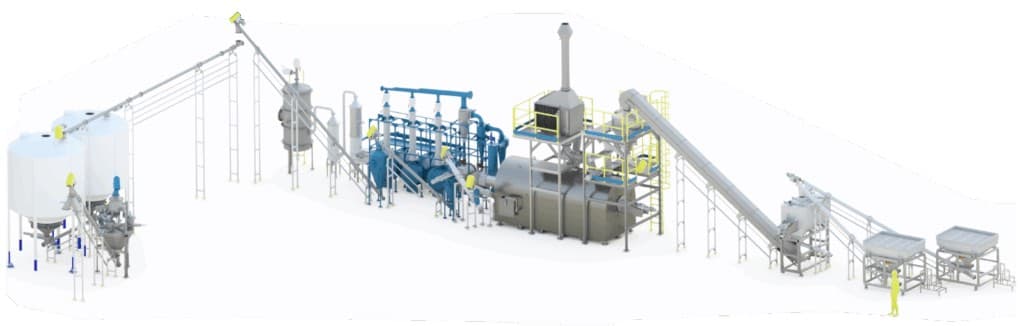
The same rotary kiln reactor principle works for all three feedstocks — but the auxiliary equipment scope differs significantly, and so does the capital cost. Getting this wrong at the project feasibility stage is one of the most common mistakes in pyrolysis project development.
| Equipment Scope Item | Biomass Pyrolysis | Tyre Pyrolysis | Plastic Waste Pyrolysis |
|---|---|---|---|
| Feed preparation | Size reduction if needed (chipping to <50 mm) | Shredding + magnetic metal separation (mandatory) | Shredding + density separation + metal removal (mandatory) |
| Pre-drying | Required if >15% inlet moisture (common) | Rarely required (<5% typical) | Usually required for contaminated streams (sludge-contaminated) |
| Pyrolysis reactor | Rotary kiln, external heat, 350–600°C | Rotary kiln, 450–550°C, continuous char discharge | Rotary kiln or auger, 450–600°C |
| Gas cleaning | Cyclone + condensation + simple scrubber | Multi-stage condensation + H₂S scrubber + activated carbon | Multi-stage condensation + HCl scrubber (PVC risk) + activated carbon (mandatory) |
| Relative capex (same reactor capacity) | 1× (reference) | 1.3–1.5× (metal separation + advanced gas cleaning) | 1.5–2.0× (HCl scrubbing + multi-stage condensation mandatory) |
Where Investment Is Concentrating — And What It Means If You're Evaluating a Project
The majority of near-term pyrolysis investment in Europe is concentrated in five markets — Germany, France, the Netherlands, Poland, and Romania. All five have significant plastic waste or tyre waste streams, supportive national policies for chemical recycling, and gate fees for tyre collection that make tyre pyrolysis economics work without subsidy.
For project developers evaluating pyrolysis in 2026, three points that come directly from what we're seeing in enquiries:
**Lead times matter more than price**: The 14–22 week lead time on standard pyrolysis systems (for the LP-P500 to LP-P3000 range) is often the binding constraint on project timelines. PPWR recycled content mandates begin in 2027 — projects starting permitting now are tight on schedule. Standard-configuration equipment with fixed lead times is more valuable to project developers than bespoke solutions at this stage.
**Feedstock qualification is underinvested**: Most feasibility studies we see model pyrolysis economics with "clean wood chips" or "baled HDPE" — materials that are tidy on paper but don't reflect what's actually available in the supply chain. Before committing to a reactor configuration, have your actual feedstock samples tested for moisture, contamination profile, halogen content (critical for plastic), and ash. One unexpected material characteristic can change the entire gas cleaning train.
**Operating model clarity**: Continuous 24/7 operations require different mechanical specifications than batch or intermittent operations. If your project is running on waste collection contracts (which are by definition intermittent), the reliability and restart specifications for your reactor and gas cleaning system need to be written for that operating pattern — not for ideal steady-state.