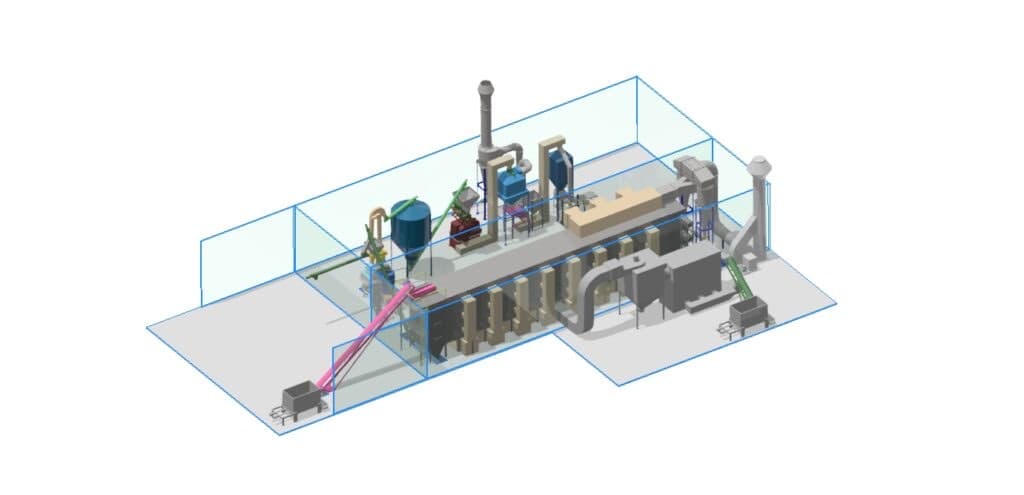
What Pulp Mill Sludge Actually Looks Like — and Why It Is Difficult to Dry
Pulp and paper mills generate two distinct sludge streams from their effluent treatment systems. Primary sludge — intercepted in the primary clarifier — consists largely of wood fibres, fines, and filler materials that escape the forming section. It is relatively easy to dewater on a screw press or belt press, reaching 30–40% dry solids (DS) without much difficulty.
Secondary sludge is the harder problem. It is the biological mass generated in the activated sludge system treating the organic load in the mill effluent. Secondary sludge is made up predominantly of bacterial cell matter and extracellular polymeric substances (EPS). It is inherently sticky, compressible under pressure, and very resistant to mechanical dewatering. Even after aggressive press-dewatering, secondary sludge typically exits at only 18–25% DS — meaning 75–82% of the mass is still water.
Most mills blend primary and secondary sludge before dewatering, achieving a combined cake at 25–45% DS (55–75% moisture). This blended cake is the typical belt dryer feed in a paper mill context. The key challenge is that the fibrous fraction from the primary sludge causes the material to mat and clump, while the biological fraction makes it sticky and prone to adhesion on conveyor surfaces. A dryer design that works well for municipal sewage sludge does not necessarily translate to paper sludge, and vendors who have not processed the specific material type should be pressed for reference installations.
Why Belt Dryers Outperform Rotary Dryers for This Application
The conventional choice for industrial sludge drying has long been the rotary drum dryer, and in some applications it remains the right tool. For pulp mill sludge specifically, however, the combination of fibrous texture and biological stickiness creates problems that rotary dryers handle poorly.
In a direct-fired rotary drum, the sludge tumbles in a stream of hot gas at 400–600°C inlet temperature. Fibrous paper sludge at 60% moisture does not tumble cleanly — it mats to the drum flights, builds up in annular rings, and periodically breaks loose in slugs that cause uneven output moisture and can overload downstream conveyors. The sticky biological component adheres to the metallic drum surface and requires regular mechanical cleaning. More critically, the high gas temperatures in direct-fired rotary dryers drive off volatile organic compounds (VOCs) and generate odour-laden exhaust that requires significant treatment before discharge.
Belt dryers operate at 60–130°C using a forced-air circuit through a horizontal perforated stainless steel belt. The material sits on the belt in a formed layer — typically 50–150 mm deep for sludge — and drying air passes through it from below, above, or in alternating zones depending on the design. Because the material is not agitated, fibrous materials behave well: they form a stable porous cake that allows uniform airflow penetration. Adhesion to the belt is manageable with appropriate surface treatments or belt materials (polyester mesh, PTFE-coated weaves). The low operating temperature means VOC generation is substantially lower, and odour-laden exhaust volumes are more compact and easier to route to a biofilter or thermal oxidiser.
Belt dryer vs. rotary dryer: key parameters for pulp mill sludge drying
| Parameter | Belt Dryer | Direct-Fired Rotary Dryer | Notes |
|---|---|---|---|
| Drying air temperature | 60–130°C | 400–600°C (inlet) | Belt dryer can use low-grade mill steam |
| Inlet moisture range | 50–85% (wet basis) | 45–65% (wet basis) | Rotary dryers are limited with very wet sticky feeds |
| Outlet moisture target | 10–15% (easily), ≤8% with extended belt | 10–20% (variable with sticky feed) | Belt dryers give more consistent outlet quality |
| Specific thermal energy | 850–1,050 kWh/t water evaporated | 750–900 kWh/t water evaporated | Rotary slightly better on raw thermal, but belt uses lower-grade heat |
| Suitability for fibrous sludge | Excellent — material forms stable cake on belt | Poor — fibre mats to drum flights | This is the primary selection criterion for paper sludge |
| VOC / odour in exhaust | Low — compact exhaust volume; biofilter or scrubber is sufficient | High — large hot gas volumes require thermal oxidiser | Odour abatement capital cost can be 30–50% of dryer cost for rotary option |
| Typical installed footprint (10 t/h water evaporation) | ~30 × 10 m (multi-deck) | ~35 × 8 m (drum + cyclone) | Similar footprints; belt dryer height is greater |
Moisture Targets: What 10–15% Actually Means for Downstream Use
The target moisture for dried pulp sludge is almost always determined by the downstream disposal or recovery route, not by the dryer itself.
For co-combustion in the mill's own bark boiler or multi-fuel boiler, the key threshold is typically 25–30% moisture (wet basis) — below this, the sludge contributes positive heat to combustion rather than absorbing heat to evaporate its own water. However, most modern boiler systems designed for biomass co-firing can accept sludge at up to 40% moisture without significant efficiency penalty, provided the feed rate is controlled relative to bark and chip feed rates. Drying to 10–15% gives a safety margin and maximises the specific calorific contribution, but over-drying below 8% offers diminishing returns in heat value while increasing fire risk in storage and handling.
For off-site co-incineration at a cement kiln or waste-to-energy plant, the receiving facility typically specifies a minimum of 65–70% dry solids (30–35% moisture). This is achievable by mechanical dewatering alone if secondary sludge fraction is low — but for most mixed sludge, thermal drying to 25–30% moisture at minimum, and 10–15% for maximum gate-fee competitiveness, is the norm.
For pelletisation or granulation of dried sludge for agricultural land application or as a fuel pellet, moisture below 15% is generally required for the press to generate product with sufficient mechanical strength. Some pellet binders are less effective above 12% moisture, so a target of 10–12% is common where pellet quality is critical.
The practical upshot: design your belt dryer for 10–12% outlet moisture but include instrumentation to modulate belt speed and air temperature to operate at 15–20% when downstream demand is lower — this reduces energy consumption by 20–30% on a per-tonne basis.
Heat Integration: Using Mill Steam to Power the Dryer
One of the strongest arguments for belt dryers in a pulp or paper mill context is heat source compatibility. A belt dryer operates with air heated to 80–130°C — a temperature range that can be achieved with low-pressure steam at 3–6 bar(g), which is routinely available in any paper mill as a by-product of the recovery boiler or bark boiler system.
The heat circuit is simple: mill steam (typically at 4–6 bar(g), saturated, ~155–165°C) passes through a steam-to-air heat exchanger — a finned-tube battery — at the inlet of each drying zone. The steam condenses, giving up its latent heat (approximately 2,100 kJ/kg at 4 bar), and the condensate is returned to the boiler feedwater circuit. This closed-loop arrangement means no combustion product contacts the sludge, no additional fuel is needed, and the dryer introduces no new emission source.
For a belt dryer evaporating 3 t/h of water from sludge (roughly equivalent to processing 8–10 t/h of wet sludge feed at 55% inlet moisture to 12% outlet), steam consumption is approximately 1.8–2.2 t/h at 4 bar. At typical mill steam costs of €12–18/GJ (where steam has been generated from bark or black liquor), this equates to €80–130 per tonne of water evaporated — well below the equivalent cost of running a separate gas-fired dryer.
A critical design point often overlooked: ensure the condensate return from the dryer heat exchangers is separated and checked before returning to the boiler system. VOC and H₂S can migrate into condensate through heat exchanger surfaces, particularly with secondary biological sludge. Condensate polishing or a dedicated flash-vessel arrangement is recommended for this reason.
Odour, VOC and Exhaust Air Management: What the Regulations Actually Require
Sludge drying is not a clean process from an air quality standpoint. Even at the low operating temperatures of a belt dryer, the biological fraction of secondary sludge releases hydrogen sulphide (H₂S), ammonia (NH₃), and various reduced sulphur compounds as the cell material breaks down. The fibrous primary sludge fraction contributes terpenes and other wood extractive-related VOCs at concentrations that can make a sludge dryer installation genuinely unpleasant for the surrounding site.
Under the EU Industrial Emissions Directive (IED, 2010/75/EU) and the associated Best Available Techniques (BAT) conclusions for the pulp and paper sector, sludge drying exhaust air is considered a diffuse emission source and must be captured and treated. The practical compliance path for a belt dryer installation is a fully enclosed machine with the exhaust air routed to one of:
**1. Biofilter:** Effective for H₂S, NH₃ and odourants; requires controlled temperature (40–55°C) and moisture in the inlet air to maintain biological activity. Capital cost for a biofilter sized for a 3 t/h evaporation dryer is typically €150,000–300,000. Operating cost is low but performance can deteriorate with variable load.
**2. Chemical scrubber (acid + caustic two-stage):** More reliable for NH₃ and H₂S removal; better suited to peak loads. Higher operating cost (chemical consumption).
**3. Thermal oxidiser with heat recovery:** Required if VOC mass load exceeds the permit threshold (typically >1 kg/h total organic carbon). Can recover heat back to the drying circuit, partially offsetting capital cost over time.
For most belt dryer installations processing mixed paper sludge, a biofilter is the standard primary treatment. Thermal oxidiser is the exception rather than the rule, but should be evaluated if the permit specifies total organic carbon (TOC) outlet limits below 20 mg/Nm³.
Sizing a Belt Dryer for Your Mill: Key Inputs and What to Expect from a Vendor
The minimum credible dataset for a belt dryer quotation for pulp mill sludge is: (a) sludge flow rate in tonnes per hour (wet) or tonnes per day; (b) inlet moisture content, confirmed by at least three measurements across different operating conditions (the number that comes from the press vendor's brochure is not reliable enough); (c) outlet moisture target and the downstream process it must satisfy; (d) available heat source — steam pressure, maximum allowable draw, and temperature; (e) sludge composition, particularly the ratio of primary to secondary sludge and the ash content (ash-rich sludge from high-filler papers behaves very differently from a kraft mill sludge).
A competent equipment vendor will request a sludge sample before confirming any performance guarantee. Belt dryer performance for sticky fibrous materials depends significantly on how the feed behaves on the belt — its tendency to bridge over the perforations, its shrinkage behaviour as moisture is removed, and whether it forms a coherent slab or breaks into fine particles that fall through the belt mesh. These properties cannot be reliably predicted from datasheet parameters alone.
Expect a guaranteed specific evaporation rate in the range of 4–8 kg water per m² of belt area per hour, depending on sludge type, bed depth, and operating temperature. A dryer handling 5 t/h of wet sludge at 60% inlet moisture to 12% outlet (evaporating approximately 2.4 t/h of water) requires approximately 300–600 m² of belt area — typically achieved in a multi-deck configuration with 2–4 belt levels stacked vertically.
Ask the vendor explicitly for: (i) the guaranteed outlet moisture variance (±2% is reasonable, ±5% is not), (ii) the minimum sludge quantity at which auto-cleaning cycles are required, and (iii) the maximum inlet temperature of the heat source, as some belt dryer designs are not suitable for superheated steam input.