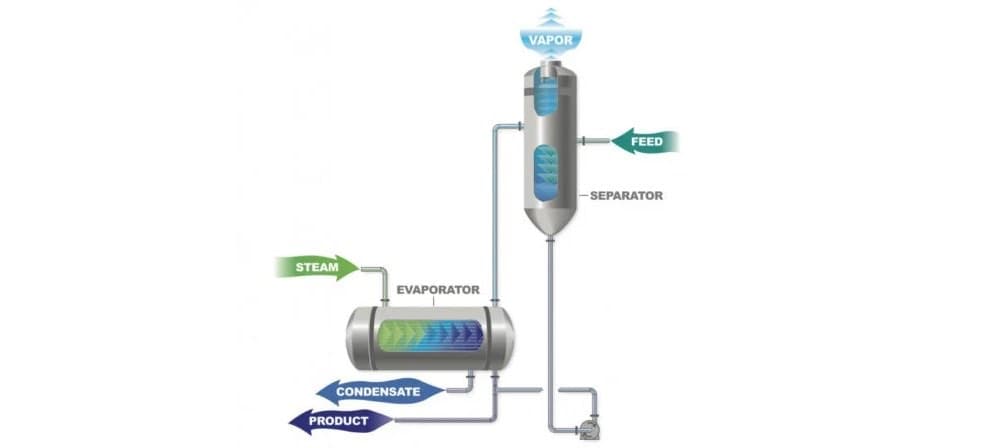
Why the Evaporator Choice Matters More Than You Think
In a liquid concentration process, the evaporator is typically the largest single energy consumer on the plant. For a facility evaporating 10 tonnes of water per hour, the difference between a single-effect falling film evaporator and an MVR system can be €600,000 to €1,200,000 per year in steam costs — at today's European energy prices.
But capital cost and energy efficiency aren't the whole story. A falling film evaporator that fouls on your liquid within a week forces expensive cleaning shutdowns and potentially damages product quality. A forced circulation unit that's oversized corrodes and cycles. Getting the evaporator type right at the design stage is one of the highest-value decisions in a liquid processing plant.
Below is the comparison that should be on every process engineer's desk when specifying evaporation duty.
Three Technologies, Side by Side
The key performance parameters that determine which evaporator type fits your application:
| Parameter | Falling Film | Forced Circulation | MVR |
|---|---|---|---|
| Steam consumption (single effect) | ~1.1 kg steam/kg water | ~1.1 kg steam/kg water | 0.02–0.05 kg steam equiv./kg water (compressor only) |
| Residence time | Seconds (gentle on heat-sensitive products) | Minutes (multiple passes through heater) | Seconds–minutes (depends on configuration) |
| Fouling resistance | Low — suitable only for clean, non-scaling liquids | High — high velocity prevents scaling | Medium — depends on base evaporator type |
| Temperature difference required (ΔT) | 3–8°C | 5–15°C | 2–5°C |
| Capital cost (relative) | Base | +20–40% | +80–150% (lower OPEX offsets) |
| Typical payback vs. single-effect | N/A (baseline) | N/A (similar energy use) | 2–4 years (at €50/t steam) |
| Best applications | Dairy, fruit juice, pharma, clean sugar liquors | Sodium sulphate, CaCO₃, black liquor, scaling salts | High-volume, continuous concentration — wherever steam is expensive |
The MVR Question: When Does It Actually Pay Back?
MVR systems get recommended frequently — but they're not always the right answer. The economics depend on three variables: evaporation duty size, steam price, and operating hours per year.
As a rough rule: if you're evaporating more than 3 t/h of water, running more than 6,000 hours per year, and paying more than €35/tonne of steam, MVR will almost certainly pay back within 3 years. Below those thresholds — particularly for smaller duties or batch operations — a well-designed multi-effect falling film or forced circulation system often delivers better overall economics.
Not sure which applies to your plant? Share your evaporation duty, available steam price, and annual operating hours, and we'll run the numbers for you.