Heat Exchanger
Recover heat you are already paying for — before it leaves the stack.
In every drying, calcining or combustion process, 20–40% of the energy input leaves as hot exhaust gas. A well-engineered heat exchanger converts this waste heat into combustion air pre-heat, dryer inlet air, hot water, steam or solvent condensate — directly reducing fuel consumption and operating cost. Lozzar designs, supplies and integrates shell-and-tube, plate-and-frame, rotary recuperator, bare-tube and finned-tube heat exchangers as part of complete process systems: gas-to-air pre-heaters for rotary and flash dryers, exhaust gas coolers before bag filters, inter-stage coolers for multi-pass flash dryers, and solvent condensers for closed-loop nitrogen drying circuits.
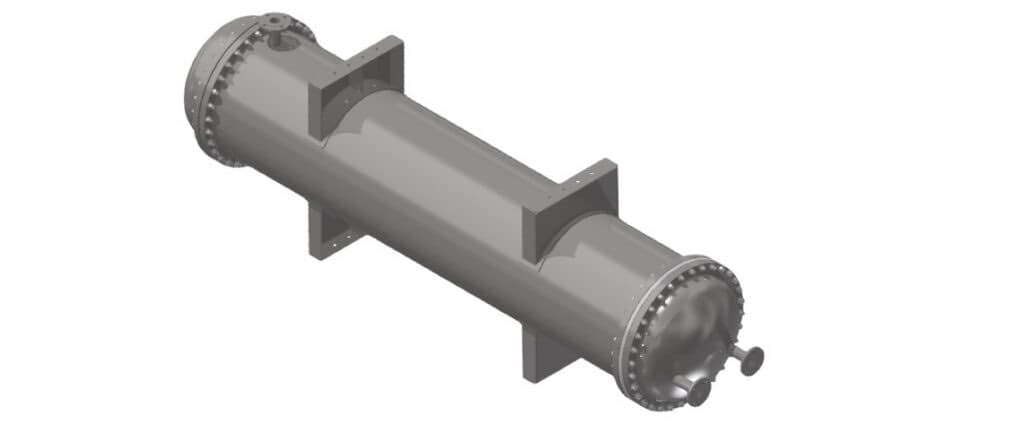
Heat Exchanger Types and Selection Logic
Heat exchangers transfer thermal energy between two fluid streams without mixing them. The fundamental sizing equation is Q = U × A × LMTD, where Q is heat duty (kW), U is overall heat transfer coefficient (W/m²·K), A is heat transfer area (m²) and LMTD is the log mean temperature difference (°C). The choice of exchanger type is driven by temperature level, fouling tendency, phase change, pressure and maintenance access requirements.
**Shell-and-tube heat exchangers (S&T)** are the process industry workhorse. One fluid flows inside the tubes (tube-side) and the other over the outside of the tubes (shell-side). The TEMA standard defines construction types: type BEM for fixed tubesheet (cheapest, no thermal expansion provision — use when ΔT < 50°C between shells); type BEU/AEU for U-tubes (thermal expansion accommodated, easy tube bundle removal, but no individual tube replacement); type BEW/AEW for floating head (full mechanical cleaning of both sides, premium cost, for fouling service). Heat transfer coefficients: gas–gas 20–80 W/m²·K; gas–liquid 50–200 W/m²·K; liquid–liquid 300–1,500 W/m²·K; condensing steam–liquid 2,000–8,000 W/m²·K.
**Plate-and-frame heat exchangers (PHE)** consist of thin corrugated metal plates clamped in a frame. The large surface area per unit volume (200–500 m²/m³ vs 50–150 m²/m³ for S&T) gives high U values (2,000–6,000 W/m²·K for liquid–liquid) in a compact unit. PHEs are gasketed (easily cleanable, dismountable, T < 160°C) or welded/brazed (T up to 350°C, no gasket, not dismountable without cutting). Not suitable for gas–gas duty, high fouling or large temperature cross, or pressures > 25 bar on gasketed units.
**Rotary recuperators (heat wheels)** use a slowly rotating porous or corrugated metal wheel that alternately absorbs heat from hot exhaust gas (half rotation) and releases it to incoming cold air (half rotation). Heat recovery efficiency 70–85%; no cross-contamination risk with sealed sector plates; suitable for large air–air or gas–air pre-heating duty (dryer FD air pre-heat, furnace combustion air). Not suitable for condensing or corrosive gas.
**Bare-tube or finned-tube gas coolers** place bare or finned tubes in the exhaust gas duct. Low U (20–60 W/m²·K bare; 30–100 W/m²·K finned) requires large area but construction is simple, low fouling risk, easily cleanable. Used for pre-cooling hot exhaust gas before a bag filter, condensate recovery from moist exhaust, and economiser duty.
Quick Reference
Technical Specifications
All parameters are indicative ranges. Final sizing is determined by process simulation based on your specific material and throughput requirements.
Operating Parameters by Exchanger Type
| Parameter | Value / Range | Note |
|---|---|---|
| Shell-and-tube: temperature range | -200°C to +600°C | CS to 400°C; SS 304/316L to 550°C; Inconel/Hastelloy to 1,000°C; cryogenic with austenitic SS |
| Shell-and-tube: pressure range | Full vacuum to 100 bar (both sides) | PED 2014/68/EU compliance; ASME VIII option; hydrostatic test at 1.5× design pressure |
| Plate heat exchanger: U value (liquid–liquid) | 2,000 – 6,000 W/m²·K | 10–20× higher than S&T for same fluid pair; 80–90% smaller footprint; gasketed PHE max 160°C / 25 bar; brazed PHE to 350°C |
| Gas-gas exchanger: U value (bare tube) | 20 – 80 W/m²·K | Low U requires large area — offset by low cost per m²; finned tubes increase U to 30–120 W/m²·K |
| Rotary recuperator: heat recovery efficiency | 70 – 85% | Cross-contamination (leakage): 1–5%; not suitable for corrosive or condensing exhaust gas |
| Energy saving potential (dryer air pre-heat) | 15 – 35% fuel reduction | Pre-heating combustion air from 20°C to 200°C reduces gas consumption by ~20% on a rotary dryer; payback typically 12–24 months |
| Fouling resistance (design margin) | Rf = 0.0001 – 0.001 m²·K/W (per TEMA) | Clean water: Rf 0.0001; cooling water: 0.0002; steam: 0.0001; hydrocarbon liquid: 0.0002–0.0004; exhaust gas with dust: 0.0005–0.001 |
| Heat duty range | 10 kW – 50 MW per unit | Multi-unit banks for larger duties; modular skid-mounted units for easy installation |
| Construction standards | TEMA B/C/R, PED 2014/68/EU, ASME VIII Div.1, EN 13445 | Material certificates 3.1 per EN 10204; NDE per ASME or EN 13480; pressure test witnessed |
Exchanger Type Selection Matrix
| Parameter | Value / Range | Note |
|---|---|---|
| Gas–gas (hot exhaust / cold air pre-heat) | Rotary recuperator (>100,000 m³/h); shell-and-tube or bare-tube (<100,000 m³/h) | PHE not suitable (gas-side U too low); rotary gives best ε at large flows |
| Steam condensation (process steam → condensate) | Shell-and-tube (BEM/BEU): U 2,000–6,000 W/m²·K | Steam on shell side, condensate gravity-drained; vent non-condensables; vacuum operation possible |
| Liquid–liquid (process cooling / heat recovery) | PHE (clean service, T < 160°C); S&T (fouling, high T/P) | PHE: 80% smaller, 10× higher U; S&T: for higher T/P, fouling or cleaning access requirement |
| Solvent condensation (closed-loop N₂ dryer circuit) | Shell-and-tube (BEM/BEW): SS 316L; coolant on tube side | N₂ on shell side; solvent condenses on cold tube bundles; condensate collected in sump; ATEX Zone 1 classification inside vessel |
| Exhaust gas cooler (hot gas to bag filter pre-cooling) | Bare-tube or finned-tube dilution cooler; T_in up to 600°C → T_out 120–180°C | Alternative: dilution air quench (no heat recovery); heat recovery with bare-tube saves fuel, adds capital |
Need a technical pre-sizing? Send us your material data sheet, moisture content, required throughput and energy source — we return a technical sizing with drum dimensions and energy balance within 2 business days.
→ Send process data on WhatsAppApplication Examples
Reference data from industrial installations. Actual values depend on feed consistency, particle size distribution and required product quality.
| Material | Inlet moisture | Outlet moisture | Particle size | Gas temp. | Industry |
|---|---|---|---|---|---|
| Rotary dryer combustion air pre-heater (gas–air) | 10–20% v/v H₂O in exhaust (hot side) | Dry ambient air → pre-heated to 150–250°C (cold side) | 5–30 g/Nm³ in exhaust gas (hot side) | Hot side in: 300–500°C → out: 180–250°C | Minerals / Aggregates / Sand / Fertiliser |
| Flash dryer exhaust gas cooler (to bag filter) | 15–30% v/v H₂O | Cooled to 120–150°C (above dew point) | 1–20 µm fine powder at 5–30 g/Nm³ | Hot side in: 180–350°C → out: 120–150°C | Chemicals / Pigments / Starch / Pharma |
| Closed-loop N₂ dryer solvent condenser (gas–liquid) | N₂ + solvent vapour (IPA, EtOH, acetone) at saturation | N₂ stripped of >98% solvent; condensate collected | Vapour-phase only (no particles) | N₂ in: 80–130°C; condenser coolant water 10–20°C | Pharmaceuticals / Fine Chemicals / Pigments |
| Spray dryer hot air supply heat exchanger (steam–air) | Dry combustion air or steam (heating medium) | Heated process air 150–350°C | Clean air (no particulate) | Steam in: 5–20 bar (152–212°C); air out: 150–350°C indirect | Dairy / Food / Detergents / Ceramics |
| Scrubber liquid cooler (water–water, closed loop) | Scrubbing liquid (pH 1–13 acidic/alkaline brine) | Cooled recirculation liquid returned to scrubber | Suspended solids 0.1–2 g/L | Hot side in: 40–70°C; cooled to 20–35°C with cooling water | Chemical / Glass / Waste Incineration / Metal |
| Waste heat boiler / HRSG (flue gas–steam generation) | 10–25% v/v H₂O in flue gas | Flue gas cooled from 400–600°C to 160–200°C; steam generated at 5–40 bar | 0.5–20 g/Nm³ fly ash in flue gas | Hot side: 400–600°C; steam drum: 152–250°C (5–40 bar sat.) | Cement / Lime / Glass / Waste / Pyrolysis |
| Fluidized bed dryer inter-stage cooler (product cooling) | Fluidisation air (dry) | Dry product cooled from 80–120°C to 30–45°C | Product in fluidised bed: 100 µm–5 mm | Cooling medium: chilled water 7–12°C or cooling water 20–30°C | Fertiliser / Salt / Sugar / Plastics |
| Kiln gas economiser (pre-heat feed water with flue gas) | 5–15% v/v H₂O in flue gas | Feed water from 60°C to 110–130°C; flue gas cooled by 80–150°C | 1–10 g/Nm³ fly ash | Flue gas in: 250–400°C; water in: 60°C; water out: 110–130°C | Cement / Lime / Ceramics / Waste |
Don't see your material? Send us your process data and we'll provide material-specific sizing.
Heat Exchanger Configurations
Shell-and-Tube (S&T)
Cylindrical shell housing a bundle of straight or U-tubes. Tube-side and shell-side fluids exchange heat across the tube wall. TEMA types: BEM (fixed tubesheet, ΔT < 50°C), BEU (U-tube, removable bundle), BEW/AEW (floating head, full cleaning access). Tube materials: CS, SS 304/316L, duplex, titanium, Hastelloy C-276, copper-nickel. Shell diameters 100–3,000 mm; tube count 4–10,000; heat area 0.5–5,000 m². Multi-pass tube-side configuration (2, 4, 6 passes) increases tube-side velocity and U without increasing shell size. Designed to TEMA Class B (chemical) or C (general) or R (refinery).
Plate Heat Exchanger (PHE)
Stack of thin corrugated metal plates (0.5–1 mm thick) clamped between fixed and moveable frames. Alternating channels carry hot and cold fluid in counter-current flow. Gasketed PHE: NBR, EPDM or Viton gaskets; plates SS 316L, titanium or Hastelloy; T ≤ 160°C, P ≤ 25 bar; fully dismountable for inspection and plate addition. Brazed PHE: copper-brazed SS plates; T ≤ 225°C, P ≤ 45 bar; compact, no gaskets, not dismountable. Welded PHE: laser-welded plates; T ≤ 350°C, P ≤ 40 bar; for aggressive chemicals. U values: 2,000–6,000 W/m²·K (water–water), 500–3,000 W/m²·K (steam–water). NTU up to 8 in a single unit (vs 2–3 in S&T), achieving temperature approaches of 1–3°C.
Rotary Recuperator (Heat Wheel)
Slowly rotating (5–20 rpm) segmented wheel of corrugated metal or ceramic honeycomb. The wheel alternately passes through the hot exhaust gas stream and the cold inlet air stream, absorbing and releasing heat. Heat transfer area: 1,000–5,000 m²/m³ of wheel volume — extremely compact. Recovery efficiency ε = 70–85% with no moving parts other than the wheel and drive. Sector plate seals limit cross-contamination to 1–5% leakage. Materials: aluminium (T < 200°C), stainless steel (T < 400°C), ceramic (T < 900°C). Wheel diameter: 0.5–16 m; flow capacity: 1,000–2,000,000 m³/h. Not suitable for corrosive or condensing exhaust gas or where any cross-contamination is unacceptable.
When to Integrate a Heat Exchanger into Your System
Dryer or kiln exhaust temperature exceeds 250°C and fuel cost is a significant operating cost
Air pre-heater or rotary recuperator recovers 15–35% of fuel cost. Simple payback is almost always under 3 years at current European gas prices.
Closed-loop nitrogen drying circuit evaporates valuable organic solvent (IPA, ethanol, acetone)
Shell-and-tube condenser is mandatory in this circuit — it recovers >98% of solvent, which is both the environmental compliance requirement and the primary payback driver.
Exhaust gas temperature exceeds the maximum rating of your downstream bag filter fabric
Bare-tube gas cooler upstream of bag filter cools exhaust to <130°C for polyester fabric, eliminating the need for P84/PTFE bags — saving €5,000–50,000 per year in bag replacement cost depending on filter size.
Scrubbing liquid temperature rises above 40°C in recirculation and reduces acid gas absorption efficiency
Plate heat exchanger on the scrubbing liquid recirculation loop maintains liquid temperature at 20–35°C — keeping Henry's law equilibrium favourable for HCl, SO₂ and NH₃ absorption without increasing reagent dose.
When NOT to Add a Heat Exchanger
Exhaust gas is below 150°C — the available temperature driving force is too small to justify capital cost
Gas stream contains sticky, hygroscopic or condensing contaminants — tubes will foul rapidly and the heat exchanger becomes a maintenance liability
Very high dust load (>30 g/Nm³) makes tube-side fouling unmanageable without frequent cleaning — plant availability suffers
Acid gases (HCl, SO₂) are present and gas temperature will drop below dew point in the exchanger — bare metal tubes will corrode within months
Not sure which dryer is right for your process? We'll review your specifications and recommend the optimal solution.
Ask a technical question →Frequently Asked Questions — Heat Exchangers
The fuel saving can be estimated from the sensible heat recovered. For a rotary dryer burning natural gas (LHV ≈ 9.5 kWh/Nm³, stoichiometric air 9.5 Nm³/Nm³ gas, actual air 10–12 Nm³/Nm³ at λ = 1.05–1.25): **Heat recovered** Q = ṁ_air × cp_air × (T_hot_out − T_cold_in), where cp_air ≈ 1.0 kJ/kg·K. If exhaust gas at 400°C pre-heats combustion air from 20°C to 200°C: Q = ṁ_air × 1.0 × (200 − 20) = 180 kJ/kg of air. For a dryer consuming 100 Nm³/h gas with air factor λ = 1.1: air flow = 100 × 9.5 × 1.1 = 1,045 Nm³/h ≈ 1,350 kg/h. Heat recovered = 1,350 × 180 / 3,600 = 67.5 kW. At 100 Nm³/h gas consumption (950 kW thermal), this represents a 7.1% saving — roughly proportional to the air pre-heat temperature divided by flame temperature (1,800°C adiabatic). For precise calculation, Lozzar uses combustion simulation software (FGLNG, CanTherm) to account for variable specific heats, dissociation losses and excess air.
From Our Projects
Related Equipment
Rotary Dryer
Combustion air pre-heater or rotary recuperator upstream of the burner reduces fuel consumption by 15–35% — highest ROI add-on for any rotary dryer
View productBag Filter
Gas cooler upstream of bag filter reduces exhaust temperature to <130°C for polyester bags — enables low-cost filtration on high-temperature exhaust gas
View productWet Scrubber
Plate heat exchanger on scrubbing liquid recirculation loop maintains optimal absorption temperature (20–35°C) — improves acid gas removal efficiency without increasing reagent dose
View productStatic Fluidized Bed Dryer
Solvent condenser (shell-and-tube) is mandatory in closed-loop N₂ static FBD circuits — recovers >98% of IPA/EtOH; typical condenser payback 3–9 months from solvent value
View productRequest a Quote for This Equipment
Include in your enquiry:
- →Hot side: fluid name/composition, mass flow (kg/h) or volumetric flow, inlet temperature (°C), target outlet temperature or heat duty (kW)
- →Cold side: same data as hot side
- →Operating pressure on each side (bar g) and maximum allowable pressure drop (Pa or bar)
- →Gas composition if applicable: moisture (%v/v), dust concentration (g/Nm³), acid gases (ppm), pH
- →Fouling tendency: clean / moderate / heavy; is tube-side rodding possible?
- →Phase change: condensing or evaporating on either side? Provide dew point and latent heat if known
- →Required construction standard: PED 2014/68/EU, ASME VIII, or local code
- →Material preference: CS, SS 316L, duplex, titanium, Hastelloy, FRP
- →Installation context: new project or retrofit? Is it part of a dryer / scrubber / filter system?
- →Annual operating hours and any seasonal flow variation