Crystallizer
Controlled crystal size from process to product — FC, DTB, and Oslo configurations.
Ermak Proses crystallizers are engineered for consistent crystal size distribution and high product purity. Three configuration options — forced circulation (FC), draft-tube baffle (DTB), and Oslo-type — cover the full range of industrial crystallization requirements, from bulk chemical salts to pharmaceutical intermediates.
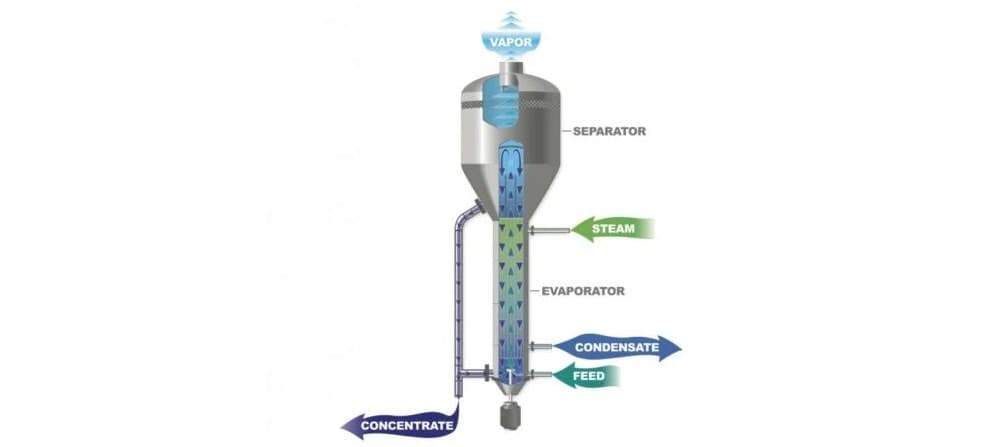
How Industrial Crystallizers Work
Crystallization is the process of forming solid crystals from a solution, melt, or gas. In industrial crystallizers, the driving force is supersaturation — the condition where the solution contains more dissolved solid than it can hold at equilibrium. Supersaturation is achieved by evaporating solvent, cooling the solution, or adding an anti-solvent.
Once supersaturation is reached, nucleation begins: tiny crystal nuclei form spontaneously or on seed crystals. These nuclei then grow by deposition of dissolved material onto their surfaces. The key engineering challenge is controlling the balance between nucleation rate and crystal growth rate to achieve the target crystal size distribution (CSD).
The three Ermak Proses crystallizer types address this control challenge differently. Forced circulation (FC) crystallizers use a high-velocity pump circuit to maintain supersaturation uniformly throughout the vessel. DTB crystallizers use an internal draft tube to create controlled upflow and a baffle to separate fine crystals for dissolution, producing narrower CSD. Oslo-type crystallizers maintain a fluidized crystal bed in the growth zone with feed entering below the bed, enabling the largest and most uniform crystals.
Quick Reference
Technical Specifications
All parameters are indicative ranges. Final sizing is determined by process simulation based on your specific material and throughput requirements.
Standard Operating Parameters
| Parameter | Value / Range |
|---|---|
| Crystallizer type | FC (Forced Circulation), DTB (Draft Tube Baffle), Oslo |
| Operating mode | Continuous or batch |
| Crystal size range (typical) | 100 µm – 5 mm (product-dependent) |
| Supersaturation control | Evaporation-based, cooling-based, or combined |
| Operating temperature | 0°C – 200°C (application-dependent) |
| Operating pressure | Vacuum to 6 bar (g) |
| Materials of construction | SS 304, SS 316L, Duplex, Hastelloy (product-dependent) |
| Capacity range | 500 kg/h – 50 t/h crystalline product |
Configuration Comparison
| Parameter | Value / Range |
|---|---|
| Forced Circulation (FC) | Wide CSD, handles scaling, broad application range, lowest capex |
| Draft Tube Baffle (DTB) | Narrow CSD, high purity, fine crystal removal, mid-range capex |
| Oslo type | Largest crystals, fluidized bed growth zone, highest product uniformity |
Need a technical pre-sizing? Send us your material data sheet, moisture content, required throughput and energy source — we return a technical sizing with drum dimensions and energy balance within 2 business days.
→ Send process data on WhatsAppTypical Crystallization Applications
Reference data from industrial installations. Actual values depend on feed consistency, particle size distribution and required product quality.
| Material | Inlet moisture | Outlet moisture | Particle size | Gas temp. | Industry |
|---|---|---|---|---|---|
| Sodium chloride (NaCl) | Saturated brine | < 0.1% moisture | 0.5–3 mm | 80–110°C | Chemical / Food |
| Ammonium sulfate ((NH₄)₂SO₄) | Process liquor | < 0.5% | 1–4 mm | 50–80°C | Fertilizer |
| Citric acid | Fermentation broth | < 0.2% | 0.3–1.5 mm | 20–40°C | Food / Pharma |
| Lithium carbonate (Li₂CO₃) | Leach liquor | < 0.1% | 0.5–2 mm | 60–90°C | Mining / Battery |
Don't see your material? Send us your process data and we'll provide material-specific sizing.
Crystallizer Types
Forced Circulation (FC) Crystallizer
Saturated solution is continuously circulated at high velocity through the vessel and an external heat exchanger. The heat exchanger generates the supersaturation by evaporation (vacuum) or cooling. Robust against scaling due to high wall velocity.
Draft Tube Baffle (DTB) Crystallizer
An internal draft tube creates an upward flow in the centre of the vessel; a baffle around the draft tube creates a clarified zone where fine crystals are separated and returned for dissolution. This selective removal of fines produces a narrower crystal size distribution and higher product purity than FC.
Oslo-Type Crystallizer
Feed enters below a fluidized bed of growing crystals. The upward flow velocity is set to just fluidize the target crystal size, allowing larger crystals to settle and grow while fines are carried up into the supersaturation zone. Produces the largest, most uniform crystals of the three types.
Which Crystallizer Type to Choose
High throughput (>5 t/h) with broad acceptable CSD
Forced Circulation (FC) — lowest capital cost, most robust, wide application range.
Tight CSD required (fertilizer, chemical salt)
DTB crystallizer — fines removal system gives narrow size distribution with continuous operation.
Largest possible crystals required (sugar, pharmaceutical)
Oslo-type crystallizer — fluidized bed growth mechanism produces the largest, most uniform crystals.
When NOT to Use a Crystallizer
Feed is a slurry that cannot be made supersaturated (non-crystallizable)
Not sure which dryer is right for your process? We'll review your specifications and recommend the optimal solution.
Ask a technical question →Frequently Asked Questions — Crystallizers
We need: (1) solute and solvent identity and concentration, (2) required crystal size range (D50 and span or PSD specification), (3) required throughput in t/h of crystalline product, (4) operating temperature and pressure, (5) whether continuous or batch operation is required, (6) any corrosion constraints (material of construction preferences), (7) upstream process (evaporator, reactor, etc.) and downstream requirements (filtration, drying). Send this to info@lozzarprocess.com and we will respond with a preliminary configuration recommendation within 5 business days.
From Our Projects
Request a Quote for This Equipment
Include in your enquiry:
- →Solute name and molecular formula
- →Solvent identity (water, organic solvent)
- →Feed concentration and target product purity
- →Required crystal size (D50 or PSD specification)
- →Required throughput — crystalline product (t/h)
- →Operating temperature and pressure
- →Continuous or batch operation
- →Material of construction preference (SS 316L, Hastelloy, etc.)