Pyrolysis Systems
Convert plastic waste, tire waste, and biomass into bio-oil, syngas, and carbon black — thermal decomposition without combustion.
Pyrolysis systems thermally decompose organic carbon-based waste materials in an oxygen-free environment, breaking complex molecules into valuable products — condensable bio-oil, non-condensable syngas, and solid carbon residue (char or carbon black). Lozzar Process supplies Ermak Proses pyrolysis units for plastic waste, end-of-life tire recycling, and biomass valorization, covering all three pyrolysis types: slow, fast, and flash.
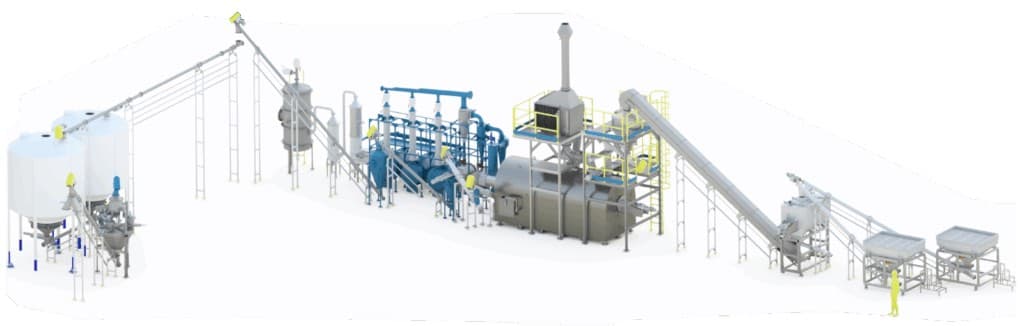
How Pyrolysis Systems Work
Pyrolysis is the thermal decomposition of organic materials at elevated temperatures (400–1,000°C) in the absence of oxygen. Without oxygen, the material cannot combust — instead, the thermal energy breaks the chemical bonds in the organic molecules, producing three product streams simultaneously.
The solid residue (char or carbon black) is the fraction of the feed that does not volatilize. For biomass feedstocks, this is biochar — a carbon-rich material useful for soil amendment or as a reducing agent. For tire pyrolysis, the residue is recovered carbon black, which can be sold as a substitute for virgin carbon black in rubber and pigment applications.
Volatile products exit the reactor as a hot gas stream and enter a condensation system. Heavy-fraction condensables (bio-oil, tire-derived oil, or pyrolysis oil) are recovered in the primary condenser at 200–400°C. Light-fraction condensables and permanent gases (syngas — primarily CO, H₂, CH₄, and light hydrocarbons) pass through a secondary condenser and into a gas cleaning system. The cleaned syngas is typically used as fuel to heat the pyrolysis reactor itself, making the process self-sustaining after startup.
The three pyrolysis modes differ in temperature and residence time. Slow pyrolysis (400–500°C, 5–30 min residence) maximizes char yield — preferred for biochar and activated carbon production. Fast pyrolysis (400–650°C, 0.5–2 s residence) maximizes bio-oil yield — the primary pathway for liquid fuel production from biomass. Flash pyrolysis (700–1,000°C, < 0.5 s residence) maximizes gas yield — used when syngas or hydrogen production is the goal.
Quick Reference
Technical Specifications
All parameters are indicative ranges. Final sizing is determined by process simulation based on your specific material and throughput requirements.
Pyrolysis System Parameters by Mode
| Parameter | Value / Range |
|---|---|
| Slow pyrolysis temperature | 400–500°C |
| Fast pyrolysis temperature | 400–650°C |
| Flash pyrolysis temperature | 700–1,000°C |
| Reactor atmosphere | Inert (nitrogen purge) — strictly oxygen-free |
| Feedstock types | Plastic waste, end-of-life tires, biomass, agricultural residues, sewage sludge |
| Feed particle size | < 50 mm (shredded) — pre-shredding required for tires and plastic bales |
| Feedstock moisture limit | < 15% (drying required above this — Ermak dryer upstream) |
| Capacity range | 1 – 100 t/day feedstock |
| Bio-oil yield (fast pyrolysis, biomass) | 60–75 wt% of dry feed (biomass) |
| Oil yield (tire pyrolysis) | 40–50 wt% of feed (fuel oil equivalent) |
| Carbon black yield (tire pyrolysis) | 30–35 wt% of feed |
| Syngas self-sufficiency | Syngas from process heats reactor — external fuel only at startup |
Need a technical pre-sizing? Send us your material data sheet, moisture content, required throughput and energy source — we return a technical sizing with drum dimensions and energy balance within 2 business days.
→ Send process data on WhatsAppFeedstock Types and Product Yields
Reference data from industrial installations. Actual values depend on feed consistency, particle size distribution and required product quality.
| Material | Inlet moisture | Outlet moisture | Particle size | Gas temp. | Industry |
|---|---|---|---|---|---|
| End-of-life tires (ELT) | <5% | N/A | < 50 mm shredded | 450–550°C | Recycling / Energy |
| Mixed plastic waste (PE, PP, PS) | <8% | N/A | < 30 mm | 400–500°C | Recycling / Chemical |
| Wood chips / biomass | <12% | N/A | < 20 mm | 400–600°C | Energy / Agriculture |
| Agricultural residues (straw, husks) | <15% | N/A | < 25 mm | 400–550°C | Agriculture / Energy |
Don't see your material? Send us your process data and we'll provide material-specific sizing.
Pyrolysis System Types
Slow pyrolysis (char/biochar maximization)
Long residence time (5–30 minutes) at 400–500°C. Material heats slowly, maximizing the solid carbon fraction. Biochar yield 25–40% of dry feed. Biochar has high surface area, stable carbon structure, and is used for soil amendment, activated carbon production, or as a metallurgical reducing agent.
Fast pyrolysis (bio-oil maximization)
Very short residence time (0.5–2 seconds) at 400–650°C. Rapid heating and rapid quench of the pyrolysis vapors maximize liquid bio-oil yield. Bio-oil is the primary product (60–75% yield from dry biomass) — a dark, viscous liquid used as fuel oil substitute or as chemical feedstock.
Tire & plastic pyrolysis (oil + carbon black recovery)
Specifically configured for end-of-life tires and plastic waste. Tire pyrolysis yields 40–50% fuel oil (tire-derived fuel, TDF), 30–35% recovered carbon black (rCB), 10–15% steel wire (direct recovery), and 10–15% syngas. The rCB can be sold to rubber and pigment manufacturers. The fuel oil replaces diesel or furnace oil in industrial burners.
When Pyrolysis is the Right Solution
Feedstock is organic carbon-based waste (plastic, tires, biomass, agricultural residues)
Pyrolysis is one of the few technologies that converts these waste streams into valuable products rather than waste heat and emissions.
Biochar production required for agricultural or industrial use
Slow pyrolysis at 400–500°C maximizes char yield — select this mode for biochar-focused projects.
When Pyrolysis is NOT Appropriate
Feedstock moisture exceeds 15% — drying required first
Inorganic waste (metals, glass, mineral waste) — no carbon content
Not sure which dryer is right for your process? We'll review your specifications and recommend the optimal solution.
Ask a technical question →Frequently Asked Questions — Pyrolysis Systems
Pyrolysis of waste materials falls under Directive 2010/75/EU (Industrial Emissions Directive) in most EU member states, which requires an integrated environmental permit (IED permit / IPPC). The specific permit requirements vary by country — Hungary, Germany, France, and Romania each have their own transposed IED regulations. We can provide a summary of the environmental permitting requirements in your country at the feasibility study stage. Ermak Proses provides the CE-certified plant equipment; environmental permitting is the client's responsibility.
From Our Projects
Request a Quote for This Equipment
Include in your enquiry:
- →Feedstock type (tire, plastic, biomass — specify polymers if plastic)
- →Feedstock quantity (t/day or t/year)
- →Current moisture content (%)
- →Required products (oil, char/carbon black, syngas — priority)
- →Site location (country — relevant for permitting discussion)
- →Available utilities (electricity, water, fuel for startup)
- →Any existing thermal treatment or recycling infrastructure on site