Conveyor Systems (Belt, Screw, Bucket Elevator)
Material handling between process steps — belt, screw, and bucket elevator configurations for every bulk solid.
Lozzar Process supplies complete conveyor systems as standalone equipment or integrated into dryer and process plant packages. Belt conveyors, screw conveyors, and bucket elevators are designed to international standards, fabricated in carbon steel or stainless steel, and supplied with full CE documentation.
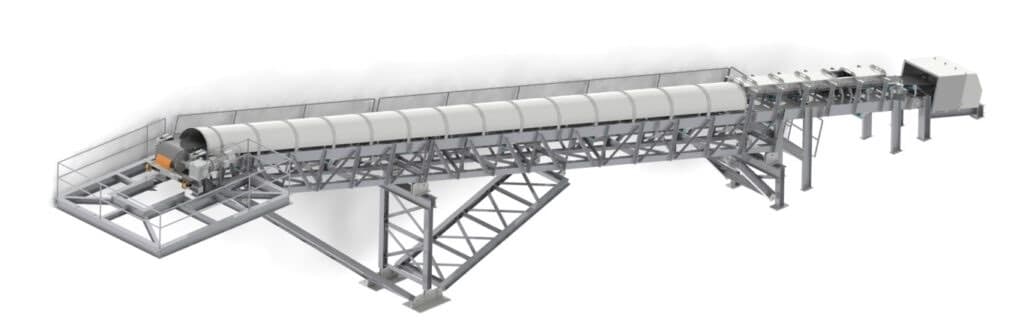
Conveyor Types and Operating Principles
Belt conveyors use an endless flat or troughed belt running between a drive drum and a take-up drum, supported by a series of idler rollers. The belt is driven by an electric motor through a gearbox. Material is loaded onto the belt at one end and discharged at the other. Troughed belts (with side idler rollers angled at 20–45°) are used for bulk solids to prevent spillage.
Screw conveyors (also called augers or helical conveyors) move material along a trough using a rotating helical screw blade (flight). Material is pushed forward by the helix in a manner similar to a corkscrew. Screw conveyors are enclosed, preventing dust emissions, and can handle wet, sticky, or hot materials. They can also be inclined up to 45° and used to meter material flow at controlled rates.
Bucket elevators are used for vertical transport of bulk solids. Buckets are attached to a belt or chain running in a vertical casing. Material is scooped or fed into the buckets at the boot (bottom), carried vertically, and discharged at the head (top) by centrifugal force or gravity. Bucket elevators handle materials from fine powders to coarse lumps and are the standard solution for vertical elevation where screw or pneumatic conveyors are not suitable.
Quick Reference
Technical Specifications
All parameters are indicative ranges. Final sizing is determined by process simulation based on your specific material and throughput requirements.
Belt Conveyor Specifications
| Parameter | Value / Range |
|---|---|
| Belt width | 300 mm – 2,400 mm |
| Conveying speed | 0.5 – 4.0 m/s (VFD-controlled) |
| Inclination | 0° – 22° (troughed belt) |
| Capacity | Up to 500 t/h (material-dependent) |
| Belt material | Rubber, PVC, SS, heat-resistant (up to 200°C), oil-resistant |
| Frame material | Carbon steel (painted), SS 304, SS 316L |
Screw Conveyor Specifications
| Parameter | Value / Range |
|---|---|
| Screw diameter | 100 mm – 800 mm |
| Length per section | Up to 6 m (multiple sections connectable) |
| Inclination | 0° – 45° |
| Capacity | Up to 200 m³/h |
| Material temperature | Up to 300°C (jacketed version available) |
| Flight type | Standard, ribbon, cut-and-fold, paddle — application-dependent |
Bucket Elevator Specifications
| Parameter | Value / Range |
|---|---|
| Elevation height | Up to 50 m |
| Capacity | Up to 300 m³/h |
| Drive type | Belt (centrifugal discharge) or chain (positive discharge) |
| Bucket material | Steel, malleable iron, nylon, polyethylene |
| Particle size handled | Fine powder to 100 mm lumps |
Need a technical pre-sizing? Send us your material data sheet, moisture content, required throughput and energy source — we return a technical sizing with drum dimensions and energy balance within 2 business days.
→ Send process data on WhatsAppMaterial Handling Examples
Reference data from industrial installations. Actual values depend on feed consistency, particle size distribution and required product quality.
| Material | Inlet moisture | Outlet moisture | Particle size | Gas temp. | Industry |
|---|---|---|---|---|---|
| Dried mineral / sand | <1% | <1% | 0.5–10 mm | Ambient–120°C | Mining |
| NPK fertilizer granules | <0.5% | <0.5% | 2–5 mm | Ambient–60°C | Fertilizer |
| Wood chips / biomass | 8–15% | 8–15% | 10–50 mm | Ambient | Biomass |
| Chemical powder / salt | <0.3% | <0.3% | 0.1–2 mm | Ambient–80°C | Chemical |
Don't see your material? Send us your process data and we'll provide material-specific sizing.
Conveyor Types
Belt Conveyor
Flat or troughed endless belt on idler rollers. Horizontal to 22° incline. Suitable for all bulk solids from powder to large lump. Heat-resistant and oil-resistant belt options available.
Screw Conveyor (Auger)
Rotating helical flight inside a closed trough or tube. Enclosed design prevents dust and handles wet, sticky or hot materials. Also serves as a metering device for controlled feed rates. Can be inclined up to 45°.
Bucket Elevator
Buckets attached to belt or chain run in a vertical casing. Material is scooped at the boot, elevated, and discharged at the head. Handles everything from fine powder to large lumps. Minimum footprint for maximum elevation height — up to 50 m in a single unit.
Selecting the Right Conveyor Type
Horizontal or slightly inclined transport of bulk solids
Belt conveyor — most versatile, lowest energy consumption, suitable for fragile materials.
Wet, sticky, or dusty material requiring enclosed transfer
Screw conveyor — fully enclosed, handles sticky materials, controllable flow rate.
Vertical elevation of bulk solids (10 m – 50 m)
Bucket elevator — minimum footprint, highest vertical capacity, all bulk solid types.
When NOT to Use These Conveyors
Very fine powder that must be transferred pneumatically over long distances
Not sure which dryer is right for your process? We'll review your specifications and recommend the optimal solution.
Ask a technical question →Frequently Asked Questions — Conveyor Systems
Yes. All Ermak Proses dryer packages include the complete material handling chain — infeed conveyor or screw, dryer, discharge conveyor or bucket elevator, and connection to downstream storage or packaging. This simplifies engineering, reduces interface risk, and means one CE declaration covers the entire plant. Contact us with your process flowsheet and we will design the full conveying system.
From Our Projects
Request a Quote for This Equipment
Include in your enquiry:
- →Material name and bulk density (kg/m³)
- →Particle size (mm) and abrasiveness
- →Required capacity (t/h or m³/h)
- →Transport distance (horizontal) or elevation height (vertical)
- →Material temperature at point of transfer
- →Any special requirements (ATEX, food-grade, enclosed transfer)
- →Whether conveyor is standalone or part of a dryer/process package